

Ireland and the UN Security Council - This Week: Week 68
Week 68, 25 – 30 April 2022
Ireland and the UN Security Council – This Week
This bulletin will provide a brief analysis of last week’s meetings at the UN Security Council (UNSC), and an overview of the upcoming meetings this week.
Last week, the Irish Minister for Foreign Affairs and Defence, Simon Coveney, briefed the Security Council on his recent visit to Ukraine. Ireland, joined by several other members, called for a Security Council meeting on the rising tensions in Jerusalem. Ireland held an Arria-formula meeting on conflict and hunger, and heard vital perspectives from the Food and Agriculture Organisation (FAO), the World Food Programme (WFP) and Concern Worldwide, Ireland's largest aid and humanitarian agency. Meetings were also held on Libya, Serbia and Kosovo, Western Sahara, and Sudan and South Sudan.
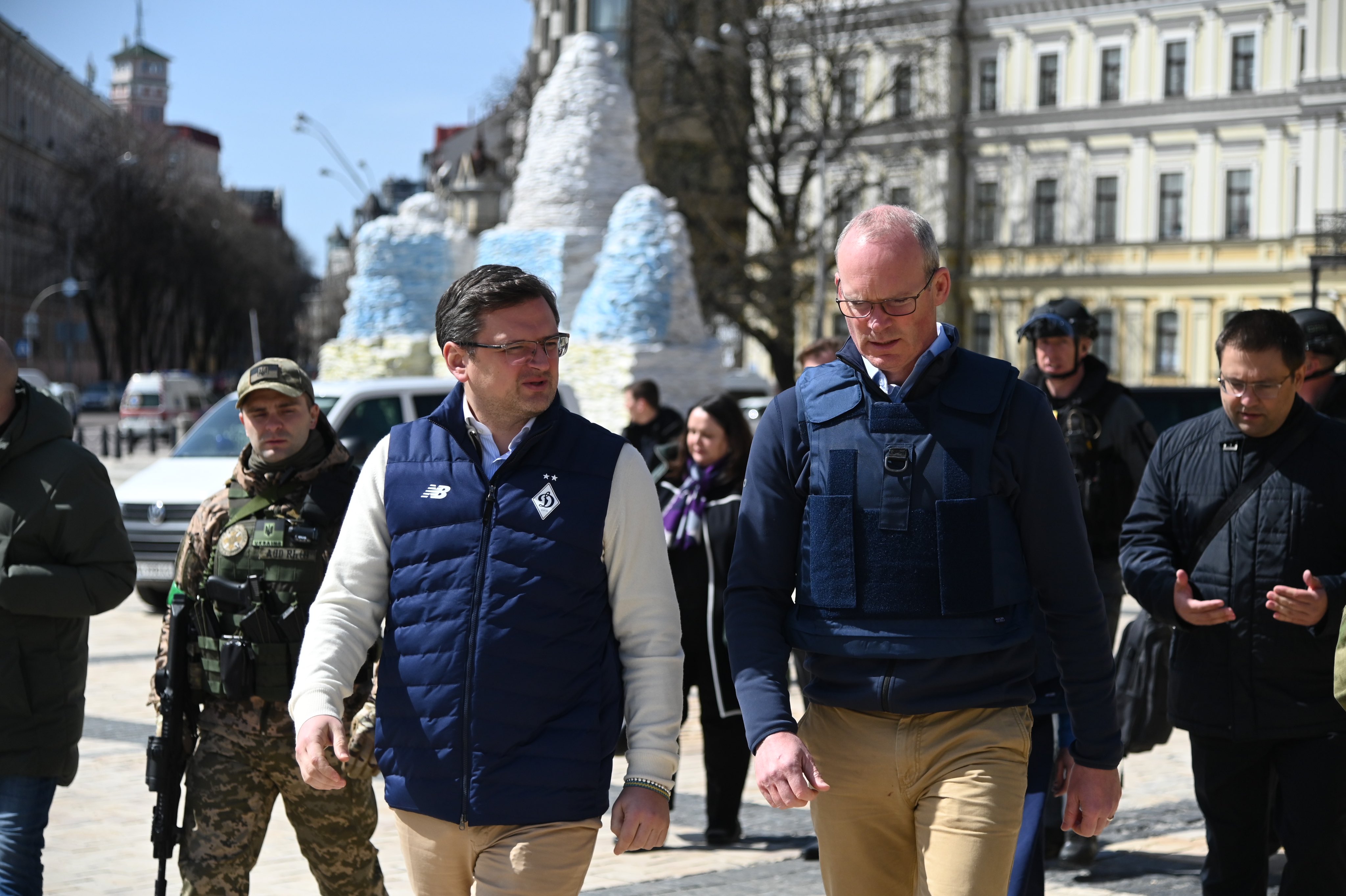
- On 19 April 2022, Minister for Foreign Affairs and Defence of Ireland, Simon Coveney, briefed the Security Council on his recent visit to Ukraine, where he was the first EU foreign minister to visit the besieged suburb of Bucha. He emphasised that there was nothing fabricated about what he witnessed in Bucha, remarking that he knows the difference between truth and staged propaganda, and further stressed that in all situations where war crimes may have been committed, timely, credible investigations must be undertaken.
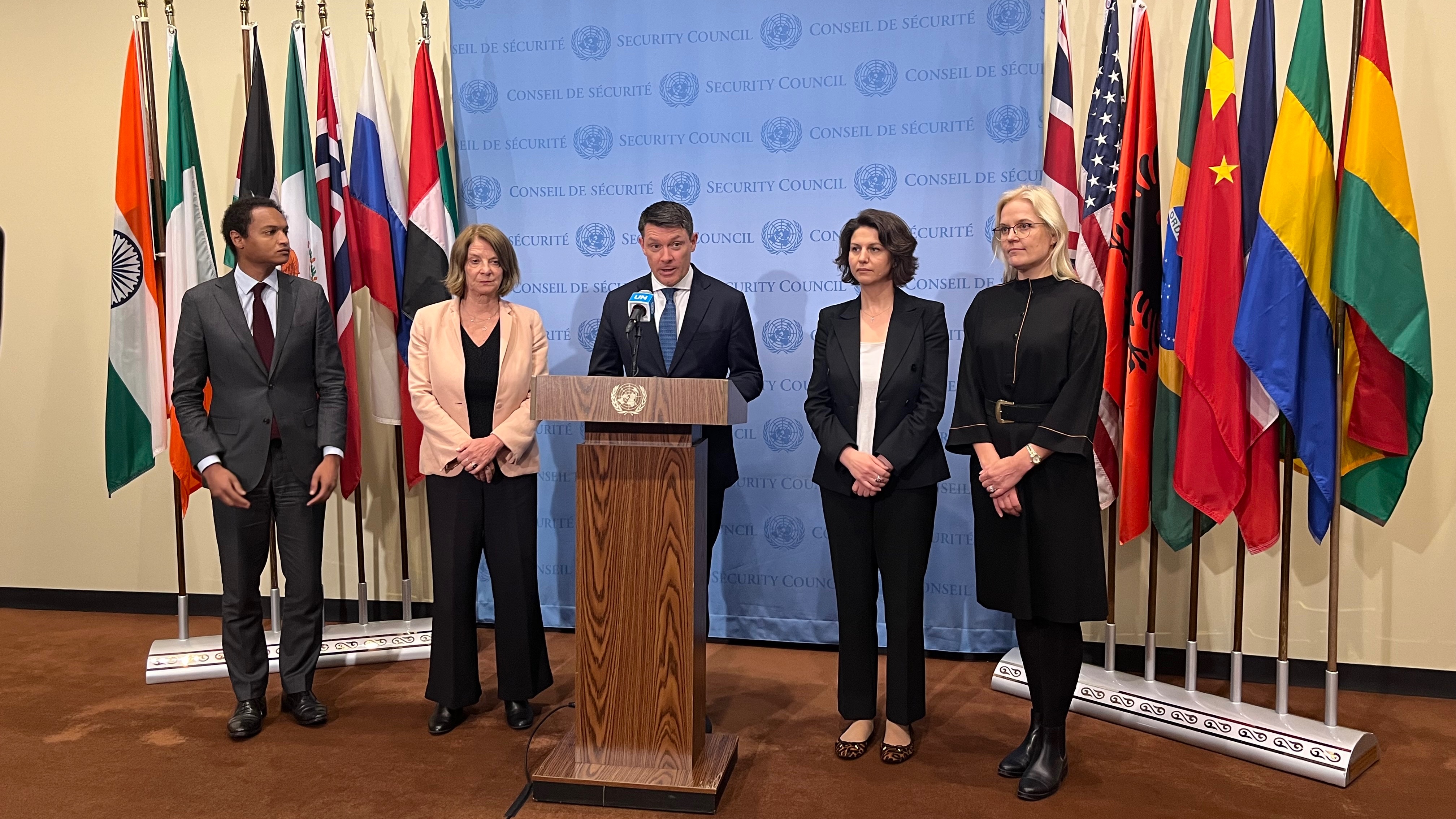
- With tensions running high in Jerusalem resulting in the death or injury of many civilians, Ireland, joined by several other members, called for a Security Council meeting on 19 April 2022. The Council was briefed on developments, including clashes in the Old City and in and around the Holy Sites, by Tor Wennesland, UN Special Coordinator for the Middle East Peace Process. Ireland (Martin Gallagher) delivered a statement on behalf of France, Albania, Norway and Estonia in a joint press stakeout, calling for an immediate end to violence and for the status quo of the Holy Sites to be fully respected.
- The Security Council issued a Press Statement on 20 April 2022, condemning the recent terrorist attack against the Abdul Rahim-e Shahid High School and Mumtaz Education Centre in the Dasht-e-Barchi area of Kabul, Afghanistan.
- The Security Council received the first briefing from the UNSG’s Personal Envoy, Staffan De Mistura, on Western Sahara, who detailed his efforts to bring the parties of the Western Sahara conflict back to face-to-face negotiations in a closed meeting on 20 April 2022.
- During a briefing on Serbia and Kosovo, on 20 April 2022, the Security Council heard about rising tensions, with senior officials from Serbia and Kosovo asserting discordant opinions regarding where the blame for regional insecurity lies. Ireland called for a constructive and sincere dialogue between Belgrade and Pristina.
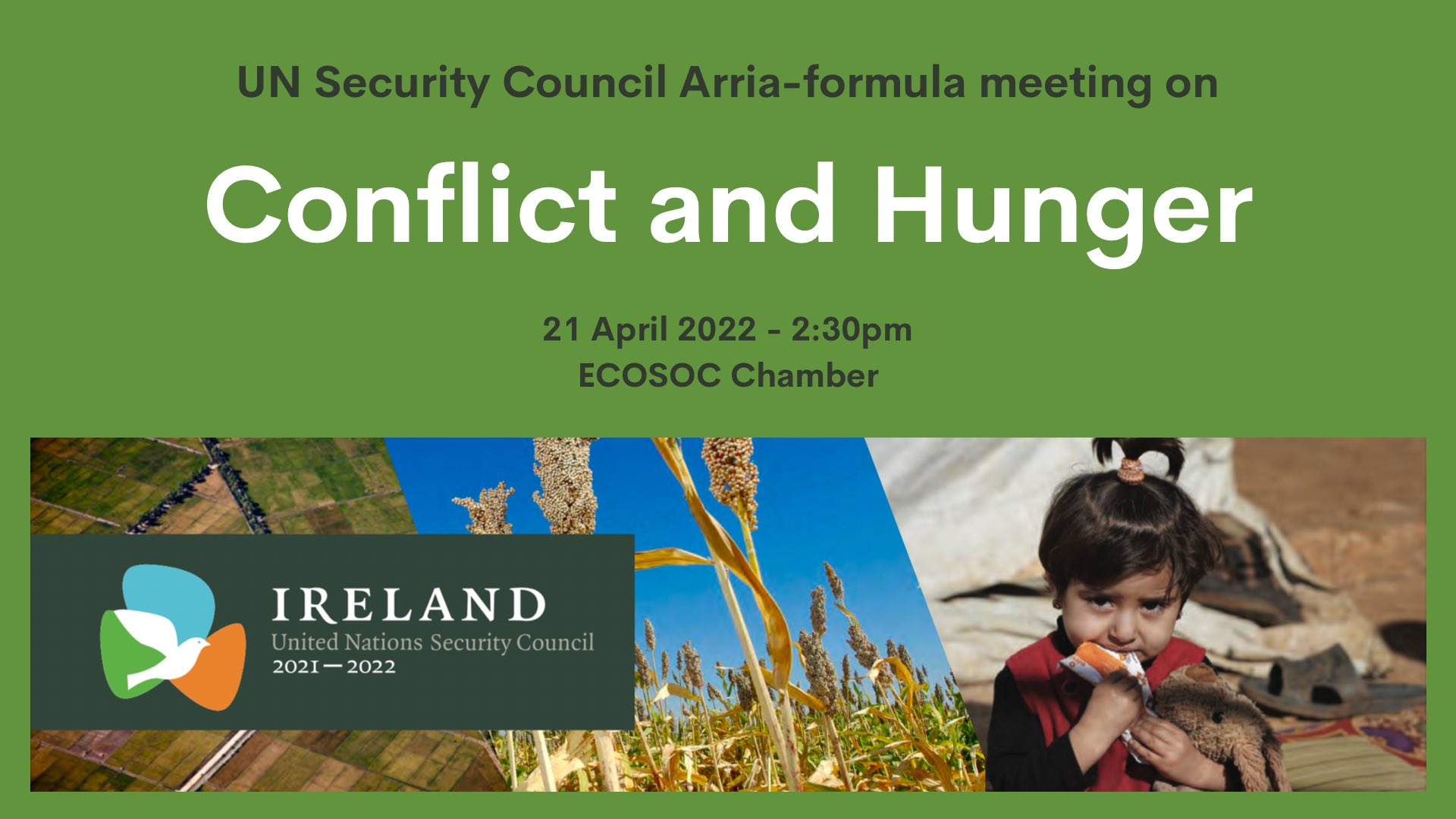
- Ireland convened an Arria-formula meeting on Conflict and Hunger on 21 April 2022. The Security Council heard from the FAO, WFP, and Concern Worldwide that this issue is more urgent than ever, as 2022 may be the most food insecure year on record ever. According to the FAO and WFP, the number of people affected by hunger, with conflict and insecurity as the main driver, rose from 99 million in 2020 to 139 million in 2021. The Permanent Representative to the UN, Geraldine Byrne Nason, detailed in a media-stakeout that the world is now facing immeasurable suffering due to the Russian Federation’s illegal and unjustified invasion of Ukraine, which is resulting in an increase of food insecurity across the globe. Recent reports indicate that that up to 47 million additional people may suffer acute hunger as result of Russia’s aggression.
The UN Security Council has a clear role in addressing instances of conflict-induced hunger. Security Council Resolution 2417, which was unanimously adopted by the UNSC, acknowledges the link between conflict and hunger, and highlights the need for respect for humanitarian principles and compliance with international humanitarian law. Previously, Minister Coveney has strongly condemned the use of hunger as a weapon of war, and emphasised the need for stronger accountability for failure to comply with international humanitarian law. He also underlined that early action leads to prevention which saves lives and money, and allows food systems to survive.
During the Arria-formula meeting, Maximo Torero Cullen, (Chief Economist, FAO), detailed how the war in Ukraine is aggravating food insecurity situations. He explained that Russia and Ukraine are the biggest producers and exporters of basic grains, exporting 30% of the world’s cereals. He further stated that many vulnerable countries also rely on Russia for fertilisers, and that their recent reduced availability and increases in prices will have severe impacts on food systems. Michael Fakhri, the Special Rapporteur on the right to food, echoed this and emphasised that armed conflict directly and indirectly destabilises food systems. He further called for an international and coordinated response to the food crisis.
- The Council received a briefing, on 21 April 2022, by Jean-Pierre Lacroix, Under-Secretary-General for Peace Operations, on the developments pertaining to the UN Interim Security Force for Abyei (UNISFA). He stated that the overall security situation in the Abyei Administrative Area is calm, but that the deficit of trust between the Misseriya and Ngok Dinka communities remains of great concern. Ireland called upon Sudan and South Sudan to facilitate the permanent deployment of relevant human rights expertise. Ireland also emphasised the need for their Governments to urgently address other issues that undermine the mission’s operational capability, and obstacles to the implementation of its mandate, including restrictions to Force personnel’s freedom of movement, and the risk of attacks against UNISFA.
The Week Ahead (25 – 29 April 2022)
This week, the Council will hold its quarterly Open Debate on the Middle East, including the Palestinian Question. USG for Humanitarian Affairs and Emergency Relief Coordinator, Martin Griffiths, and UN Special Envoy, Geir Pederson, will brief the Council on Syria. A resolution renewing the UNSMIL (Libya) mandate is expected to be adopted on 28 April 2022.
Monday – 25 April 2022
- The Council will hold its quarterly Open Debate on the Middle East, including the Palestinian question, with a briefing from UN Special Coordinator (UNSCO) Tor Wennesland.
Tuesday – 26 April 2022
- The Council will hold a combined briefing and consultations on Syria (both political and humanitarian issues). On humanitarian issues, USG Martin Griffiths will include an update on the progress and challenges in implementing Resolution 2585. On the political file, UN Special Envoy, Geir Pedersen, will brief on the seventh session of the Constitutional Committee, which concluded in March, and other issues.
Wednesday – 27 April 2022
- The Council will hold its regular briefing and consultations on the Great Lakes region. The Special Envoy of the SG for the Great Lakes region, Huang Xia, will brief the Council.
Thursday – 28 April 2022
- A resolution renewing the UNSMIL (Libya) mandate should be adopted on 28 April, with the current mandate due to expire at the end of the month. The mandate has been extended in two successive technical rollovers, in September 2021 and January 2022, as a substantive renewal could not be agreed.
- The Prosecutor of the International Criminal Court (ICC), Mr Karim Khan, will deliver his semi-annual briefing to the Council on Libya.
Friday – 29 April 2022
- The UN High Representative for Disarmament Affairs Izumi Nakamitsu will brief the Council on Syria (chemical weapons).