

EU Review - This Week
This review highlights the main meetings and events in the EU institutions on a weekly basis, and alerts readers to articles of interest on EU developments. It provides a European perspective on political and policy developments within the European Union.
Compiled by Heather Burke, Future Proofing Europe Researcher
8 September – 14 September 2025
A lot of the attention this week will be on France as its internal political crisis worsens. French Prime Minister François Bayrou faces a confidence vote on Monday, 8 September which he is expected to lose, whereupon he will have to submit his resignation to President Macron. He would be the fourth Prime Minister to resign since President Macron’s re-election.
President Macron himself is leading plans for a “coalition of the willing” to provide assistance to Ukraine post-war. At a summit convened by President Macron on Thursday, 4 September, leaders from over 35 countries attended in-person or online, at which 26 coalition members agreed to send troops or provide other assistance to Ukraine after its war with Russia is over.
Then, Strasbourg will host the European Parliament’s plenary session from 8 – 11 September, where Ukraine will continue to feature high on the political agenda. President von der Leyen will issue her State of the Union address to the Parliament on Wednesday 10 September.
Activities in European Institutions
European Commission
President of the European Commission
On 10 September 2025, President von der Leyen will issue her State of the Union address. This is an annual speech by the President of the European Commission to the European Parliament, setting her priorities for the Union for the year ahead. The IIEA will host a live streaming of the speech in Europe House, Balfe Street, which will be followed by an expert panel discussion to assess the themes that emerge.
The MFF
The European Commission presented its second and final package of budget proposals for the MFF 2028-2034 on 3 September. This included almost doubling the funding for the Single Market and Customs Programme to €6.2 billion, and close to €800 million for the justice programme to support inclusive and digital-first justice systems across the EU. Nuclear Research and Training will also see a budget increase, up to €9.8 billion to assist the Euratom Research and Training Programme.
Strategic Foresight
At their weekly Wednesday meeting on 10 September 2025, the College of Commissioners will discuss the 2025 Strategic Foresight Report. Every year since 2020, the European Commission has been producing annual Strategic Foresight Reports, which inform the Commission's Work Programmes and multi-annual programming exercises.
European Council
President of the European Council
This week, President Costa continues his visits the heads of government of EU member states. On Monday 8 September he will meet the heads of government of Finland, Stockholm and Estonia. On Tuesday, President Costa will meet the heads of government of Latvia, Lithuania and Poland, before travelling to meet the Prime Minister of Hungary and the Chancellor of Germany on Wednesday. On Thursday, he will meet the Prime Minister of Slovakia.
European Parliament
The European Parliament’s first plenary session since the summer break will take place from 8-11 September. The week’s agenda includes a focus on geopolitical challenges to policy and the need for simplification, ahead of negotiations on the next EU budget.
Address by Maia Sandu, President of the Republic of Moldova
On Tuesday morning, President Sandu of Moldova is scheduled to address Parliament in a formal sitting. This will be President Sandu’s first address since 2022, following her election in 2024, and the first since the country’s constitutional referendum on EU accession. The EU opened accession negotiations with Moldova in June 2024. Council and Commission statements are expected later in the day on strengthening Moldova’s resilience against Russian hybrid threats and malign interference.
Ukraine
MEPs will hear a statement on Tuesday morning by HR/VP Kallas on EU actions to ensure security guarantees and just peace for Ukraine. Members will also debate a Committee on Foreign Affairs (AFET) report on the Commission’s 2023 and 2024 reports on Ukraine. The report notes Ukraine’s consistent commitment to its European path but emphasises that Ukraine needs to step up its fight against corruption, including by granting greater independence to the Specialised Anti-Corruption Prosecutor’s Office.
Common Agricultural Policy
Proposed changes to the common agricultural policy will be discussed on Wednesday, where Members will vote on a report from the Committee on Agriculture and Rural Development (AGRI) that opposes the Commission’s plans to include agricultural funding in a single fund covering structural and cohesion policy, fisheries, security and defence. The AGRI committee suggests increasing funding for agriculture in the post-2027 CAP budget instead, and to reinforce direct income support for farmers, regardless of their size, as well as increasing support for smaller and family-run farms.
Cohesion Policy
On Tuesday afternoon, Members will debate three reports from Parliament’s Committee on Regional Development (REGI) calling for increased EU cohesion policy support for citizens. The first proposes strengthened cohesion policy support for regions most affected by the need to transition towards a climate-neutral economy. The second REGI report recommends increased and more flexible cohesion policy funding for housing, beyond the current focus on social housing and energy efficiency. Finally, the third report considers plans to simplify EU cohesion funds more generally, where the REGI committee seeks assurance that modernisation to improve implementation can be carried out without sacrificing the current focus on long-term investment and place-based rationale. The report recommends simplifying cohesion funds by earmarking resources for integrated territorial development tools, direct funding for cities, and eliminating duplication of national oversight.
Digital Tax
Members of Parliament and the Commission will discuss the issue of a digital tax for large digital platforms on Wednesday evening. Members are likely to ask the Commission if a unilateral EU-level digital tax could be considered in the absence of an international agreement on taxation of digital platforms.
Other News
EU-Mercosur Partner Agreement
On Wednesday 3 September, the European Commission adopted a text to begin the process of ratifying the EU-Mercosur Partner Agreement by EU Member States and the European Parliament. The deal must be ratified by 15 member states accounting for 65% of the EU’s population before it then progresses to the European Parliament, where it must secure a majority. The deal which was struck by the European Commission and the South American bloc of Brazil, Argentina, Uruguay and Paraguay would create the world’s biggest free trade zone. However, it has been met with opposition from some EU Member States including France, Poland and Ireland, whose farmers fear that imported beef would reduce demand for EU agricultural products (including Irish beef). These three countries alone will not be sufficient to prevent the deal from ratification by the weighted majority of 65%.
The European Commission has proposed to introduce safeguards into the deal, by which European products such as beef would be protected by “any harmful surge in imports”, allowing EU Member States to trigger an emergency brake if they are badly affected. This poses strategic choices for Ireland and other EU countries who could benefit from reductions on EU exports in other sectors such as pharmaceuticals, cars and machinery.
Future of Ukraine
At a summit in Paris, on Thursday, 4 September, 26 countries in the “coalition of the willing," offered security guarantees to Ukraine after a potential ceasefire. Putin responded on Friday, saying that all Western troops in Ukraine would be legitimate targets for Russia.
The European Commission and Israel’s War on Gaza
Teresa Ribera, Executive Vice President for a Clean, Just, and Competitive Transition, the most senior portfolio after President von der Leyen, described Israel’s actions in Gaza as genocide while addressing a French university on Thursday, 4 September 2025. Subsequently, the European Commission chief spokesperson distanced the Commission from this opinion. Previously, EVP Ribera, and three commissioners, including Michael McGrath, wrote a letter to civil servants saying that the situation in Gaza was at the top of the Commission’s political agenda.
Russian Involvement in Von Der Leyen GPS Jamming Now Doubted
An incident that caused President von der Leyen’s flight to lose GPS signal while flying into Bulgaria last week was initially blamed on Russian GPS jamming. However, officials in Bulgaria and Brussels are now playing down Russia’s involvement, with the Bulgarian Prime Minister instead calling the incident a routine glitch tied to broader fallout from the war in Ukraine.
Articles/Speeches of Interest
- 5 September 2025, Speech by President António Costa at the Congress of Regional and Local Authorities in Uzhhorod (Ukraine)
- Are Ukraine’s ‘coalition’ allies willing to turn words into action? (Financial Times)
- Merz and Macron anxious to speak the same political language (Irish Times)
- Von der Leyen’s GPS scare gripped Europe. The Russia allegations are starting to unravel (Politico)
1 September – 7 September 2025
September is getting off to a busy start in Brussels after the summer recess. Already in August, the Danish Presidency of the Council of the EU organised informal meetings of foreign ministers and an informal meeting of defence ministers, which were held in Copenhagen on 28 and 29 August. On 29 August, Commission President von der Leyen embarked on a tour of countries with a border to Russia or Belarus: Finland, Estonia, Lithuania, Latvia and Poland, as well as to Bulgaria and Romania to reassure them about plans for possible military deployment to Ukraine as part of any post-conflict security guarantees, try to increase defence spending and improve the EU’s military readiness. On 1 September, President von der Leyen’s plane was subject to suspected Russian GPS jamming but landed safely in Bulgaria, according to media sources.
Activities in European Institutions
European Commission
President of the European Commission
From Friday 29 August until Monday 1 September, President von der Leyen is visiting Finland, Estonia, Lithuania, Latvia and Poland — all of which are countries that share a border with Russia or Belarus — as well as Bulgaria and Romania. This is part of a diplomatic démarche on EU security and defence to reassure those member states of the EU’s support.
The MFF
On 3 September 2025, the College of European Commissioners will meet to discuss the second package of proposals relating to the post-2027 Multiannual Financial Framework (MFF). The European Commission unveiled its contentious first package of proposals on 16 July, in which existing funds including Cohesion Policy and the Common Agricultural Policy (CAP) are proposed to be merged into tailored National and Regional Partnership Plans.
Preparations are also underway in the Commission for the upcoming State of the Union speech on 10 September. This is an annual speech by the President of the European Commission to the European Parliament, setting her priorities for the Union for the year ahead. The IIEA will host a live streaming of the speech in Europe House, Balfe Street, which will be followed by an expert panel discussion to assess the themes that emerge.
Public Consultations
The European Commission has launched a call for evidence on a new EU visa strategy and will accept submissions from the public between 21 August to 18 September on how ‘visa policy can further secure borders, manage migration and promote better cooperation with non-EU countries’.
The European Commission has also launched a public consultation on the Digital Markets Act for evidence and submissions on the impact of artificial intelligence on the Act, in order to assess the effectiveness of the Act in achieving its objectives of facilitating competition in the digital environment by enabling smaller companies to compete against dominant platforms. Submissions will be accepted until 24 September, and the Commission will report its findings in May 2026.
Fisheries
Costas Kadis, Commissioner for Fisheries and Oceans will receive representatives from Seafood Alliance Ireland on 2 September 2025. Commissioner Kadis had met with Minister Timmy Dooley T.D. and various fisheries-associated organisations in May 2025 in Cork, when Ireland chaired the European Maritime Day. Concerns raised during the meeting in May included a call by the Seafood Ireland Alliance for a comprehensive review of the Common Fisheries Policy (CFP), to secure a fairer fishing quota for Ireland and the ringfencing of funding to modernise Ireland’s fishing fleet under the EMFAF fund.
European Council
President of the European Council
The first week of September will commence for European Council President, Antonio Costa, with a keynote address at the opening ceremony of the 20th Bled Strategic Forum in Slovenia which runs from 1-2 September. The theme of this year’s annual Bled conference is: ‘A Runaway World’ and discussions will be held on how the EU can strengthen global governance, counter the rise of autocratic leaders and re-commit to multilateralism.
Following the forum, President Costa will make a whistle stop tour of several EU Member States between 27 August-19 September. These working meetings are designed to help shape the EU’s political agenda for the months ahead. The first port of call for his journey started in Brussels with the Prime Minister of Belgium, Bart de Wever.
On 2 September, President Costa will meet the Prime Minister Robert Golob of Slovenia and will then travel to Croatia to meet the Croatian Prime Minister, Andrej Plenković. On 3 September he will be received by the Federal Chancellor of Austria, Christian Stocker. On 4 September, President Costa will meet President Dan of Romania in Bucharest and the Prime Minister of Bulgaria, Rosen Zhelyazkov, in Sofia. On 5 September, President Costa will meet with Petr Fiala, Prime Minister of the Czech Republic, in Prague and will conclude the week with a meeting with the Prime Minister of the Netherlands, Dick Schoof, in the Hague.
European Parliament
The European Parliament’ returned from its Summer Recess on 1 September. It will host its first plenary session from 8-11 September. The European Parliament’s Committee on Development will consider the European Union’s draft budget proposals. MEPs, including Irish MEP, Barry Andrews, have submitted a proposal to increase the humanitarian aid budget by 5% (or €91.7 million) more than that proposed originally by the European Commission. The Committee on Development will also consider the funding of civil society organisations in the EU budget.
Council of the European Union
On 1-2 September, Ministers for European Affairs will meet for an informal ministers’ meeting in Copenhagen to discuss different aspects of EU enlargement, including the Copenhagen criteria, gradual integration and strengthening the rule of law. Participants from Ukraine, Moldova, the Western Balkans and Türkiye will join the working sessions.
On 4-5 September, EU Energy Ministers will meet in Copenhagen for an informal ministers’ meeting on the future of Europe’s energy architecture and clean technologies.
On 7-9 September, EU Ministers of Agriculture will meet for an informal ministers’ meeting. The programme’s overarching theme is the future of the Common Agricultural Policy, with a focus on simplification and new technologies.
Other News
Franco-German Council
On Friday, 29 August, the Franco-German Council took place, the first since the German federal elections in February 2025. The Council was co-chaired by President Macron and Chancellor Merz in Toulon, France. Ten ministers from each side joined to focus on economic and security policy, with both leaders calling their partnership central to Europe's future.
Future Ukraine Peace Deal Talks
According to the Financial Times, European leaders who met President Trump in July to discuss security guarantees for Ukraine have been invited to Paris on Thursday 4 September by President Macron to continue these discussions. This includes German Chancellor Friedrich Merz, UK Prime Minister Sir Keir Starmer, Nato secretary-general Mark Rutte and European Commission President von der Leyen.
Articles/Speeches of Interest
- Putin defies pressure for peace with massive strike hitting EU mission in Kyiv Politico
- UK, France and Germany move to reimpose UN sanctions on Iran BBC
- Von der Leyen defends trade deal with Trump Brussels Times
- Macron, Merz promise ‘new momentum’ for Europe with joint economic agenda Euractiv
- Europe has ‘pretty precise’ plan to send troops to Ukraine, von der Leyen says The Financial Times
- Tech regulations will be recurring tension point between Brussels and Trump The Irish Times
7 – 11 July 2025
Activities in the EU Institutions
European Commission
The European Commission has published its sixth annual Rule of Law Report, which examines rule of law developments in all EU Member States. According to the Commission, The Rule of Law Report and the annual rule of law cycle contribute to the resilience of Europe's democracy, security and economy in a global environment where the respect for fundamental rights and democratic systems are increasingly under pressure. Similarly to 2024, this year’s Report does not only cover the 27 Member States, but also includes four country chapters dedicated to developments in Albania, Montenegro, North Macedonia, and Serbia.
This year's Report confirms that there is a positive trajectory in many Member States, as important reforms have been taken forward across the four key areas covered by the report – justice, anti-corruption, media freedom and institutional checks and balances. While challenges remain in some Member States, most have addressed a substantial number of the 2024 recommendations, in full or in part.
The key findings for 2025 are:
Justice systems: Many Member States have advanced on justice reforms over the last year. Measures include strengthening the independence of Councils for the Judiciary, additional safeguards for judges' appointments and autonomy of prosecutors, as well as for the quality and efficiency of justice systems. Nevertheless, reforms are progressing at a slower pace in some Member States, and serious concerns remain in certain cases. In the four candidate countries, efforts to implement judiciary reforms, to strengthen accountability, and to improve efficiency have continued, but undue influence and attempts to undermine judges' independence need to be addressed.
Anti-corruption frameworks: The Report shows that several Member States have developed new anti-corruption strategies and strengthened their institutional capacity, including by increasing the resources for law enforcement, prosecution services and the judiciary. At the same time, further action is needed to strengthen preventive frameworks, such as those related to lobbying and conflicts of interest, as well as to ensure the effective investigation, prosecution and final judgments of corruption cases. In the EU candidate countries, legal and institutional frameworks were strengthened, while the investigation, prosecution and adjudication of corruption cases - including high-level cases - need to be further improved.
Media freedom and pluralism: Many Member States are undertaking reforms to strengthen the independent functioning and financing of public service media and to improve fairness and transparency of state advertising allocation. Additionally, several national media regulators are expanding their competences to also comply with the Digital Services Act (DSA). Increasing attention is also given to the safety and protection of journalists, amidst continuing threats. In the enlargement countries, there are concerns in relation to the politicisation of media regulators and the financial sustainability of public broadcasters.
Institutional checks and balances: While the report finds that most Member States continue to ensure an enabling and supportive framework for civil society, obstacles remain in several Member States related to funding or registration requirements. However, in some Member States, civil society organisations are facing serious challenges, being subject to excessive financial restrictions or controls or inadequate protection. In the enlargement countries, challenges to legislative processes and ineffective public consultations limit inclusive governance. Challenges also remain regarding the systematic follow-up to recommendations of the Ombudsperson institutions and other independent bodies.
Across the four pillars, the Report emphasises the impact on the functioning of the Single Market and the operating environment for businesses. An effective justice system, the fight against corruption, good governance, legal certainty and sound lawmaking all have a significant economic impact, shaping the business environment and guiding investment decisions. Across the four pillars, the report emphasises how the issues identified impact the functioning of the Single Market and the operating environment for businesses.
Council of the European Union
Economic and Financial Affairs Council: 7 July 2025
Ministers will convene to discuss (i) the euro area fiscal stance ahead of the preparation of 2026 budgets, (ii) the international role of the euro, based on the annual review published by the European Central Bank, and (iii) Bulgaria’s conversion rate to the euro. The Council will also elect a new President of the Eurogroup, with Paschal Donohoe, Minister for Finance of Ireland, likely to be elected for a third term.
Meeting of Directors General for European Affairs: 8 –9 July 2025
Directors General for European Affairs will meet in Aalborg, Denmark to discuss EU enlargement and internal reforms.
European Parliament
European Parliament Plenary: 7 – 10 July 2025
The European Parliament will hold a plenary session in Strasbourg, focusing on the following agenda items:
On Monday, 7 July 2025, Ursula von der Leyen, the President of the European Commission, will resume the session by commemorating the 30th anniversary of the Srebrenica genocide. This will be followed by a discussion regarding the 2024 Annual Report on the Financial Activities of the European Investment Bank.
On Tuesday, 8 July 2025, the Plenary will discuss preparations for the 2025 EU-China Summit, which will take place on 24 – 25 July 2025 in Beijing and Anhui, China. The Council of the EU and the European Commission will also present the programme of activities of the Danish Presidency, which will be followed by votes on Bulgaria’s adoption of the euro on 1 January 2026 and on the EU-Greenland and Denmark Sustainable Fisheries Partnership Agreement. In the afternoon, MEPs will address the situations in the Middle East and Belarus, and reports on Albania, Bosnia and Herzegovina, North Macedonia, and Georgia.
On Wednesday, 9 July 2025, the key debates will focus on the conclusions of the European Council meeting on 26 June 2025 and on the EU’s post-2027 long-term budget. In the afternoon, MEPs will debate EU-US trade negotiations, the EU Preparedness Union in light of the upcoming wildfire and drought season, the alleged misuse of EU funds by Members of the far-right, and the continued Turkish occupation of Cyprus.
On Thursday, 10 July 2025, the Plenary will discuss the role of cohesion policy for the equality of the regions and sustainability of the regional cultures, which will be followed by an exchange of views on tackling China’s critical raw materials export restrictions.
Articles and Press Releases of Interest
- Speech by President von der Leyen at the EP plenary joint debate on EU-China relations
- Joint Declaration following the first EU-Republic of Moldova Summit
- EU Parliament confidence vote: Where do parties stand on von der Leyen? Euronews
- Far-right climate delayers to lead Parliament talks on EU’s 2040 target Politico
- Eurogroup: Paschal Donohoe re-elected president by consensus Agence Europe
30 June – 4 July 2025
Activities in the EU Institutions
European Commission
The European Commission has proposed an amendment to the EU Climate Law, which enshrined in legislation the EU’s commitment to reach climate neutrality by 2050, by setting a 2040 EU climate target of 90% reduction in net greenhouse gas emissions, compared to 1990 levels.
The European Union is currently on track to meet its next target of a 55% reduction by 2030, with the new proposal building on this legally binding goal. The proposed 2040 climate target considers the current economic, security, and geopolitical landscape. It also emphasises the importance of accelerating and strengthening the conditions to achieve said target and is aligned with the EU Competitiveness Compass, the Clean Industrial Deal, and the Affordable Energy Action Plan.
The Commission’s proposal will now be submitted to the European Parliament and the Council of the EU for adoption. A future agreed EU climate target will also serve as a benchmark for the post-2030 EU policy framework.
Council of the European Union
Visit of the College of Commissioners and Official Opening Ceremony: 3 July 2025
On Thursday, 3 July 2025, the European Commission College will visit Aarhus, the second-largest city in Denmark, as part of the launch of the Danish Presidency to the Council of the European Union. The European Commission will meet with the Danish Government, which will be followed by a press conference with President of the European Commission, Ursula von der Leyen, and the Prime Minister of Denmark, Mette Frederiksen. In the evening, the official opening ceremony will be held at Aarhus City Hall, with attendance from the King and Queen and speeches by the Prime Minister Frederiksen and the Commission President.
European Parliament
Committee on the Environment, Climate and Food Safety: 3 July 2025
The Committee will convene to adopt a draft opinion on the implementation of the EU-UK Trade and Cooperation Agreement, which will be followed by a debate on the conservation and sustainable use of marine biological diversity of areas beyond national jurisdiction.
Special Committee on the European Democracy Shield: 3 July 2025
The Special Committee will exchange views on domestic disinformation with the European Fact-Checking Standards Network and with the Director of the Authority for European Political Parties and European Political Foundations.
Other News
The 4th International Conference on Financing for Development (FfD4) will take place in Seville, Spain from 30 June – 3 July 2025. The conference will address new and emerging issues in the field of development and the urgent need for full implementation of the Sustainable Development Goals and the reform of the international financial architecture.
The International Conferences on Financing for Development are the only space where leaders from all governments, along with international and regional organisations, financial and trade institutions, businesses, civil society and the UN System unite at the highest levels, fostering stronger international cooperation.
Articles and Press Releases of Interest
- Remarks by Executive Vice-President Ribera and Commissioner Hoekstra at the press conference on the proposal for an EU climate target for 2040
- Western Balkans Leaders' meeting in Skopje reaffirms commitment for swift delivery of the Growth Plan
- Denmark pushes to suspend Hungary’s EU voting rights Politico
- Danish Presidency of the Council of the EU intends to make swift and decisive progress on the prevention of irregular arrivals and returns Agence Europe
- Fourteen member states oppose the Commission's EU budget overhaul Euronews
23 – 27 June 2025
Activities in the EU Institutions
This week marks the final week of the Polish Presidency of the Council of the European Union, which began on 1 January 2025. This was Poland’s second Presidency, after its first in 2011. The slogan of the 2025 Polish Presidency was “Security, Europe” and focused on the following priorities:
- Stronger trans-Atlantic partnership
- Border security
- Health and welfare security
- Military security
- Greater European economic and military independence
The next Presidency will be held by Denmark beginning on 1 July 2025 until 31 December 2025. It will be the eighth time Denmark assumes the Presidency of the Council of the European Union. Under the slogan “A strong Europe in a changing world”, the Danish Presidency will focus on a secure, competitive, and green Europe. It will work on further enlargement of the EU as a geopolitical necessity, strengthening the EU’s resilience to handle current and future crises, reinforcing EU competitiveness, strengthening European defence industry and its economic security, tackling illegal migration and ensuring effective control of the EU’s external borders, strengthening Europe’s internal energy market, simplifying the EU’s agriculture, food, and fisheries policies, reducing environmental consumption footprints and better protecting natural resources, among others.
European Commission
The European Commission has released its Annual Report on Taxation, which provides an overview of the current state of taxation in the EU.
Some of the key findings include:
- Tax revenues in the EU-27 have decreased to 39% of GDP, the lowest ratio since 2011. The decline is mostly driven by lower revenues from environmental and property taxes.
- Member States reported close to 500 tax reform measures for 2024, aiming to generate revenue, ensure fairness, sustainability, and investment.
- Compliance gaps remain a concern, with VAT revenue losses estimated at €89 billion (for 2022) and corporate income tax losses estimated at €40 billion (in 2018). These are substantial losses in a time when public deficits and debt remain high.
- An ageing population will increase the pressure on tax systems due to increased expenditure and a reduced workforce. Member States may need to shift away some burden from labour taxation towards other revenue sources. Additionally, an ageing workforce may also pose a challenge for the business continuity in tax administrations where increasingly the average age of staff is moving closer to retirement age.
The European Commission is employing different instruments to address the key challenges laid out in the report. For instance, the European Semester makes Member State specific recommendations to call on Member States to address imbalances in their tax mix, for example, by reducing reliance on revenues from labour taxation.
Council of the European Union
Foreign Affairs Council: 23 June 2025
The Foreign Affairs Council will convene to discuss the following agenda items:
- Russia’s aggression against Ukraine, particularly military support to Ukraine and the 18th package of sanctions on Russia.
- China and European security in the context of how China’s support to Russia and hybrid activities affect the security of the European Union.
- The situation in the Middle East and Libya, including latest developments in Iran and Gaza.
- The rapidly deteriorating situation in Georgia and serious human rights violations and abuses in Syria.
EU Eastern Border Regions High-Level Conference: 25 – 26 June 2025
This Conference, in line with the priorities of the Polish Presidency of the Council of the EU, will provide a forum for discussion on strengthening EU security by developing solutions to increase the cohesion and resilience of regions on the EU's eastern border in the face of challenges arising from Russian aggression against Ukraine.
European Council: 26 – 27 June 2025
EU leaders will convene in Brussels for the European Council, which will focus on current geopolitical challenges and the ongoing developments in Ukraine and the Middle East. European defence and security, migration, preparedness, and internal security will also feature on the agenda.
On Ukraine, EU leaders will take stock of recent developments regarding Russia’s war of aggression, particularly how to further support efforts towards peace and putting pressure on Russia to accept a meaningful ceasefire.
On the Middle East, the humanitarian situation in Gaza and the escalation that threatens to destabilise the region will be at the forefront of the discussion.
On European defence and security, EU leaders will follow up on ongoing work to build up defence capabilities and strengthen the EU’s defence industry. They will also discuss the outcome of the June NATO Summit.
On competitiveness, the EU’s place in the world will be addressed, particularly in the context of completing the single market and the geoeconomic challenges Europe is facing. Opportunities for strengthening the international role of the euro will also be discussed.
The European Council will also provide an opportunity for an exchange of views on migration and the strengthening of security at Europe’s external borders, on Moldova’s EU accession process, on the situation in the Western Balkans and the EU’s support for the partners’ reform efforts and their European paths, and on the EU’s preparedness in the face of crises and risks.
European Parliament
Special Committee on the European Democracy Shield: 23 June 2025
The Special Committee will convene to discuss financing interferences and attacks on democracy in the form of two panel discussions. The first will focus on money flows, financial networks, opaque financing of fake NGOs and other strategies used to undermine democratic processes. The second panel will contemplate the best practices and methods to combat financial interference as a threat to democracy.
Committee on International Trade: 24 June 2025
The Committee will discuss the state of play of EU-US trade relations, the trade aspects of the EU-Israel Association agreement, and the EU’s Deep and Comprehensive Free Trade Areas with Ukraine and Moldova. A public hearing will also take place on the EU-Mercosur Trade Agreement.
Articles and Press Releases of Interest
- Statement by President von der Leyen with President Zelenskyy, NATO Secretary-General Rutte and President Costa at the NATO Summit Defence Industry Forum
- Association agreement - EU Council gives Israel another chance to improve humanitarian situation in Gaza Agence Europe
- EU readies retaliatory tariffs to secure better trade deal with Trump Financial Times
- French government to face no-confidence vote after pension talks collapse Politico
- Brazilian ambassador denounces disinformation campaign on Mercosur deal Euronews
16 – 20 June 2025
Activities in the EU Institutions
40th Anniversary of the Schengen Area
On Saturday, 14 June 2025, the European Union celebrated 40 years of the Schengen Agreement, which was signed by Belgium, France, Germany, Luxembourg, and the Netherlands on 14 June 1985 to allow for the free movement of people, goods, and service amongst themselves. Since then, the Schengen area has expanded 9 times and become the world’s largest area of freedom and security. It is also considered one of the biggest success stories of European integration. Today it comprises 29 countries, including 4 that are not EU Member States, ensures the free movement of more than 450 million people, and is a major driver of competitiveness for 32 million businesses.
The 29 members of the Schengen area are the EU Member States, excluding Ireland and Cyprus, along with Iceland, Liechtenstein, Norway, and Switzerland. Cyprus is currently in the process of fully applying the Schengen rules and aims to become a full member by 2026, though its participation has been complicated due to the occupation of Northern Cyprus by Türkiye. Ireland, on the other hand, maintains an opt-out due to the Common Travel Area between Ireland and the UK.
European Commission
On Monday, 16 June 2025, the European Commission, under the auspices of the Polish Presidency to the Council of the EU, launched the Energy Union Task Force. The Task Force comprises high-level representatives from the European Commission and Member States and aims to foster better cooperation and coordination on key energy policy issues. Specifically, it seeks to give political impulse to address key challenges that currently obstruct the development of an Energy Union. Key priorities include optimising the use of energy infrastructure, accelerating interconnectivity, improving grid and energy system planning coordination among Member States, providing support in monitoring national actions to implement the Action Plan for Affordable Energy, and discussing areas of mutual interest related to EU energy legislation implementation.
The next meeting of the Task Force will take place in September to discuss first concrete policy items.
Council of the European Union
Environment Council: 17 June 2025
The Council will convene to discuss preparations for the 30th Conference of the Parties to the UN Framework Convention on Climate Change (COP30), which will take place in Brazil on 10 – 21 November 2025. Ministers are also expected to reach an agreement on a new regulation regarding end-of-life vehicles, which would improve the sustainability and circularity of the automotive sector, in line with the objectives of the European Green Deal.
Economic and Financial Affairs Council: 20 June 2025
The Council will convene to discuss the following agenda items:
- The Polish Presidency to the Council of the EU will present the progress achieved on the Customs Union reform package, which creates a single tariff area for all goods imported from outside the EU and allows goods to move freely between Member States without customs.
- On enlargement of the euro area, the Council will exchange views on the convergence reports for Bulgaria, which were adopted by the European Commission on 4 June 2025. The finalisation of the legal acts for Bulgaria to adopt the euro is expected by January 2026.
- In an effort to improve competitiveness, the Council will hold a policy debate on how to lower energy prices in the EU.
- On taxation, the Council will be invited to approve a report to the European Council on tax issues as well as conclusions on the progress achieved by the Code of Conduct Group during the Polish Presidency.
European Parliament
European Parliament Plenary: 16 – 19 June 2025
The European Parliament will hold a plenary session in Strasbourg, focusing on the following agenda items:
On Monday, 16 June 2025, Roberta Metsola, the President of the European Parliament, will resume the session with a statement commemorating the 40th anniversary of the Schengen Agreement. This will be followed by statements by the Council of the European Union and the European Commission on illegally detained civilians and prisoners of war and the continued bombing of civilians in Russia’s war of aggression against Ukraine. MEPs will then discuss strengthening rural areas in the EU through cohesion policy.
On Tuesday, 17 June 2025, the European Commission will make a statement regarding the European Ocean Pact, followed by discussions on the 2023 and 2024 reports on Montenegro and Moldova, the Commission’s 2024 Rule of Law report, and the implementation report on the Recovery and Resilience Facility. MEPs will also exchange views on financing for development ahead of the Fourth International Conference on Financing for Development in Seville, which will take place on 30 June – 3 July 2025.
On Wednesday, 18 June 2025, MEPs will discuss potential EU sanctions on Israel to stop the genocide in Gaza, the need for the Commission to act in the matter of freedom of assembly in Hungary, and safeguarding the rule of law in Spain in the context of ensuring an independent and autonomous prosecutor’s office to fight crime and corruption. The discussion will then move towards debates on breaches of media freedom in Georgia, the political situation in Mali, and the rise in violence and the deepening humanitarian crisis in South Sudan.
On Thursday, 19 June 2025, the European Commission will make a statement regarding the institutional and political implications of the EU enlargement process and global challenges. Voting will then take place on the Green Industrial Deal and on the UK’s accession to the Convention of 2 July 2019 on the Recognition and Enforcement of Foreign Judgments in Civil or Commercial Matters.
Articles and Press Releases of Interest
- State of the Digital Decade 2025 report: urgent and bold action needed
- Hungary and Slovakia resist EU’s energy security plan Euronews
- Corruption scandals put Spain’s Sánchez under pressure to call snap elections Politico
- EU spurns economic dialogue with China over deepening trade rift Financial Times
- EU co-legislators are expected to reach an agreement on 17 June on the reform of the mechanism for suspending visa-free regimes Agence Europe
9 – 13 June 2025
Activities in the EU Institutions
European Commission
EU International Digital Strategy
The European Commission has set out a new International Digital Strategy, which aims to support the EU’s partners in their digital transition while boosting competitiveness in AI and other key technologies at home. The Strategy reaffirms the EU’s commitment to digital cooperation with allies and partners and to building a rules-based global digital order in line with its fundamental values.
The International Digital Strategy consists of three main objectives:
- Expanding international partnerships by fostering collaboration through a new Digital Partnership Network, with the aim of strengthening the tech competitiveness and security of both the European Union and its partners.
- Deploying an EU Tech Business Offer, which will combine EU private and public sector investments to support the digital transition of partner countries.
- Strengthening global digital governance by promoting a rules-based global digital order in line with the EU’s fundamental values.
The following priority areas have also been identified in the EU’s cooperation with partner countries:
- Secure and trusted digital infrastructure to enable developments in critical sectors, such as energy, transport, finance, and health.
- Emerging technologies, such as AI and quantum technologies.
- Digital governance that fosters social cohesion, protects human rights and democratic principles.
- Cybersecurity and strengthening partners’ cyber defence as a direct investment in the EU’s own security.
- Digital identities and Digital Public Infrastructure that can simplify cross-border business and facilitate citizens’ mobility.
- Online platforms to continue promoting the protection of children online, freedom of speech, democracy, and citizens’ privacy.
The European Commission and the EU High Representative for Foreign Affairs, Kaja Kallas, will present the proposal in a series of events after adoption, with a view to begin implementing the actions laid out in the joint communication as soon as possible.
EU Annual Budget 2026
The European Commission has put forward a draft EU annual budget for 2026, which builds on the mid-term revision of the EU’s long-term budget 2021-2027. The revision addressed a series of recent unpredicted developments, including the Covid-19 pandemic, energy crisis, and growing geopolitical tensions worldwide. As a result, the 2026 Annual Budget outlines funding for the EU’s strategic priorities: continued support for Ukraine, competitiveness, migration management, security and defence, strategic investment, and continued support for the green and digital transition.
The draft budget has been set at €193.26 billion, which will be complemented by an estimated €105.32 billion under Next Generation EU. Aside from the outlined strategic priorities, the draft budget foresees the reprogramming of cohesion funding towards emerging priorities in Member States, such as competitiveness, defence, affordable housing, water resilience, and energy transition.
The highest amount of funding has been allocated to cohesion, resilience and values (€71.7 billion) and to natural resources and environment (€57 billion). These are followed by single market, innovation and digital (€22 billion); neighbourhood and the world (€15.5 billion); migration and border management (€5 billion); and security and defence (€2.8 billion).
The EU Annual Budget 2026 will now have to be formally adopted by the European Parliament and the Council of the European Union before the end of 2025.
Council of the European Union
Justice and Home Affairs Council: 12 – 13 June 2025
The Council will convene to discuss a new directive to harmonise certain aspects of insolvency law as part of the 2020 Capital Markets Union action plan; the fight against impunity regarding crimes committed in connection with the war in Ukraine; the current state of play of the EU’s accession to the European Convention for the Protection of Human Rights and Fundamental Freedoms (ECHR); and the progress made on measures to combat organised crime.
Informal Meeting of Agriculture Ministers: 15 – 17 June 2025
The three-day meeting of EU agriculture ministers will focus on innovation and modernisation in agriculture and the implementation of modern technologies in rural areas.
European Parliament
President Metsola’s visit to New York, USA: 9 June 2025
President of the European Parliament, Roberta Metsola, will visit New York City to participate in a fireside chat with the European American Chamber of Commerce, followed by a keynote speech at the US Council on Foreign Relations. She will also meet with the Clinton Foundation and the leadership of the New York Stock Exchange.
Committee on Civil Liberties, Justice and Home Affairs: 12 June 2025
The Committee on Civil Liberties, Justice and Home Affairs will hold a public hearing on strengthening media freedom, freedom of expression and safety of journalists, which will be followed by an exchange of views on Child-Friendly Justice in Criminal Matters – Children as Victims, Witnesses and Offenders.
Articles and Press Releases of Interest
- Bulgaria meets criteria to join the euro area on 1 January 2026
- Lula da Silva calls on Emmanuel Macron to ratify EU/Mercosur agreement Agence Europe
- Commission adopts European Ocean Pact to protect marine life and strengthen blue economy
- Chances of solving US-EU trade dispute over tariffs slim, expert says Euronews
2 – 6 June 2025
Activities in the EU Institutions
European Commission
The European Commission has put forward a new strategy for a stable and secure Black Sea region, which aims to link Europe with the South Caucasus and Central Asia to boost connections and growth and reinforce the EU’s geopolitical role as a reliable actor in the Black Sea region amidst Russia’s aggression against Ukraine. The European Union will forge closer cooperation with Ukraine, Moldova, Georgia, Türkiye, Armenia, and Azerbaijan by investing in and deepening key mutually beneficial partnerships.
The three pillars for future EU-Black Sea cooperation are:
- Enhancing security, stability, and resilience;
- Fostering sustainable growth and prosperity;
- Promoting environmental protection, climate change resilience and preparedness, and civil protection.
Three flagship initiatives will be implemented in the region through investments in line with the Gobal Gateway Strategy to promote regional growth and address the immediate challenges of conflict and security:
- The establishment of a Black Sea Maritime Security Hub will strengthen maritime safety and security and protect critical maritime infrastructure and the marine environment.
- A dedicated Connectivity Agenda will develop transport, energy, and digital networks to leverage the potential of the Black Sea region as a vital corridor linking Europe with Central Asia to boost economic growth and competitiveness.
- Reinforcing the preparedness of coastal communities and blue economy sectors will enable Black Sea countries to tackle war-related environmental damage, respond to climate-change related risks, and promote sustainable growth.
The European Union will implement the new strategic approach to the Black Sea in conjunction with the enlargement process and the Eastern Partnership policy. The European Commission and the High Representative for Foreign Affairs, Kaja Kallas, have proposed an EU ministerial meeting with partner countries to advance cooperation under the new approach.
Council of the European Union
EU-US Justice and Home Affairs Ministerial Meeting: 2 – 3 June 2025
The Polish Presidency of the Council of the European Union will host the EU-US Ministerial Meeting on Justice and Home Affairs in Warsaw on 2nd and 3rd June, to reaffirm the value of sustained EU-US cooperation in addressing shared challenges in justice and home affairs matters. They will review recent joint achievements and identify joint actions in areas of common interest and priorities, such as fighting transnational organised crime and drug trafficking, counterterrorism, illegal migration, and cyber-related criminal activity.
The United States will be represented by Attorney General, Pamela Bondi, and by Senior Counsellor to the Secretary for Homeland Security, Rob Law. The European Union will be represented by the Commissioner for Internal Affairs and Migration, Magnus Brunner, and the Commissioner for Democracy, Justice, the Rule of Law, and Consumer Protection, Michael McGrath, along with the Polish Minister of the Interior and Administration, Tomasz Siemoniak, and the Polish Minister of Justice, Adam Bodnar.
EU Industry Days 2025: 5 – 6 June 2025
One of the flagship events of the Polish Presidency of the Council of the European Union, EU Industry Days 2025, will convene senior industry figures and EU officials to discuss three main themes: (i) Competitiveness and Decarbonisation, (ii) An Innovative Industry, and (iii) Increasing Security and Reducing Dependencies with EU Industry. The conference will highlight the key drivers of EU competitiveness, particularly in support of decarbonisation, clean-tech development, and strengthening the single market. Amid growing geopolitical instability, it will also focus on ways to enhance security and defence capabilities and reduce European industry’s strategic dependencies.
European Parliament
Joint Meeting of the Special Committee on the European Democracy Shield (EUDS) and the Committee on Civil Liberties, Justice and Home Affairs (LIBE): 2 June 2025
Both the LIBE Committee and Special Committee on the EUDS will convene to exchange views on the use of migration by foreign state actors as an instrument of foreign interference and information manipulation.
European Parliament Conference of Presidents visit to Copenhagen: 3 June 2025
The European Parliament Conference of Presidents will visit Copenhagen ahead of the Danish Presidency of the Council of the EU, which commences on 1 July 2025. European Parliament President, Roberta Metsola, will meet with Danish Prime Minister, Mette Frederiksen, along with the Speaker of the Danish Parliament, Members of the Danish Parliament’s Political Groups, and the Danish Minister of European Affairs. She will also meet with His Majesty King Frederik X of Denmark and Her Majesty Queen Mary Elizabeth of Denmark.
Committee on Foreign Affairs: 4 June 2025
The Foreign Affairs Committee will convene to adopt the European Commission’s draft reports on Bosnia and Herzegovina, Albania, North Macedonia, and Georgia. An exchange of views with Stefano Sannino, the Commission’s Acting Director-General for Middle East, North Africa, and the Gulf will also take place, followed by a debriefing on the parliamentary elections in Albania, which were held on 11 May 2025.
Other News:
The second round of the 2025 Polish Presidential Elections took place on 1 June 2025, after no candidate had secured more than 50% of the vote in the first round on 18 May 2025. In the first round, the Mayor of Warsaw, Rafał Trzaskowski, of the centre-to-centre-right Civic Platform party, came in first with 31.4% of the vote. Independent candidate Karol Nawrocki, with conservative political views, came in second with 29.5% of the vote. Despite Trzaskowski’s lead in the first round and backing by the incumbent government, Karol Nawrocki won with a narrow 50.89% of the vote. The second round also saw an increase in voter turnout from 67% to 72%. Nawrocki ran on a Christian nationalist and culturally conservative platform and against Donald Tusk’s ruling coalition. He called for significant government intervention in the economy, maintaining close ties between the Polish Government and the Catholic Church in Poland, the broad criminalisation of abortion, and opposition to the legalisation of same-sex marriage or civil unions. In contrast, Trzaskowski ran on a platform of economic liberalisation, European integration, the broad legalisation of abortion, and the introduction of same sex civil unions. He also supported further strengthening relations with the European Union and Ukraine’s membership to NATO, which Nawrocki opposed.
Articles and Press Releases of Interest
- No candidate country can join EU without “fully respecting and defending” European values, says Marta Kos Agence Europe
- No majority among EU countries to sanction Hungary over rule of law Euronews
- Dutch premier resigns after far-right leader Wilders quits government Financial Times
- Defiant Tusk to call confidence vote to reassert his authority in Poland after election setback Politico
26 – 30 May 2025
Activities in the EU Institutions
European Commission
The European Commission has launched a new Call for Interest to support 10 cities in the Eastern Partnership with EU financing to foster resilience and local economic growth. The call is open to Armenia, Moldova, and Ukraine, where selected cities will receive up to $120, 000. According to Commissioner for Enlargement, Marta Kos, the programme aims to support cities across the Eastern Partnership to lead their own economic transformation journeys by aligning local, national, and EU priorities, which will foster inclusive and sustainable growth and strengthen their economic resilience.
Council of the European Union
Competition Policy and Law: 26 May 2025
European Competition Day is an event organised by each Presidency of the Council of the EU and serves as a platform to exchange views on competition policy and law, particularly focusing on the adaptation of the law to political changes and global trends in Europe and globally. This year’s theme is The Evolution of Competition Law: Adapting to Current Policy Shifts and Global Challenges. Teresa Ribera, Executive Vice-President of the European Commission for a Clean, Just and Competitive Transition, will serve as a special guest and present the Commission’s approach towards the development of competition policy and its role in strengthening Europe’s competitiveness worldwide.
Foreign Affairs Council: 26 May 2025
In advance of the 4th International Conference on Financing for Development, (FfD4), which is taking place in Seville from 30 June 2025 to 3 July 2025, the Foreign Affairs Council will convene to discuss development financing and the EU’s role in external relations in development.
The Seville conference will be held against a backdrop of rising geopolitical tensions, exacerbated by proposed cuts to overseas development aid by the US, the UK, and several other countries, which have put considerable strain on development financing. It will focus on reform of the international financial architecture to make it more inclusive and fairer, and on the need to fully implement the sustainable development goals.
A particular focus of the Development FAC will be on EU-Africa relations and on highlighting the visibility of the EU’s Global Gateway projects for investments in Africa. Other important items on the agenda will be the discussion on alignment between Africans and Europeans in multilateral fora with a view to possible joint action, and on humanitarian aid from the EU to deal with the parlous situation in Ukraine.
General Affairs Council: 27 May 2025
Ministers responsible for European Affairs will convene to begin preparations for the European Council meeting, which will take place on 26 – 27 June 2025. The eighth hearing of Hungary as part of the Article 7 procedure features on the agenda, along with country-specific discussions on the rule of law situation in Belgium, Finland, Slovakia, and Sweden.
European Parliament
Committee on Budgets delegation to Montenegro: 26 – 28 May 2025
A delegation of 10 MEPs will visit Montenegro in the context of the country’s progress towards EU accession. The delegation’s focus will be on the implementation of the Reform and Growth Facility for the Western Balkans, on Montenegro’s overall progress towards EU membership, and on the potential budgetary implications of Montenegro’s future accession for the EU’s post-2027 long-term budget.
Special Committee on the European Democracy Shield delegation to Moldova: 26 – 28 May 2025
MEPs from the Special Committee on the European Democracy Shield (EUDS) will be in Chișinău, Moldova to learn about the country's experience and capacities in countering foreign information manipulation, hybrid threats, and cyberattacks, while strengthening democratic resilience and securing critical infrastructure.
Committee on International Trade delegation to Washington, D.C.: 27 – 29 May 2025
A delegation of 8 MEPs will travel to Washington, D.C. to discuss political, trade and investment relations between the US and the EU with representatives of various US administration departments, legislators, US business organisations and major EU businesses active in the US, focusing on how the recent tariffs are being applied, how business is adapting, and how EU-US trade tensions can be eased.
Articles and Press Releases of Interest
- EU countries 'losing patience' as Hungary grilled on rule of law Euronews
- EU countries frustrated by Commission's delay on Ukraine trade deal Euronews
- Austrian chancellor says EU asylum rules are no longer fit for purpose Financial Times
- Nicușor Dan starts nightmare new job as president of Romania Politico
- Trade negotiations between EU and Washington expected to continue until 9 July Agence Europe
19 – 23 May 2025
Activities in the EU Institutions
On Monday, 19 May 2025, the first EU-UK Summit since the UK’s withdrawal from the EU will take place in London, where António Costa, President of the European Council, and Ursula von der Leyen, President of the European Commission, will meet with Keir Starmer, Prime Minister of the United Kingdom.
The Summit will serve as an opportunity to demonstrate a common stance for peace and security in Europe and to establish a new strategic partnership between the EU and the UK. Leaders will discuss Russia’s war of aggression against Ukraine, the situation in the Middle East, and security and defence. They will also address a renewed agenda for EU-UK cooperation entitled ‘Common Understanding’, which explores areas with the potential to strengthen bilateral cooperation between the EU and the UK, such as internal security and judicial cooperation, irregular migration, and fisheries.
European Commission
The European Commission has announced a humanitarian pledge of €2.3 billion for 2025 at the European Humanitarian Forum in Brussels to address urgent global crises such as Russia’s aggression against Ukraine, the humanitarian situation across the Middle East, particularly in Gaza, and the escalating crisis in Sudan.
The Forum took place during a record-high number of ongoing armed conflicts, climate-related disasters, and food insecurity, with an estimated 305 million people in need of urgent humanitarian assistance. Aside from the monetary donation, the EU also pledged to boost humanitarian diplomacy, strengthen respect for International Humanitarian Law, and foster an integrated response to fragility. The European Union is now the world’s leading humanitarian donor and key advocate for principled humanitarian action.
Council of the European Union
Foreign Affairs Council: 20 May 2025
EU High Representative for Foreign Affairs and Security Policy, Kaja Kallas, will chair the Foreign Affairs Council, which will convene EU Defence Ministers in the morning and EU Foreign Affairs Ministers in the afternoon of Tuesday, 20 May 2025.
In the morning, EU Defence Ministers will discuss Russia’s war of aggression against Ukraine and the EU’s support for Ukraine, particularly in the context of enhanced military support and EU contributions to security guarantees. This will be followed by an exchange of views on defence readiness, focusing on the implementation of the White Paper for European Defence-Readiness 2030 and the ReArm Europe Plan.
In the afternoon, EU Foreign Affairs Ministers will discuss Russia’s aggression against Ukraine from the perspective of diplomatic developments, including a meeting between a Ukrainian and Russian delegation in Türkiye. Ministers will then exchange views on the situation in the Middle East in light of the intensification of Israeli military operations and worsening humanitarian situation in Gaza. They will also discuss the situation in Syria and the potential for lifting EU economic sanctions.
Conference on Shielding EU Democracy from Malign Interference and Disinformation: 21 May 2025
This conference, organised by the Polish Permanent Representative to the EU, will address the increasing challenges from external and internal actors, which aim to undermine EU democratic processes via malign interference and disinformation campaigns that particularly target frontline border regions.
The conference will consist of two panels: on the EU’s response to hybrid threats and foreign information manipulation and on how the EU can better support the preparedness and resilience of regions at the Union’s border. The European Democracy Shield’s capacity to support vulnerable democracies will also be discussed.
Competitiveness Council: 22 May 2025
The Council will convene to discuss (i) how to boost competitiveness in EU industries, (ii) how to ensure business friendly regulations, (iii) the 2025 Single Market Strategy, which is part of the Competitiveness Compass, and (iv) the role of public procurement to increase competitiveness.
European Parliament
European Parliament Plenary: 21 – 22 May 2025
The European Parliament will hold a plenary session in Strasbourg, focusing on the following agenda items:
On Wednesday, 21 May 2025, the Council of the European Union and the European Commission will make a statement on the EU’s response to the Israeli government’s plan to seize the Gaza Strip, ensuring effective humanitarian support and the liberation of hostages. A second statement will focus on the Hungarian government’s drift to Russia-style repression, which includes legislative threats to freedom of expression and democratic participation. The European Commission will also present the Single Market Strategy and the Russian energy phase-out.
On Thursday, 22 May 2025, MEPs will discuss the Choose Europe for Science initiative and the modification of customs duties applicable to imports of certain Russian and Belorussian goods.
Other News:
Albania, Poland, and Portugal are currently holding or have recently held important elections, which will charter their national political course for the upcoming years.
Parliamentary elections were held in Albania on 11 May 2025 to elect the 140 Members of Parliament, which culminated in a fourth consecutive victory for the ruling Socialist Party led by Prime Minister, Edi Rama. The centre-left Socialist Party secured more mandates than in any previous election, 74 out of 140 seats, and promised to achieve Albania’s membership of the European Union by 2030. It was followed by the centre-right Democratic Party-Alliance for Change with 59 seats, while the centre-left Socialist Movement for Integration received 4 and the centre-left Social Democratic Party of Albania received 3 seats. The OSCE’s observation mission reported that the election was competitive and well-run but lacked self-censorship by journalists and included confrontational and polarising campaigns, with the two main political parties using divisive language and attempting to unduly influence voters. This election also marked the first time that Albanian citizens living abroad were allowed to vote.
The 2025 Polish Presidential Elections took place on 18 May 2025 and, as no candidate secured more than 50% of the vote, a second round will be held on 1 June 2025. 13 candidates ran for President of Poland, which is the largest number of candidates in the past 30 years. Incumbent President Andrzej Duda is not eligible for re-election due to Poland’s limit on the term of office. In the first round, the Mayor of Warsaw, Rafał Trzaskowski, of the centre-to-centre-right Civic Platform party, came in first with 31.4% of the vote. Independent candidate Karol Nawrocki, with conservative political views, came in second with 29.5% of the vote. Therefore, Trzaskowski, who has since been endorsed by most of the Polish political parties from all sides of the spectrum, and Nawrocki, who has been endorsed by the right-wing Law and Justice party, has advanced to the second round on 1 June 2025.
The 2025 Portuguese Legislative Elections took place on 18 May 2025 to elect members of the Portuguese Parliament, known as the Assembly of the Republic. All 230 seats to the Assembly were at stake following a no confidence vote against Prime Minister Luís Montenegro. As of 19 May 2025, the results from 226 of the 230 seats have been announced, with the 4 remaining seats reserved for overseas voters yet to be allocated. The voter turnout was at 64.4%, which shows a slight decrease from the previous election in 2024 (66.2%). The centre-right Democratic Alliance, led by Prime Minister Montenegro, received 89 seats and strengthened his position, though the composition of his new government is uncertain. The party’s vote share increased to 33%, but this was still short of the 116 seats required for a majority. The Socialist Party and the right-wing populist Chega party followed, both receiving 58 seats.
Articles and Press Releases of Interest
- A simpler Single Market to make companies choose Europe
- Management of cohesion policy after 2027 must not be centralised, warns Polish Presidency of the Council of the EU Agence Europe
- MEPs call on European Commission to cut Hungary off from EU funds Euronews
- Romanian court rejects George Simion’s election challenge Politico
- EU industry chief pushes ‘buy European’ in response to Trump Financial Times
12 – 16 May 2025
Activities in the EU Institutions
European Commission
On Friday, 9 May 2025, Commissioner Michael McGrath, High Representative Kaja Kallas, the Council of Europe, and the Prime Minister of Ukraine, Denys Shmyhal, gathered in Lviv to formally endorse the establishment of a Special Tribunal for the Crime of Aggression against Ukraine within the Council of Europe. The Tribunal will have the power to investigate, prosecute, and try Russian political and military leaders responsible for the crime of aggression against Ukraine and will be based on an agreement between Ukraine and the Council of Europe. Once the Special Tribunal is established, Ukrainian national authorities will be able to refer ongoing domestic investigations and prosecutions related to the crime of aggression to the Prosecutor of the Special Tribunal.
Council of the European Union
Economic and Financial Affairs Council: 13 May 2025
The Ecofin Council will convene to discuss the following agenda items
- SAFE: A policy debate will be held on the proposed Security Action for Europe (SAFE) instrument, which is a new financial instrument proposed by the European Commission to help Member States increase expenditure on common defence procurement.
- Competitiveness: The European Commission will present its communication on the savings and investments union (SIU), the stated aim of which is to create better financial opportunities for EU citizens.
- Russia’s aggression against Ukraine: Ministers will exchange views on the state of play of the economic and financial impact of Russia’s invasion of Ukraine.
- International meetings: The Polish Presidency of the EU Council will debrief on the main outcomes of the G20 Finance and Central Bank Governors meeting, which took place on 23 and 24 April.
- Financial services: The Polish Presidency will present the state of play of legislative proposals in the field of financial services.
Informal Meeting of Energy Ministers: 12 – 13 May 2025
This meeting will take place to discuss (i) rebuilding Ukraine’s energy infrastructure, (ii) winter preparedness in Ukraine and Moldova, (iii) legal approximation of Ukraine and Moldova to the EU’s energy legislation, (iv) and increasing energy security within the Union through improved access to crucial clean technologies.
Foreign Affairs Council (Trade): 15 May 2025
EU Ministers for Foreign Affairs will convene to hold a policy debate on EU-US trade relations, ongoing trade negotiations between the EU and other countries, and on European economic security.
European Parliament
Committee on Foreign Affairs: 13 May 2025
The Committee will vote on the adoption of the 2023 and 2024 Commission reports on Montenegro and Moldova, which will be followed by a public hearing on EU-US political relations. The Committee will then hold debates on (i) the EU’s political strategy in Latin America, (ii) the escalation of India-Pakistan relations following the terrorist attack in Pahalgam, and (iii) the 2023 and 2024 Commission reports on Ukraine. The Committee will also hold an exchange of views with Borjana Kristo, Chairwoman of the Council of Ministers of Bosnia and Herzegovina.
EP Committee on International Trade: 14 May 2025
The Committee will convene to discuss the state of play of EU-US trade relations with Commission representatives and the updated study on the trade aspects of the EU-Mercosur Partnership Agreement.
Articles and Press Releases of Interest
- Statement by President von der Leyen with Prime Minister Frieden, President Metsola and President Costa
- Albania and Montenegro could join the EU before the others, Costa says Euronews
- Albanian PM Edi Rama on course to win fourth term in power Financial Times
- Romania presidential hopeful Simion's emissaries reach out to Hungary's Orbán in search of a pact Euronews
- EU sets out priorities for Brexit summit Politico
5 – 9 May 2025
Activities in the EU Institutions
On Friday, 9 May 2025, Europeans will celebrate Europe Day and the 75th anniversary of the Schuman Declaration, which laid the foundations for the European Union. To mark the occasion, several events will take place across Member States and around the world, while the EU institutions will open their doors for citizens to visit their premises and engage in educational and entertainment activities. Furthermore, landmark buildings and monuments worldwide will be illuminated in the EU colours.
Ursula von der Leyen, President of the European Commission, will visit the Schuman House in Luxembourg together with Prime Minister of Luxembourg, Luc Frieden, President of the European Parliament, Roberta Metsola, and the President of the European Council, Antonio Costa.
European Commission
On Monday, 5 May 2025, the “Choose Europe for Science” conference will take place in Paris to offer an alternative to US researchers disenfranchised by President Trump’s policies. French President Emmanuel Macron and European Commission President, Ursula von der Leyen, will attend the conference to present a new EU package of incentives worth €500 million to attract scientists who have been affected by the increasing political and financial pressures on universities and research facilities in the United States, including closure of research programmes, the firing of thousands of federal workers, and fears of possible deportation.
The European Commission has kicked off EU Diversity Month by announcing the winners of the 2025 European Capitals of Inclusion and Diversity Award. The Award recognises the work done by cities, towns, or regions in the European Union to promote inclusion and create discrimination-free societies.
This year’s winners come from the Netherlands, Finland, Portugal, Spain, Italy, and Poland. Cities and municipalities from these countries have been recognised as leading examples of promoting inclusion on the grounds of sex, racial or ethnic origin, religion or belief, disability, age or sexual orientation.
In the category of local authorities with more than 50 000 inhabitants, Utrecht in the Netherlands won the Gold Award for city-wide inclusion across all departments; Bilbao in Spain won the Silver Award for initiatives on employment, transport, security, youth, and sports; and Krakow in Poland won the Bronze Award for programmes supporting diverse individuals in public spaces, health, education, and culture.
In the category of local authorities with less than 50 000 inhabitants, Mariehamn in Finland received the Gold Award for its inclusive approach across municipal workplaces, education, and newcomer integration; Usurbil in Spain received the Silver Award for its dedication to gender equality, migrant integration, and co-responsibility in care; and Settimo Torinese in Italy received the Bronze Award for its approach towards participatory budgeting, public engagement, and cross-sector collaboration.
In addition, specific awards were distributed for inclusive housing: the Gold Award to the city of Braga, Portugal, the Silver Award to the town of Gualdo Tadino, Italy, and the Bronze Award to the city of Zaragoza, Spain.
Council of the European Union
Informal Meeting of Foreign Affairs Ministers: 7 – 8 May 2025
The Polish Minister of Foreign Affairs, Radosław Sikorski, and the High Representative of the Union for Foreign Affairs and Security Policy, Kaja Kallas, will organise an informal meeting of EU foreign ministers to discuss (i) EU-UK relations, (ii) Russia’s aggression against Ukraine, (iii) EU-US relations, and (iv) challenges for European foreign and security policy, in particular building resilience to hybrid threats, with the participation of EU candidate countries.
Think Tanks on the Future of the EU: 9 – 10 May 2025
This two-day conference will focus on discussing key challenges facing Europe in the context of global changes and will also serve as a platform for collaboration among think tanks from around the world. Topics for discussion will include international security, transatlantic relations, EU reforms, competitiveness, and the development of science and technology.
European Parliament
European Parliament Plenary: 5 – 8 May 2025
The European Parliament will hold its fifth plenary session of 2025 in Strasbourg, focusing on the following agenda items:
On Monday, 5 May 2025, the European Commission and Council of the EU will make a statement on the preparation of the EU-UK Summit, which will take place on 19 May 2025. The Plenary will also discuss economic and social cohesion within the EU and the financial activities of the European Investment Bank.
On Tuesday, 6 May 2025, MEPs will discuss a unified EU response to US trade measures and global trade opportunities for the Union, followed by a statement by HR/VP Kaja Kallas on protecting Greenland’s right to decide its own future and maintain the rule-based world order.
On Wednesday, 7 May 2025, debates will focus on the EU’s support for sustainable peace in Ukraine, boosting innovation in the Union’s tech industry, and lessons learnt from the recent blackouts on the Iberian Peninsula regarding resilience and interconnection of energy grid infrastructure in the EU. The Plenary will also discuss Malta’s Golden Passport scheme and its circumvention of EU sanctions against Russia, and the illegal visit of President Erdoğan to the occupied areas of Cyprus. In the afternoon, MEPs will address cases of breaches of human rights, democracy and the rule of law worldwide, particularly the arrest and risk of execution of the leader of the Tanzanian opposition, the return of Ukrainian children forcibly transferred and deported by Russia, and violations of religious freedom in Tibet.
On Thursday, 8 May 2025, the European Parliament will make a statement commemorating the 80th anniversary of the end of World War II in Europe, focusing on freedom, democracy and security as the heritage of the EU. This will be followed by a debate on old challenges and new commercial practices in the internal market.
Other News:
Romania, Germany, and Portugal are currently holding important elections, which will charter their national political course for the upcoming years.
The first round of the 2025 Romanian Presidential Elections was held on 4 May 2025, with a second round scheduled for 18 May 2025, following the annulment of the 2024 presidential election due to alleged Russian interference in favour of the then first round winner, Călin Georgescu. Georgescu has since been barred from running for president pending several criminal investigations and the leader of the right-wing Alliance for the Union of Romanians (AUR), George Simion, announced his candidacy in Georgescu’s place. Having advanced to the runoffs with 40.96% of the votes, Simion will go head-to-head with the pro-Western, Nicușor Dan, the current General Mayor of Bucharest, who received 20.99% of the votes in the first round and just barely surpassed non-affiliated Crin Antonescu, who received 20.07% of the votes. Nicușor Dan is an independent candidate but was previously affiliated with the liberal Save Romania Union (USR).
Following the 2024 collapse of the German government and subsequent 2025 federal elections, the German parliament voted on 6 May 2025 to elect the next Federal Chancellor. In advance of the voting, on 9 April 2025, Friedrich Merz announced that an agreement had been reached between the centre-right Christian Democratic Union (CDU) and the centre-left Social Democratic Party (SPD) to form a grand coalition government, with a second agreement that Merz would be elected chancellor. In the first voting phase on 6 May 2025, however, Merz failed to achieve an absolute majority and was 6 votes short of a required 316 out of 630 votes, which has never happened before in Germany’s postwar history. Friedrich Merz was confirmed as the next chancellor of Germany in the second voting phase with 325 out of 630 votes.
The 2025 Portuguese Legislative Election will take place on 18 May 2025 to elect members of the Portuguese Parliament, known as the Assembly of the Republic. All 230 seats to the Assembly will be at stake, following a vote of confidence against Prime Minister Luís Montenegro due to allegations of conflicts of interest in relation to his family business. Montenegro lost the confidence vote on 11 March 2025 by 142 votes against him to 88 in favour. Portuguese President, Marcelo Rebelo de Sousa, announced the dissolution of the Parliament on 13 March 2025 and called an election for 18 May, making it the third legislative election in less than four years.
Articles and Press Releases of Interest
- Speech by President von der Leyen at the 2025 EPP Congress
- Closing speech by President von der Leyen at the ‘Choose Europe for Science' event at La Sorbonne
- Commission embarking on long process to remove barriers in single market Agence Europe
- EU-UK defence pact could be main deliverable of upcoming London summit Euronews
28 April – 2 May 2025
Activities in the EU Institutions
European Commission
The European Commission has published its annual State of Schengen report in celebration of 40 years of Schengen on 23 April 2025.
Considered one of the EU’s biggest success stories, the Schengen area began in 1985 as an intergovernmental project between France, Germany, Belgium, the Netherlands, and Luxembourg, and has since expanded into the largest free travel area in the world. It covers 25 of the 27 Member States (excluding Cyprus and Ireland), as well as all members of the European Free Trade Association (Iceland, Liechtenstein, Norway, and Switzerland). Ireland is in a separate Common Travel Area with the UK, the operation of which is not compatible with membership of the Schengen Area Border Code.
The benefit of being part of an area without internal border controls is that its countries do not carry out checks at their internal borders, except in cases of specific threats, and perform harmonised controls at their external borders. The latest two countries to join the Schengen area were Bulgaria and Romania in January 2025.
This year’s State of Schengen report has concluded that its rules are being well applied and that the EU’s intensified efforts have led to a reduction in irregular crossings at its external borders. Additionally, it states that the accession of Bulgaria and Romania has strengthened the EU’s economy. The Schengen requirements have also become a crucial aspect of the EU enlargement process.
Looking ahead, the report identifies the following areas where more work is required:
- Rapid and effective information sharing for improved collaboration among member countries
- Accelerated implementation of digital tools
- Better adaptation to the evolving security landscape
- Deepened relations with partner countries for preparedness beyond our borders
- More effective measures to return those with no legal right to stay in the EU.
Council of the European Union
“The Future is Data” Conference: 28 – 29 April 2025
This conference will provide a forum for debate on key data-related issues in the EU. Topics for discussion will include (i) the impact of new digital regulations on the creation of data spaces, (ii) data protection in the digital market, (iii) best practices and challenges to data use in cities, and (iv) the objectives of the Data Union Strategy.
Meeting of Directors of Foreign Affairs’ Crisis Management Centres: 29 April 2025
Heads of unit responsible for crisis management in the Ministries of Foreign Affairs of EU Member States, UK, Switzerland, Norway, Iceland, Liechtenstein, the USA, and Canada will convene to share experience and best practices in the field of planning and coordination of national and international emergencies. The aim of the conference is to strengthen international cooperation by analysing current situations and coordinate activities in the field of crisis management.
European Parliament
Committee on Economic and Monetary Affairs: 28 April 2025
An exchange of views will he held following the presentation of the 2024 European Central Bank Annual Report by ECB Vice-President Luis De Guindos.
European People's Party Congress: 29 – 30 April 2025
The European People’s Party (EPP) will hold its Statutory Congress in Valencia to elect the new EPP Presidency, including the offices of President, Vice-Presidents, Secretary General, and Treasurer. The meeting will also serve to reaffirm the EPP’s political values and principles.
Roberta Metsola, President of the European Parliament, will meet with Tánaiste Simon Harris at the event.
Articles and Press Releases of Interest
- Speech by President von der Leyen at the Summit on the Future of Energy Security
- MAGA man leads the field before Romanian election rerun Politico
- UK chancellor: EU trade relations 'arguably' more important than US Euronews
- Europe fears Trump preparing to walk away from Ukraine talks Financial Times
21 – 25 April 2025
Activities in the EU Institutions
European Commission
The European Commission has proposed to accelerate the implementation of certain aspects of the Pact on Migration and Asylum, which is due to enter into application in June 2026.
Specifically, the Commission wishes to frontload the following two elements of the Asylum Procedure Regulation, so that Member States can process asylum claims faster and more efficiently for those applicants whose claims are likely to be unfounded:
- The 20% recognition rate threshold, which would allow Member States to apply an accelerated procedure to applicants coming from countries where 20% or fewer are granted international protection in the EU.
- Designating exceptions to safe countries of origin, wherein Member States would be allowed to exclude specific regions from countries the European Union otherwise deems safe.
In addition, the Commission has proposed the establishment of a first EU list of safe countries of origin. While some Member States already have a national list of safe countries of origin, the EU-wide list would support a more uniform application of the concept and would allow Member States to expedite the processing of asylum claims of nationals from countries on the list.
The European Commission has proposed the following be included on the list of safe countries of origin: Bangladesh, Colombia, Egypt, India, Kosovo, Morocco, and Tunisia, as well as EU candidate countries. This would also be subject to review, expansion or suspension over time.
The European Parliament and the Council of the European Union must now agree on the Commission’s proposal for it to go forward.
Council of the European Union
The Role of Civil Society in the Protection of the Rule of Law: 22 – 23 April 2025
This conference, hosted by the Polish Presidency, will discuss the active participation of civil society in the protection of the rule of law, particularly focusing on (i) legal education, (ii) the process of consultation with citizens, and (iii) the independence of the legal profession. It will also touch on the role of the media, academia, and NGOs.
Meeting of Directors-General responsible for Territorial Cohesion: 24 April 2025
This meeting of high-level experts from EU Member States, European institutions, and other relevant organisations will discuss key challenges for spatial development and territorial cohesion of the EU. Debates will focus on (i) the cost of no territorial cohesion, (ii) territoriality in policy design and implementation, (iii) building resilience of different types of territories, and (iv) the role of the EU Territorial Agenda 2030 in guiding future development in Europe.
European Parliament
Special Committee on the European Democracy Shield: 22 April 2025
The Special Committee on the European Democracy Shield (EUDS) will hold a hearing on Russia’s hybrid threats and attacks in Europe, including best practices to counter them. The hearing will look at examples of cyberattacks, acts of sabotage, disinformation, interference in electoral processes, assassination attempts, and others. It will then examine examples of existing structures established to counter hybrid threats, attacks, and disinformation.
Committee on Civil Liberties, Justice and Home Affairs: 23 April 2025
The Committee will discuss the implementation and enforcement of the Artificial Intelligence Act, followed by an exchange of views on combating corruption and the Convention on the fight against corruption involving officials of the European Communities or officials of Member States of the European Union.
Committee on Foreign Affairs: 23 April 2025
The Committee will hold an exchange of views with Filip Ivanovic, Deputy Prime Minister for Foreign and European Affairs of Montenegro.
Articles and Press Releases of Interest
- Commission rolls out plan to boost circular and efficient products in the EU
- Von der Leyen: World is ‘lining up’ to work with Europe amid Trump’s trade war Politico
- Polish Presidential elections 2025: who is ahead in the polls? Euronews
- Portugal: President dissolves parliament and calls early elections Euractiv
- On a visit to Sofia, Marta Kos insists on the "crucial" importance of enlargement for the EU's "security and competitiveness" AgenceEurope
- Global energy supplies still vulnerable to shocks, warns IEA Financial Times
14 – 18 April 2025
Activities in the EU Institutions
European Commission
The European Commission has welcomed a landmark agreement at the International Maritime Organisation (IMO) towards achieving net-zero greenhouse gas (GHG) emission from global shipping by 2050. The historic deal in the fight against climate change marks a significant advancement in reducing the environmental impact of the shipping industry on a global scale.
The agreement includes a new measure, which will regulate how “clean” the energy used by a ship should be based on its climate impact, thus setting a global standard for the gradual reduction of the GHG intensity of marine fuels. The measure will prevent emissions from shifting to other sectors and encourage sustainable investments that will reduce emissions throughout the entire lifecycle globally.
The introduction of the first global pricing mechanism for emissions will also encourage shipping companies to use the cleanest fuels and technologies early on. Revenues generated from the measure will be allocated to support a just and equitable transition, which will prioritise the least developed countries and small island developing states and ensure that no country is left behind.
Council of the European Union
Foreign Affairs Council: 14 April 2025
The Foreign Affairs Council will convene to discuss the latest developments surrounding Russia’s aggression against Ukraine, the situation in Israel and Gaza, including the Arab Plan for Gaza’s recovery and reconstruction, and latest developments in Syria in light of the recent outbreak of violence in the country’s coastal region. Ministers will also exchange views on the EU’s policy towards Iran, focusing on Iran’s military support to Russia, arbitrary detention of EU citizens, hybrid operations in the EU, its destabilising role in the Middle East, and nuclear capabilities. Lastly the Council will address the EU-US relations, particularly tariffs and trade relations.
Eastern Partership Business Forum: 16 April 2025
The Eastern Partnership Business Forum is organised every two years and includes Armenia, Azerbaijan, Georgia, Moldova, Ukraine, and independent Belarussian businessmen. This year, the Eastern Partnership countries will be joined by the European Commission, experts from EU Member States, and representatives from business communities and governments. The Forum will discuss broad economic cooperation between the EU and the partner countries, and exchange experiences, establish business contacts and discuss investment opportunities between entrepreneurs and governments within the Eastern Partnership.
European Parliament
Committee on Security and Defence delegation to Moldova: 14 – 16 April 2025
A delegation from the Committee on Security and Defence will visit Moldova for talks with high-level government and parliament official to assess the recently signed EU-Moldova Security and Defence Partnership. MEPs will also discuss the support provided to Moldova through the Common Security and Defence Policy (CSDP) and the use of the European Peace Facility to strengthen and reform Moldova’s security and defence institutions.
Articles and Press Releases of Interest
- EU pauses countermeasures against US tariffs to allow space for negotiations
- France’s united front against Mercosur deal starts to show cracks Euronews
- Tirana opens its third group of chapters of achievements and moves one step further towards EU membership Agence Europe
- Why Serbia’s EU ambitions are on the line as Vučić weighs up Putin invite Financial Times
7 – 11 April 2025
Activities in the EU Institutions
European Commission
The European Commission has undertaken a revision of the EU’s cohesion policy in the context of the 2025 mid-term review to better support EU competitiveness and decarbonisation, defence and security, the situation of Member States on the EU’s Eastern border, as well as issues such as affordable housing, water resilience, and the energy transition.
This initiative aims to encourage Member States and regions to invest in Europe’s current strategic priorities and reprogramme part of their 2021-2027 Cohesion Funds towards new investments. The proposal met with some concern from Member States who see the primary objective of cohesion policy as reducing economic, social, and territorial disparities between the less well-off regions and worry about the diversion of funds away from this priority.
The revised amendments made by the European Commission will be discussed by the European Parliament and the Council of the European Union. The reprogramming is planned to conclude this year, and the implementation of new programmes will begin in early 2026.
IIEA Researcher Heather Burke has written an Explainer setting out the issues and the perspectives of the actors involved: Future-proofing Cohesion Policy - the Glue that Binds the EU | IIEA
Council of the European Union
Foreign Affairs Council (Trade): 7 April 2025
Ministers will hold an exchange of views on the current trade relations with the US in the context of the volatility in the markets following the tariffs imposed by US President Trump and will provide an orientation for future work. This will be followed by a debrief on the state of play of the EU’s trade relations with China.
Informal Meeting of the EU Ministers for Economic and Financial Affairs and Central Bank Governors: 11 – 12 April 2025
The meeting will focus on defence financing, which is at the forefront of geopolitical discussions in the EU, and on other key topics including financial markets and the current geopolitical situation.
On Friday, 11 April 2025, Ministers will discuss the current geopolitical challenges for Europe, followed by a working session between Ministers and Governors on the competitiveness of European financial markets.
On Saturday, 12 April 2025, a second working session will take place on security and defence financing.
European Parliament
Subcommittee on Human Rights: 7 April 2025
A public hearing will take place in the Parliament on human rights and justice as key requirements for lasting peace, which will be organised in association with the EU-Ukraine Parliamentary Association Committee.
Committee on Civil Liberties, Justice and Home Affairs: 7 April 2025
The Committee will convene to discuss the state of play of negotiations on Readmission Agreements and establishing a common system for the return of third-country nationals staying illegally in the Union. An exchange of views with Magnus Brunner, Commissioner for Internal Affairs and Migration, will also take place on migration partnerships with Jordan and Morocco, and the Facility for Refugees in Türkiye.
Committee on International Trade: 8 April 2025
The Committee will update MEPs on the state of play of EU-China trade and investment relations, followed by a modification of customs duties applicable to imports of certain goods from Russia and Belarus. A public hearing will also take place on the implementation of the EU-UK Trade and Cooperation Agreement.
Articles and Press Releases of Interest
- Statement by President von der Leyen on the announcement of universal tariffs by the US
- EU seeks help from Beijing to stop Trump’s trade war deepening Politico
- Trump pushes France to reassess trade alternatives — even the Mercosur deal? Politico
- Kallas says Albania faces tricky reforms but its future is in the EU Euronews
EU-Serbia Joint Consultative Committee calls on Belgrade to move forward on the path of reforms, particularly with regard to the rule of law Agence Europe
31 March – 4 April 2025
Activities in the EU Institutions
European Commission
The European Commission has launched the Preparedness Union Strategy to support Member States and enhance Europe’s capabilities in preventing and responding to emerging threats.
The Strategy comes as a response to the increasingly complex crises and challenges facing the European Union, which include geopolitical tensions, conflicts, hybrid and cybersecurity threats, foreign information manipulation and interference, climate change and natural disasters, and others. It consists of 30 key actions and a detailed Action Plan to advance the objectives of the Preparedness Union and develop a so-called ‘preparedness by design culture’ across all EU policies.
The 7 crucial areas of the Preparedness Union Strategy include:
- Protecting Europe’s Essential Societal Functions
- Promoting Population Preparedness
- Enhancing Crisis Response Coordination
- Strengthening Civil-Military Cooperation
- Bolstering Foresight and Anticipation Capabilities
- Increasing Public-Private Cooperation
- Enhancing Cooperation with External Partners
Council of the European Union
EU – US Senior Officials Meeting on Justice and Home Affairs: 31 March – 1 April 2025
EU and US representatives will convene to exchange experiences and identify areas of cooperation on security and justice issues, particularly the fight against organised crime, drug trafficking and terrorism.
EU Security Forum on the White Paper on the Future of European Defence: 2 April 2025
Within the framework of the White Paper on the Future of European Defence by Andrius Kubilius, EU Commissioner for Defence and Space, the Security Forum will take place to discuss the need for increased European defence capabilities. The conference will include a main presentation of the White Paper, followed by two panel discussions on Development of Defence Capabilities withing the EU and on Financing of Defence Capabilities Development within the EU.
Policy Planners Meeting: 2 – 3 April 2025
Heads of Planning Units of EU Ministries of Foreign Affairs and representatives of the European External Action Service (EEAS) will convene for a cyclical meeting to discuss the following topics:
- EU enlargement and reform
- The future of transatlantic relations
- Major threats to the international order, including Russia’s invasion of Ukraine
- A report by the European Union Institute for Security Studies (EUISS) entitled ‘Unpowering Russia’
- Global geopolitical trends and recommendations for EU leadership
The Director of Policy Planning at the Office of the NATO Secretary General will also take part in the meeting.
European Parliament
European Parliament Plenary: 31 March – 3 April 2025
The European Parliament will hold its fourth plenary session of 2025 in Strasbourg, focusing on the following agenda items:
On Monday, 31 March 2025, the European Commission will make a statement on the European Cultural Compass as a driving force for economic competitiveness and resilience, followed by a statement on the need to ensure democratic pluralism, strengthen integrity, transparency and anti-corruption policies in the EU.
On Tuesday, 1 April 2025, MEPs will discuss the conclusions of the European Council meeting of 20 March 2025 and Russia’s war crimes in Ukraine. This will be followed by debates on the implementation of the common security and defence policy and the EU’s policy on human rights and democracy in the world. The European Commission will also present the New European Internal Security Strategy.
On Wednesday, 2 April 2025, debates will focus on progress made towards a solution to the Cyprus problem, recent legislative changes in Hungary and their impact on fundamental rights, and the importance of trans-European transport infrastructure for economic growth and security. MEPs will also vote on the EU-Bosnia and Herzegovina Agreement for cooperation between Eurojust and the Bosnian authorities competent for judicial cooperation in criminal matters.
On Thursday, 3 April 2025, the European Commission will make a statement on the 110th anniversary of the Armenian genocide, followed by discussions regarding the prosecution of journalists in Cameroon, executions in Iran, the immediate risk of further repression by Lukashenko’s regime in Belarus, and targeted attacks against Christians in the DRC.
Articles and Press Releases of Interest
- Statement by President von der Leyen on the US announcement of car import tariffs
- EU exploring weaker 2040 climate goal Politico
- EU budget negotiators urged to include green energy in increased security spending Euronews
- Cohesion policy must be modified to take account of new challenges, admits Polish Presidency of EU Council Agence Europe
- EU plans to strengthen police powers to tackle foreign threats Financial Times
- The time has come to punish Orbán, Germany’s next government says Politico
- Marine Le Pen banned from standing for office for five years Financial Times
24 - 28 March 2025
Activities in the EU Institutions
On 20 March 2025, the European Council took place in Brussels, which adopted conclusions on Ukraine, the Middle East, competitiveness, European defence and security, and the next Multiannual Financial Framework, along with migration, oceans, multilateralism, and other agenda items.
- Ukraine: The European Council held an exchange of views with President Zelenskyy and discussed the latest developments in Ukraine. It will revert to this issue again at its next meeting.
- Middle East: The European Council addressed the situation and latest developments in the region, which included deploring the breakdown of the ceasefire in Gaza and calling for the handover of hostages and a permanent end to hostilities based on the two-state solution. The Council also welcomed the Arab Recovery and Reconstruction Plan, which was endorsed at the Cairo Summit on 4 March 2025. Furthermore, the transition in Syria and the recent widespread violence against civilians in the country were discussed.
- Competitiveness: An urgent need to strengthen Europe’s competitiveness was identified during the meeting, along with a clear link between investing in competitiveness and defence. In order to boost competitiveness, strengthen the Single Market, and close the innovation and productivity gap, the Council agreed to prioritise simplification and reduce regulatory and administrative burdens, lower energy prices, and unlock private savings to unlock necessary investment in the EU economy.
- Defence and Security: The European Council called for an acceleration of work to ramp up Europe’s defence readiness by 2030, based the EU’s strength and capability in the field of defence and security directly contributing to global and transatlantic security.
- Multiannual Financial Framework: The Council held a first exchange of views on the next MFF and on new own resources.
- Migration: Further work on the prevention and countering of irregular migration, fighting human trafficking and smuggling, and on accelerating returns was encouraged at the meeting, along with efforts on identifying safe third countries and safe countries or origin, visa policy alignment by neighbouring countries, and safe and legal pathways in line with national competences.
- Oceans: The European Council stressed the strategic importance of the oceans, water resilience and the blue economy in strengthening the EU’s competitiveness, resilience, maritime security, and environmental sustainability. In this context, the European Commission will put forward a European Ocean Pact, which aims to foster healthy oceans and seas, energy security, maritime security, food security, and sustainable fisheries, and will contribute to responsible governance of the oceans.
- Multilateralism: The Council reaffirmed the European Union’s commitment to effective multilateralism and the rules-based international order with the United Nations at its core. It affirmed that the EU would remain a predictable, reliable, and credible partner. The Fourth International Conference on Financing for Development was also mentioned, to be held in Sevilla from 30 June to 3 July 2025.
European Commission
The European Commission has presented a White Paper for European Defence – Readiness 2030, which presents solutions to building a strong defence industrial base and identifies Europe’s investment needs. The White Paper outlines several key lines of action, which includes closing capability gaps; supporting the European defence industry through aggregated demand and increased collaborative procurement; supporting Ukraine through increased military assistance and deeper integration of the EU’s and Ukraine’s defence industries; deepening the EU-wide defence market; accelerating the transformation of defence with AI, quantum technology, and other innovations; enhancing European readiness for worst-case scenarios; and strengthening partnerships with like-minded countries.
Council of the European Union
Environment Council: 27 March 2025
Ministers will convene to discuss the environmental dimension of the clean industrial deal, which was presented on 26 February 2025 by the European Commission as a joint roadmap for competitiveness and decarbonisation. This will be followed by an exchange of views on global environment policies with Inger Andersen, Executive Director of the United Nations Environment Programme.
General Affairs Council (Cohesion): 28 March 2025
The General Affairs Council will hold an exchange of views on a Presidency paper entitled ‘A More Dynamic and Strategic Cohesion Policy: Delivering Change in the Current and Next Perspective’, where Ministers will discuss how to achieve the treaty objectives of cohesion policy. The Council is also expected to approve conclusions on cohesion and cohesion policy post-2027, which highlight the importance of economic, social, and territorial cohesion within the EU and reaffirms the interconnectedness of cohesion and competitiveness.
European Parliament
Committee on Development at the Nutrition Growth Summit 2025: 27 – 28 March 2025
A delegation of members of the Committee on Development, which includes the Commitee Chair Mr Barry Andrews, will participate in the Nutrition for Growth Summit in Paris to support the Team Europe efforts towards ending malnutrition, in particular mobilising global action to support nutrition, promote food security, and build resilient food systems and agriculture. The Committee will also organise a side event on Thursday, 27 March 2025, focused on sustaining and strengthening responses to nutritional crises in fragile and conflict-affected settings.
Articles and Press Releases of Interest
- Opening remarks by President von der Leyen at the joint press conference with President Costa following the meeting of the European Council of 20 March 2025
- After Georgescu’s disqualification, here’s who’s running for president of Romania Politico
- EU leaders reject Putin's demand to halt military aid to Ukraine Euronews
- Warsaw to suspend right to asylum in cases of instrumentalisation and no longer accept migrants from other Member States, insists Donald Tusk Agence Europe
- Brussels seeks to create single market for European defence Euronews
17 - 21 March 2025
Activities in the EU Institutions
European Commission
9th Brussels Conference on Syria: 17 March 2025
The EU will chair this high-level ministerial segment of the 9th Brussels Conference on “Standing with Syria: Meeting the Needs for a Successful Transition”.
The meeting will gather delegates from EU Member States, Syria’s transitional government, Syria’s neighbouring countries, other partner countries and donors, and international organisations, including the UN.
The European Union is set to commit €2.5 billion for 2025 and 2026 to aid Syria’s transition process and socio-economic recovery. The financial aid will also be used to address the urgent humanitarian needs within Syria and in the host communities across Jordan, Lebanon, Iraq, and Türkiye.
Council of the European Union
Foreign Affairs Council: 17 March 2025
Ministers will convene to discuss the latest developments regarding Russia’s war of aggression against Ukraine, including further financial support for a defence initiative. The Council will also exchange views on the Middle East, particularly the recent outbreak of violence in Syria, the EU’s policy towards Iran, and the situation in Israel and Gaza, where the Arab Plan for Gaza’s recovery and reconstruction will be discussed. Finally, Ministers will exchange views on EU-US relations, with a focus on tariffs and trade relations.
General Affairs Council: 18 March 2025
The meeting will begin with discussing the draft conclusions for the upcoming European Council. Then, Ministers will hold an exchange of views on EU-UK relations in the run up to the EU-UK Summit on 19 May 2025.
European Council: 20 – 21 March 2025
EU leaders will convene in Brussels to discuss the following agenda items:
- Competitiveness: In light of previous conclusions, including the Budapest declaration on a new competitiveness deal, the Commission's competitiveness compass, and the clean industrial deal, the leader’s debate on competitiveness will focus on simplification, energy, and the savings and investment union.
- Ukraine: EU leaders will take stock of recent developments, particularly the proposals for a ceasefire agreement, humanitarian efforts, and the resumption of US intelligence sharing and security assistance.
- European defence: The discussion will focus on strengthening the EU’s defence readiness and ensuring faster mobilisation of necessary procedures and financing.
- MFF 2028-2034: A first exchange of views will be held on the next multiannual financial framework (MFF), particularly on ways to ensure the budget has the necessary resources for the EU to achieve its goals.
- Middle East: EU leaders will address the latest developments in the Middle East, notably in Gaza and Syria.
- Migration: Leaders will follow up on past conclusions and review the progress made on returns.
- Foreign policy: During a working lunch, a debate will be held on multilateralism and oceans with UN Secretary-General António Guterres.
European Parliament
Committee on Foreign Affairs: 19 March 2025
The Committee will convene to discuss the 2023 and 2024 Commission reports on Albania, North Macedonia, Bosnia and Herzegovina, and Moldova.
Joint meeting of the Committee on Economic and Monetary Affairs and the Committee on Civil Liberties, Justice and Home Affairs: 20 March 2025
MEPs will hold a hearing with the candidates proposed for the position of Members of the Executive Board of the Anti-Money Laundering Authority (AMLA), followed by a vote on the appointment of the candidates.
Articles and Press Releases of Interest
- Press statement by President von der Leyen with Commissioner Šefčovič on EU countermeasures to US tariffs
- Joint Statement by High Representative Kallas and Commissioners Šuica and Lahbib on the breakdown of the ceasefire in Gaza
- European leaders warn Putin’s talk of peace is a mirage Politico
- Brussels 'intensively' looking to start talks on EU-UK security pact Euronews
- Germany’s parliament approves Merz’s €1tn spending plan Financial Times
- Polish Presidency calls on Member States to address challenges of industrial decarbonisation and circular economy Agence Europe
10 – 14 March 2025
Activities in the EU Institutions
European Commission
11 March 2025 will mark 100 days since the new College of Commissioners took office, this time with a first-ever Commissioner for Defence. Its work has been based on three pillars – prosperity, security, and democracy – which are laid out in the Political Guidelines.
In the past 100 days, the European Union has focused on strengthening old and building new partnerships, which has included forging three landmark agreements with Switzerland, Mexico, and Mercosur. Furthermore, trade talks were reignited with Malaysia and the Caricom countries, while a Free Trade Agreement with India is set to reach a conclusion by the end of the year.
The European Commission has also delivered eight initiatives to make Europe more competitive, including the Competitiveness Compass, the Clean Industrial Deal, the Vision for Agriculture and Food, the Automotive Industrial Action Plan. Three more initiatives will follow, such as the Action Plan on Steel. Furthermore, a historic €800 billion package for defence has been adopted, which is also set to boost the competitiveness of the Single Market.
Council of the European Union
Economic and Financial Affairs Council: 11 March 2025
Ministers will convene to discuss EU competitiveness and improving its business environment, particularly reducing administrative burdens for small- and medium-sized enterprises. The Council will also aim to reach a political agreement on the Directive on Administrative Cooperation in the Field of Taxation, which aims to ensure a global minimum level of taxation for multinational enterprises and large-scale domestic groups in the EU. Furthermore, Ministers will discuss the state of play of the economic and financial impact of Russia’s aggression against Ukraine, the main outcomes of the G20 Finance Ministers and Central Bank Governors meeting on 26 – 27 February 2025, and the state of play of financial services legislative proposals.
Competitiveness Council: 12 March 2025
This Council meeting will focus on the competitiveness compass and the clean industrial deal, following their publication on 29 January 2025 and 26 February 2025, respectively. Ministers will also discuss a strategy for a modernised single market and the competitiveness and decarbonisation of the EU industry in the context of the carbon border adjustment mechanism (CBAM).
Informal Meeting of the Working Party on Enlargement and Countries Negotiating Accession to the EU: 14 March 2025
This informal meeting will focus on EU enlargement policy, its tools, and new initiatives to enhance the effectiveness of reforms in candidate countries. In particular, it will assess Ukraine’s progress in alignment with the Fundamental Rights cluster and the bilateral support provided by Member States. Ministers will review the most effective forms of support and identify areas where Member States could cooperate to increase their efforts.
European Parliament
European Parliament Plenary: 10 – 13 March 2025
The European Parliament will hold its third plenary session of 2025 in Strasbourg, focusing on the following agenda items:
On Monday, 10 March 2025, the European Commission will make a statement on supporting the EU’s most vulnerable regions against the effects of climate change, followed by a discussion regarding establishing the Reform and Growth Facility for the Republic of Moldova.
On Tuesday, 11 March 2025, MEPs will prepare for the upcoming European Council on 20 – 21 March 2025, which will be followed by discussions on urgent decisive steps regarding Ukraine, the Clean Industrial Deal, the just transition and reconstruction in Syria, and the deteriorating situation in Gaza following the non-extension of the ceasefire.
On Wednesday, 12 March 2025, debates will focus on frozen Russian assets, accelerating the phase-out of Russian gas and other energy commodities in the EU, and on cases of breaches of human rights, democracy and the rule of law, particularly in Thailand, Sudan, and Azerbaijan.
On Thursday, 13 March 2025, the European Commission will make two statements on the future of agriculture and food and on an action plan for affordable energy.
Articles and Press Releases of Interest
- Press remarks by President von der Leyen on the first 100 days of the 2024-2029 Commission
- EU leaders' summit ends with Orbán vetoing conclusions on Ukraine Euronews
- EU-US rift triggers call for made-in-Europe tech Politico
- Romania bans far-right frontrunner from presidential election Financial Times
3 – 7 March 2025
Activities in the EU Institutions
European Commission
The European Commission, along with the European Environment Agency (EEA), has published the second Zero Pollution Monitoring and Outlook report, which provides an overview of the EU’s work to meet the 2030 zero pollution targets, and the fourth Clean Air Outlook report.
The reports show that EU policies have contributed to reducing air pollution, pesticide use, and maritime plastic littering. However, pollution levels are still too high, specifically in terms of harmful noise, microplastic releases into the environment, nutrient pollution, and waste generation. The reports state that much stronger action is needed to achieve the EU’s 2030 pollution reduction targets. Fostering the EU’s circular economy will help reduce resource consumption and alleviate pressures on ecosystems and human health. The Zero Pollution Action Plan will also support the sustainable transition of the Union’s economy and increase its competitiveness.
Council of the European Union
EU Youth Conference: 3 – 5 March 2025
The Polish Ministry of National Education will hold an EU Youth Conference with the central theme of Connecting the EU with Youth, which is a shared priority for the entire Poland-Denmark-Cyprus Trio Presidency. The event will focus on (i) improving the youth dialogue process, (ii) fostering a sense of community among young Europeans, and (iii) ensuring meaningful participation and dialogue at all stages of the EU decision-making process. Young people will provide European and national authorities with recommendations on how to connect with, engage, and empower youth within the EU.
Informal Meeting of the EU Ministers for Telecommunication: 4 – 5 March 2025
This informal meeting will convene to discuss the current cybersecurity challenges facing the European Union, including the issue of responding to large-scale incidents and crises in the digital domain.
Conference on Common Agricultural Policy for Food Security: 5 March 2025
This conference will address the issue of food security and the role of the Common Agricultural Policy (CAP), including the effectiveness of the policy, the development of agriculture, and the challenges of maintaining food security.
Special European Council: 6 March 2025
EU leaders will convene for a special summit to discuss continued support for Ukraine and European defence.
On support to Ukraine, the Council of the EU has identified a new momentum as regards the situation in Ukraine. EU leaders will exchange views on European contributions to the necessary security guarantees required to ensure a lasting peace in Ukraine.
On European defence, leaders will take first decisions on helping Europe become more sovereign, capable, and better equipped to deal with present and future security challenges.
European Parliament
Joint Meeting of the Committee on Foreign Affairs and the Committee on Budgets: 6 March 2025
The Committees will convene to report on the interinstitutional negotiations and vote on the provisional agreement resulting from said negotiations regarding establishing the Reform and Growth Facility for the Republic of Moldova. The €1.9 billion support facility aims to accelerate Moldova’s socio-economic reforms, strengthen its resilience against the hybrid attacks and foreign malign interference (FIMI) targeting the country and democratic processes and institutions, and advance its EU integration.
Committee on Civil Liberties, Justice and Home Affairs: 6 March 2025
Along with the Delegation to the Euro-Latin American Parliamentary Assembly, the Committee will discuss EU-Latin American cooperation on security matters and in relation to the prevention, detections, and investigation of migrant smuggling and trafficking in human beings.
Other News
2025 London Summit on Ukraine: 2 March 2025
Summoned by British Prime Minister, Keir Starmer, international leaders met on 2 March 2025 in London for the 2025 London Summit on Ukraine to draft a peace plan to take to the United States. The Summit followed the 28 February 2025 White House meeting between President Trump, Vice President JD Vance, and President Zelenskyy, and aimed at creating a “coalition of the willing” in Europe that would present a peace plan for Ukraine.
Along with Ukrainian President Zelenskyy, the Summit was attended by leaders from Canada, Czechia, Denmark, Finland, France, Germany, Italy, the Netherlands, Norway, Poland, Romania, Spain, Sweden, and Türkiye. Additionally, Mark Rutte, Secretary General of NATO; Ursula von der Leyen, President of the European Commission; and Antonio Costa, President of the European Council.
Four key outcomes were identified following the Summit:
- The commitment to maintaining the flow of military aid to Ukraine and increasing economic pressure on Russia through sanctions.
- Affirming that any lasting peace agreement must ensure the sovereignty and security of Ukraine, which includes Ukraine’s presence at all peace negotiations.
- Pledging to enhance Ukraine’s defensive military capabilities following a peace deal to deter potential future invasions.
- The development of a “coalition of the willing”, which consists of multiple nations prepared to defend the terms of any peace agreement.
Articles and Press Releases of Interest
- Macron: EU needs ‘hundreds of billions’ in defense spending as US pivots away Politico
- UK distances itself from Macron ceasefire proposal Financial Times
- How is trade between the EU and Ukraine evolving? Euronews
- Centre-right ÖVP's Christian Stocker sworn in as new Austrian chancellor Euronews
- EU adopts €6 million assistance measure for Montenegro under European Peace Facility Agence Europe
- EU asylum requests down by 11% in 2024, but still exceed one million Euronews
24 – 28 February 2025
Activities in the EU Institutions
European Commission
Commission President von der Leyen and the College of Commissioners are visiting Kyiv on 24 February 2025 to commemorate the third anniversary of Russia’s invasion of Ukraine. President von der Leyen will meet with Ukrainian President Volodymyr Zelenskyy to co-chair a College-to-Government meeting on Ukraine’s future as a free and sovereign nation.
Since the beginning of Russia’s full-scale invasion of Ukraine in February 2022, the European Union has provided almost €135 billion of economic, military, financial, and humanitarian aid for Ukraine, continues to work on Ukraine’s EU accession process, and has significantly weakened Russia’s economy and war capabilities through 16 hard-hitting sanction packages. Furthermore, the EU is working with the International Centre for the Prosecution of the Crime of Aggression against Ukraine in The Hague to hold those responsible for war crimes accountable.
Council of the European Union
Foreign Affairs Council: 24 February 2025
Chaired by Kaja Kallas, the EU High Representative for Foreign Affairs and Security Policy, the Foreign Affairs Council will mark the third year of Russia’s invasion of Ukraine and engage in an exchange of views with the Ukrainian Minister of Foreign Affairs, Andrii Sybiha. The Council will also discuss the latest developments in the Middle East, with specific focus on Syria, Lebanon, and UNRWA, followed by an exchange of views on the continued escalation of the conflict in eastern Democratic Republic of the Congo and a discussion on Iran. Finally, the Council will discuss current affairs with a focus on recent events and the fast-moving developments in security and defence, which will be joined by Philippe Lazzarini, the Commissioner-General of UNRWA, and Sigrid Kaag, UN Special Coordinator for the Middle East Peace Process.
General Affairs Council: 25 February 2025
EU Ministers for European Affairs will convene to begin preparations for the European Council on 20-21 March 2025 by discussing the draft agenda. The European Commission will also present its work programme for 2025, which will be followed by an exchange of views.
Meeting of Directors of Eastern European Departments: 27 February 2025
The Heads of the Eastern European Departments within the EU Foreign Ministries will convene to discuss the challenges of Eastern policy. The agenda will include relations with Russia in the context of its aggression against Ukraine, the situation in Belarus, and relations with Central Asian countries. The purpose of the meeting is to analyse current events in the region, exchange opinion of foreseeable developments, promote stability and security in the region.
Expert Seminar on the Future of Cohesion and Territorial Approaches in the Evolving European Union: 27 – 28 February 2025
Academics, policy makers, and practitioners will engage in an informal exchange of views on the role of cohesion as an important value for post-2027 EU policy making. The seminar will address (i) building EU competitiveness through cohesion, (ii) building territorially rooted resilience, which enhances EU cohesion, and (iii) strengthening multi-level governance to develop the European Union.
European Parliament
Commitee on Foreign Affairs delegation trip to Moldova: 25 – 27 February 2025
Five MEPs from the Committee on Foreign Affairs (AFET) will visit Chișinău to meet with representatives of Moldova’s government and parliament ahead of the upcoming parliamentary elections in July 2025. The focus of the visit will be on Moldova’s continued efforts to implement reforms and drive its EU accession forward despite external and internal challenges, with the upcoming elections viewed as vitally important for the country’s pro-European trajectory.
Committee on Regional Development delegation trip to Ireland: 26 – 28 February 2025
Six MEPs from the Committee on Regional Development (REGI) will travel to County Galway and the Midland region of Ireland to learn about the use of cohesion funds with local stakeholders and will discuss the possibility of using cohesion funds to reopen a former railway line as part of the Western Rail Corridor.
Other News
The German Federal elections were held on Sunday, 23 February 2025, to elect 630 members of the 21st Bundestag. The snap election was the fourth in Germany’s post-war history and was initially expected to take place on 28 September 2025 but was brought forward due to the collapse of the governing coalition in late 2024. With a voter turnout of 82.5%, which was the highest since German reunification, the centre-right and conservative CDU/CSU bloc won 28.4% of the vote, followed by the far-right Alternative for Germany (AfD) with 20.4%. The Social Democratic Part of Germany (SPD) fell to third place and below 20% for the first time in nearly a century, followed by the Greens and Die Linke (The Left). The provisional results show that the Christian Democratic Union of Germany/Christian Social Union will fill 208 seats in the Bundestag, leaving 152 seats for AfD, 120 for SDP, 85 for The Greens, 64 for The Left, and 1 seat for the South Schleswig Voters’ Association. Germany’s far-left Sahra Wagenknecht Alliance (BSW) and the liberal Free Democratic Party (FDP) will not be represented in the national parliament (Bundestag).
Along with a conservative win, German voters handed the far-right Alternative for Germany its best-ever result in second place. Though AfD is hoping to form a coalition, all the mainstream parties have ruled out working with them, including incoming chancellor Friedrich Merz, whose winning party scored its second worst post-war result. Mr Merz will now head into lengthy coalition talks and is beginning his role as Chancellor of Germany during an economic downturn and challenges pertaining to migration, security, and living standards.
Articles and Press Releases of Interest
- Statement by President von der Leyen at the International Summit on the Support of Ukraine in Kyiv
- Merz won the German election. Here’s what it means for Europe. Politico
- German election winner to welcome Netanyahu despite ICC arrest warrant Financial Times
- Hungary's Orbán delivers combative annual speech emboldened by Trump Euronews
- Bulgarian nationalists stage protest against plans to join eurozone Euronews
- Security, defence and competitiveness at heart of European Parliament’s draft general approach on EU budget for 2026 Agence Europe
17 – 21 February 2025
Activities in the EU Institutions
European Commission
The Road to the Next Multiannual Financial Framework
The European Commission has published a communication entitled ‘The Road to the Next Multiannual Financial Framework’, which outlines the key policy and budgetary challenges that will shape the design of the next MFF and adapt the EU’s long-term budget to evolving needs and priorities.
The next long-term budget will start in 2028, and Commission President von der Leyen would like to focus on making it simpler, more flexible, more targeted, and impactful to respond to the new challenges and expectations. The key objectives of the ‘new approach for a modern EU budget’ will include a plan for each country with key reforms and investments, a European Competitiveness Fund, revamped external action financing, and the protection of rule of law. It is also set to fund the following policy areas:
- Competitiveness
- External action
- Cross-border education, training and solidarity, youth, media, culture and creative sectors, values, and civil society
- Civil protection, preparedness, and response to crises
- The Single Market and cooperation between national authorities
Council of the European Union
Informal Meeting of the General Affairs Council: 17 – 18 February 2025
EU Ministers of European Affairs will convene to exchange views on hybrid threats faced by Member States and candidate countries, followed by a discussion about the Multiannual
Financial Framework post-2027 and the expectations of each Member State for the future Commission’s proposal expected later this year. Finally, Ministers will exchange views on strengthening Europe’s military and civilian preparedness.
Senior Expert Level Conference on the MFF Post-2027: 17 February 2025
This conference will bring together experts from Member States and European institutions to exchange views on the upcoming challenges and expectations for the Commission’s MFF proposal, which will be published later this year. The debate will begin with a presentation on the European economy in the global landscape and will then be split into four sessions:
- External and internal security and migration
- Competitiveness of the EU, including the role of cohesion policy and the CAP
- Preparing for EU enlargement
- Balancing new resources for the EU budget
Economic and Financial Affairs Council: 18 February 2025
The Council will convene to discuss the Competitiveness Compass initiative, which steers the European Commission’s work in the field of competitiveness. Ministers will also exchange views on competitiveness, simplification and improving the business environment in Europe. Furthermore, the Council is expected to approve its guidelines for the EU’s annual budget for 2026 and agree on the 2025 recommendations on the economic policy of the euro area.
European Parliament
European Parliamentary Week 2025: 17 – 18 February 2025
The European Parliament and Polish Presidency of the Council of the EU will jointly host the European Parliamentary Week 2025, which gathers national Parliamentarians from EU Member States and candidate and observer countries, as well as Members of the European Parliament, to discuss economic, budgetary, and social matters. The event consists of the following two conferences:
- The Interparliamentary Conference on Stability, Economic Coordination and Governance in the European Union provides a framework for implementing the provisions of the Treaty on Stability, Coordination and Governance in the Economic and Monetary Union and aims to strengthen cooperation between national Parliaments and the European Parliament. It also contributes to ensuring democratic accountability in economic governance and budgetary policy within the EU.
- The European Semester Conference provides an opportunity to exchange information on best practices in implementing the cycles of the European Semester, a yearly exercise to coordinate economic, fiscal, employment, and social policy.
This year’s European Parliamentary Week will also include an opening session on EU priorities to promote growth, competitiveness and stability and two Plenary sessions on (i) Improvement of EU’s competitiveness through the single market, innovation policy, better regulation and quality jobs and (ii) The first national plans under the revised Economic Governance Framework - lessons learned.
Committee on International Trade: 19 February 2025
The Committee will convene to exchange views with the European Commission on the state of play of EU-US trade relations. The Commission will also present the modifications of customs duties applicable to imports of goods from the Russian Federation and the Republic of Belarus.
Articles and Press Releases of Interest
- Speech by President von der Leyen at the Munich Security Conference 2025
- Statement on the US reciprocal tariff policy
- Europe races to respond as US and Russia prepare for Ukraine peace talks Financial Times
- German election: Five key issues next chancellor will have to face Euronews
- France confirms emergency European summit Monday in Paris Politico
10 – 14 February 2025
Activities in the EU Institutions
European Commission
Commission Work Programme 2025
The European Commission has adopted its annual work programme for 2025, which sets out a list of the most important actions it will take in the year ahead, including political commitments, new initiatives, pending proposals, planned repeals, and a review of existing EU legislation.
The Programme builds on the Political Guidelines and mission letters sent to each College Member by President von der Leyen and outlines the main initiatives the European Commission will take in the first year of its mandate. President von der Leyen has emphasised the need for “a simpler EU that delivers prosperity” and that the objective of Programme is to achieve a more competitive, resilient, and growth-oriented Europe. This would involve plans to protect EU citizens and businesses from unfair competition, from obstacles to accessing capital, high energy costs, and climate change. The simplification of legislation and initiatives is regarded as crucial in this respect to ensure more effective rules, which will include reducing administrative burdens by 25-35% for small- and medium-sized enterprises, removal of paper requirements, a Digital package and a Common Agricultural Policy simplification package, and others.
Furthermore, the following are some of the new initiatives in the European Commission Work Programme 2025:
1. Sustainable Prosperity and Competitiveness
- Competitiveness Compass
- Single Market Strategy
- Clean Industrial Deal
- Action plan on affordable energy
- Industrial Decarbonisation Accelerator Act
- Digital Networks Act
- AI Continent Action Plan
- Roadmap towards ending Russian energy imports
- Sustainable Transport Investment Plans
2. European Defence and Security
- White Paper on the Future of European Defence
- EU Preparedness Union Strategy
- New European Internal Security Strategy
- Firearms Trafficking Directive
- European Migration and Asylum Strategy
3. Society and Social Model
- A new action plan to implement the European Pillar of Social Rights
- Quality Jobs roadmap
- 2030 Consumer Agenda, including an action plan for consumers in the Single Market
4. Food Security, Water and Nature
- European Climate Law amendment
- Vision for Agriculture and Food
- Common Agricultural Policy simplification package
- Ocean Pact
- European Water Resilience Strategy
5. Democracy and Values
- European Democracy Shield
- Roadmap for Women’s Rights
- New equality strategies for LGBTIQ and Anti-racism
6. A Global Europe
- Pact for the Mediterranean
- Black Sea Strategy
- A New Strategic EU-India Agenda
7. Preparing for the future
- Post-2027 Multiannual Financial Framework proposals
- An EU fit for enlargement: policy reviews and reforms
In total, the 2025 Work Programme encompasses 51 new policy initiatives, 37 proposals for withdrawal, 4 proposals to repeal, and 123 pending proposals. The full European Commission Work Programme 2025 can be found here.
Council of the European Union
Informal Meeting of the EU Ministers for Development Policy: 10 – 11 February 2025
An informal meeting of the Foreign Affairs Council will be held in its development format to discuss the current EU development and humanitarian agenda, long-term actions and strategic challenges. Ministers will focus on how to support building resilience of public institutions and societies in developing countries, particularly Mauritania, Ukraine, and Syria. The meeting will also provide an opportunity to discuss the implementation of the Global Gateway strategy and the financing of development ahead of the Fourth International Conference on Financing for Development, to be held in Seville in June 2025.
European Parliament
European Parliament Plenary: 10 – 13 February 2025
The European Parliament will hold its second plenary session of 2025 in Strasbourg, focusing on the following agenda items:
On Monday, 10 February 2025, the European Central Bank will present its annual report for 2024, and the European Parliament will make a statement regarding the Universal Declaration of Human Rights, particularly the need for the European Union to contribute to resolving the humanitarian crisis of persons missing in wars and conflicts.
On Tuesday, 11 February 2025, the key debate will focus on preparing for a new trade era, including on multilateral cooperation and tariffs. The Council of the EU and the European Commission will also make a statement regarding the approaching third anniversary of Russia’s war of aggression against Ukraine and the need for the continued unwavering support for Ukraine. In the afternoon, the Plenary will address the escalation of violence in the Democratic Republic of the Congo, the political crisis in Serbia, the need for a wider comprehensive EU-Middle East strategy, and protecting the system of international justice and its institutions.
On Wednesday, 12 February 2025, the European Commission will present its 2025 Work Programme, followed by statements on (i) the Competitiveness Compass, (ii) the US withdrawal from the Paris Climate Agreement, the World Health Organisation, and the suspension of US development and humanitarian aid, and (iii) the need for targeted support to EU regions bordering Russia, Belarus, and Ukraine. A series of debates on cases of breaches of human rights, democracy, and the rule of law will follow, particularly in Türkiye, Nicaragua, and Nigeria.
On Thursday, 13 February 2025, the Commission will make two statements on the EU-Mercosur Trade Agreement and on threats to EU sovereignty through strategic dependencies in communication infrastructure.
Articles and Press Releases of Interest
- The Baltic countries switch off electricity reliance on Russia as they connect to the European grid European Commission
- Commission presents the Competitiveness Compass, with security as a key priority
- Trump tariffs: EU ministers hold crisis talks Politico
- Italy presents proposals on gradual integration of candidate countries into EU Agence Europe
- 'Perfect storm' of crises threatening EU's security, economic model Euronews
3 – 7 February 2025
Activities in the EU Institutions
European Commission
EU Competitiveness Compass
The European Commission has presented its Competitiveness Compass in response to former Italian Prime Minister Mario Draghi’s report on the future of European competitiveness and Europe’s two-decade long gap in productivity growth. The Compass will set a path for Europe to invent, manufacture, and market future technologies, services, and clean products, while also becoming the first climate neutral continent. The three core areas of action of the Competitiveness Compass are (1) closing the innovation gap by promoting industrial leadership and the diffusion of technologies, (2) creating a joint roadmap for decarbonisation and competitiveness via the upcoming Clean Industrial Deal, and (3) reducing excessive dependencies and increasing security.
Council of the European Union
Informal EU Leaders’ Retreat: 3 February 2025
EU leaders will convene to discuss key aspects of European defence centred around ongoing security challenges, including Russia’s aggression against Ukraine, instability in the Middle East, nuclear threats, and cyber and hybrid attacks. Critical gaps in the EU’s defence and strengthening Europe’s defence industry will also be addressed. Furthermore, EU leaders will discuss the total defence expenditure of Member States and the need for the continued allocation of part of the EU budget towards defence financing.
European Parliament
Special Committee on the European Democracy Shield: 3 February 2025
The European Parliament has formed a new Special Committee, which has been tasked to deal with the so-called “Democracy Shield” initiative, a term used to capture the challenges to the democratic information sphere. The initiative was included in the European Commission’s 2024-2029 political guidelines to counter malicious interference in democratic processes. In its inaugural meeting on Monday, 3 February 2025, the Special Committee will elect a Chair and Vice-Chair and launch its activities.
Other news
EU Ambassadors’ Conference: 3 – 7 February 2025
Under the auspices of the European External Action Service, the Ambassadors’ Conference is a yearly event that brings together Ambassadors from over 145 EU Delegations to discuss the European Union’s external activities, global developments, and the EU’s strategic outlook. This year’s conference will focus on the uncertain geopolitical order and the EU’s diplomacy in that context, with emphasis on EU foreign policy in light of geopolitical changes; the future of EU security and defence; EU enlargement; hybrid warfare and information manipulation; the EU’s crisis response; digital transition; and international cultural relations and how the EU can work closely with its allies.
Articles and Press Releases of Interest
- Opening remarks by President von der Leyen at the joint press conference with President Costa and Polish Prime Minister Tusk following the Informal EU leaders' retreat
- EU is ready for ‘tough negotiations’ with Trump, says von der Leyen Euronews
- Starmer will ‘fight’ to restore closer EU ties, says UK’s Brussels minister Financial Times
- German election poll: Merz’s far-right gambit costs conservatives Politico
- EU hails 'major' progress to set up special tribunal to judge Putin Euronews
- European Commission and Moldovan government agree on strategy to strengthen country’s energy independence AgenceEurope
27 – 31 January 2025
Activities in the EU Institutions
European Commission
2024 Report on Energy Subsidies in the European Union
The European Commission has published the 2024 Report on Energy Subsidies in the EU, which details the volume of public subsidies by national governments across the EU and is required in the context of international commitments on phasing out fossil fuel subsidies by 2030. While energy subsidies increased dramatically in 2022 due to the energy crisis, 2023 saw a 10% decrease. The report concludes that more needs to be done to phase out fossil fuel subsidies and to incentivise clean technology uptake. Commissioner Wopke Hoekstra (for Climate, Net Zero and Clean Growth) and Commissioner Dan Jørgensen (for Energy and Housing) have been jointly tasked with developing a roadmap to further scale down and phase out the use of fossil fuel subsidies, including in the context of the next Multiannual Financial Framework.
EU Competitiveness Compass
The European Commission will present its Competitiveness Compass this week in response to former Italian Prime Minister Mario Draghi’s report on the future of European competitiveness. His report identified the innovation gap between the European Union and the United States as the primary reason for lagging growth in Europe, which is why the Competitiveness Compass is set to address challenges like the EU’s innovation gap and ability to compete with global powers like China and the US while balancing sustainability goals. It is set to propose simplifying regulation, increasing investment, and supporting competitiveness and will focus on ensuring that the transition to a decarbonised economy aligns with economic competitiveness and on fostering cooperation and innovation within the EU.
Council of the European Union
Foreign Affairs Council: 27 January 2025
The meeting will be chaired by the new EU High Representative for Foreign Affairs and Security Policy, Kaja Kallas. EU Foreign Ministers will discuss Russia’s ongoing aggression against Ukraine with Ukrainian Minister of Foreign Affairs, Andrii Sybiha; EU-US Relations; the latest developments in the Middle East, including Syria; and current affairs, focusing on developments in Moldova and Georgia, Belarus, and hybrid threats.
General Affairs Council: 28 January 2025
The Polish Presidency of the Council of the EU will present its Presidency priorities to Ministers responsible for European affairs, with a focus on the those within the remit of the General Affairs Council. Then, a country-specific discussion will be held in the framework of the annual rule of law dialogue, focusing on the rule of law situation in Hungary, Portugal, Romania, and Slovenia.
Informal Meeting of Justice and Home Affairs Ministers: 30 – 31 January 2025
On Thursday, 30 January 2025, Home Affairs Ministers will discuss strengthening EU security in the areas of migration and civil protection and the prevention of organised crime.
On Friday, 31 January 2025, Justice Ministers will discuss challenges to the rule of law and subsequent impact on mutual trust between Member States. Further EU action on documenting and drawing consequences in relation to Russia’s aggression against Ukraine will also be covered.
European Parliament
Committee on International Trade
29 January 2025, 16.15 – 18.15 OJ\PE767.984v01-00EN.rtf 3/4 PE767.984v01-00 EN 8. Exchange of views with Maroš Šefčovič, Commissioner for Trade and Economic Security, Interinstitutional Relations and Transparency, on the state of play of EU international trade relations, including EU-US trade relations and the modernised EU-Mexico Global Agreement.
Subcommittee on Human Rights: 28 January 2025
The Subcommittee on Human Rights will hold an exchange of views on justice and accountability in Syria; the EU’s response to the human rights and humanitarian crisis in Gaza; the situation of Ukrainian prisoners of war in Russia; the human rights situation in Mozambique in the aftermath of its general election; and on attacks on LGBTIQ+ people’s rights worldwide.
Other news
European External Action Service (EEAS)
The EU HRVP, Kaja Kallas, has announced the appointment of Ms Martinez Carbonell as the new Secretary General of the European External Action Service to replace the incumbent, Mr Stefano Sannino, on 1 February 2025. She has also appointed Mr Olaf Skoog as the Deputy Secretary General for Political Affairs. He is currently the EU Special Representative for Human Rights and will take up his new post on 1 March 2025.
Articles and Press Releases of Interest
- Commissioner Brunner travels to Member States to discuss migration and internal affairs priorities
- According to Ambassador Faruk Kaymakcı, 2025 could allow the revival of EU-Turkey relations Agence Europe
- Hungary drops veto threat and allows renewal of EU sanctions on Russia Euronews
- Lukashenko wins ‘sham’ election in Belarus with 87.6 percent of vote Politico
- Denmark to spend €2bn on Arctic security as Trump threatens Greenland Euronews
- German election 2025: Who’s ahead in the polls? Financial Times
20 – 24 January 2025
Activities in the EU Institutions
European Commission
The European Commission has announced its initial humanitarian budget for 2025 of €1.9 billion, which means the European Union will remain a leading global humanitarian aid donor. The figure was chosen based on the assessment that more than 300 million people are estimated to need humanitarian assistance this year and will be allocated as follows:
- Middle East: €375 million, with focus on Gaza and Syria.
- North Africa: €95 million, with focus on Yemen.
- Ukraine: €140 million, with an additional €8 million for neighbouring Moldova.
- Africa: €510 million.
- Latin America and the Caribbean: €113 million, with focus on Venezuela, Colombia, Haiti, Mexico, and Ecuador.
- Asia and the Pacific: €182 million, with focus on Afghanistan, Bangladesh, and Myanmar. An additional €35 million will be allocated to the Southern Africa and Indian Ocean region and €5 million to the southern Caucasus and Central Asia.
- Additional emergency funding: €295 million for worldwide actions, sudden emergencies and unforeseen humanitarian crises and €110 million for horizontal activities, including projects and policy initiatives.
The European Commission has been providing humanitarian aid since 1992 in more than 110 countries. Its assistance is delivered through humanitarian partner organisations, which include European humanitarian NGOs, UN agencies, and specialised agencies in the Member States.
Council of the European Union
Economic and Financial Affairs Council: 21 January 2025
In this year’s first meeting of the Economic and Financial Affairs Council, the Polish Presidency will present its work programme in the field of economic and financial affairs and the state of play of legislative proposals in the field of financial services. Ministers will then discuss ensuring a globally competitive business environment in Europe, particularly in the context of reducing regulatory burden; exchange views on the economic and financial impact of Russia’s aggression against Ukraine; and take stock of the implementation of the Recovery and Resilience Facility.
Informal Meeting of the Committee for Civilian Crisis Management: 22 January 2025
The Committee’s meeting will focus on strengthening cooperation between EU and Member States’ institutions involved in implementing the Common Security and Defence Policy (CSDP), as well as increasing the visibility of EU civilian missions.
European Parliament
European Parliament Plenary: 20 – 23 January 2025
The European Parliament will hold its first plenary session of 2025 in Strasbourg, focusing on the following agenda items:
On Monday, 20 January 2025, the European Parliament will release a statement on the ceasefire in Gaza, the urgent need to release hostages, ending the humanitarian crisis in Gaza, and paving the way for a two-state solution. In light of 2024 marking the warmest year on record, the European Commission will make a statement calling for the need for climate action to fight global warming. The Commission will also make a statement on advancing the fusion industry for energy independence and innovation.
On Tuesday, 21 January 2025, the Plenary will discuss (i) the geopolitical and economic implications of Trump’s new administration for the transatlantic relationship, (ii) the need to detect and counter Russian shadow fleet sabotage damaging critical undersea infrastructure in the Baltic Sea, (iii) the Hungarian Government’s illegal espionage of EU institutions, (iv) addressing the continued oppression and fake elections in Belarus, (v) the situation in Venezuela following the usurpation of the presidency, (vi) further deterioration of the political situation in Georgia, and (vii) the humanitarian crisis in Sudan.
On Wednesday, 22 January 2025, the Council of the European Union and the European Commission will present the conclusions of the European Council meeting on 19 December 2024, followed by a presentation of the programme of activities of the Polish Presidency. The Plenary will then discuss (i) strengthening the EU’s security and defence against hostile actors, (ii) tackling plastic pollution at international and EU level, (iii) the links between organised crime and smuggling of migrants, and (iv) cases of breaches of human rights, democracy and the rule of law in the Democratic Republic of the Congo, Iran, and Algeria.
On Thursday, 23 January 2025, the European Commission will make a statement on combating desertification in light of the 16th session of the Conference of the Parties (COP16) in Saudi Arabia on 13 December 2024, followed by a debate on the need for global standards regarding cryptocurrencies.
Articles and Press Releases of Interest
- G7 Leaders Statement on Ceasefire and Hostage Deal
- Enrico Letta tells European Parliament that “the gap with United States is due to fragmentation of EU’s capital market” Agence Europe
- EU Commissioner Kos says enlargement will remain based on merit rather than geopolitics Euronews
- German foreign minister Baerbock attacks Scholz over Ukraine aid Financial Times
- Fear and loathing in Davos: EU frets about its lose-lose choice between Trump’s US and Xi’s China Politico
13 – 17 January 2025
Activities in the EU Institutions
European Commission
Commission President von der Leyen has established fourteen Project Groups in the European Commission to ensure coordination, preparation and a political steer in delivering initiatives within the EU. The Project Groups reflect the Commission’s political priorities, which were defined in the Political Guidelines announced by President von der Leyen in July 2024. They have been established for an initial period of one year and can be renewed until their specific mission is achieved. Should new priorities requiring coordination of additional cross-cutting elements arise, new Project Groups may be established.
Each Project Group has its own mandate, composition, duration, and working methods, and is chaired by one or more Members of the College.
The established Groups and their Chairs are:
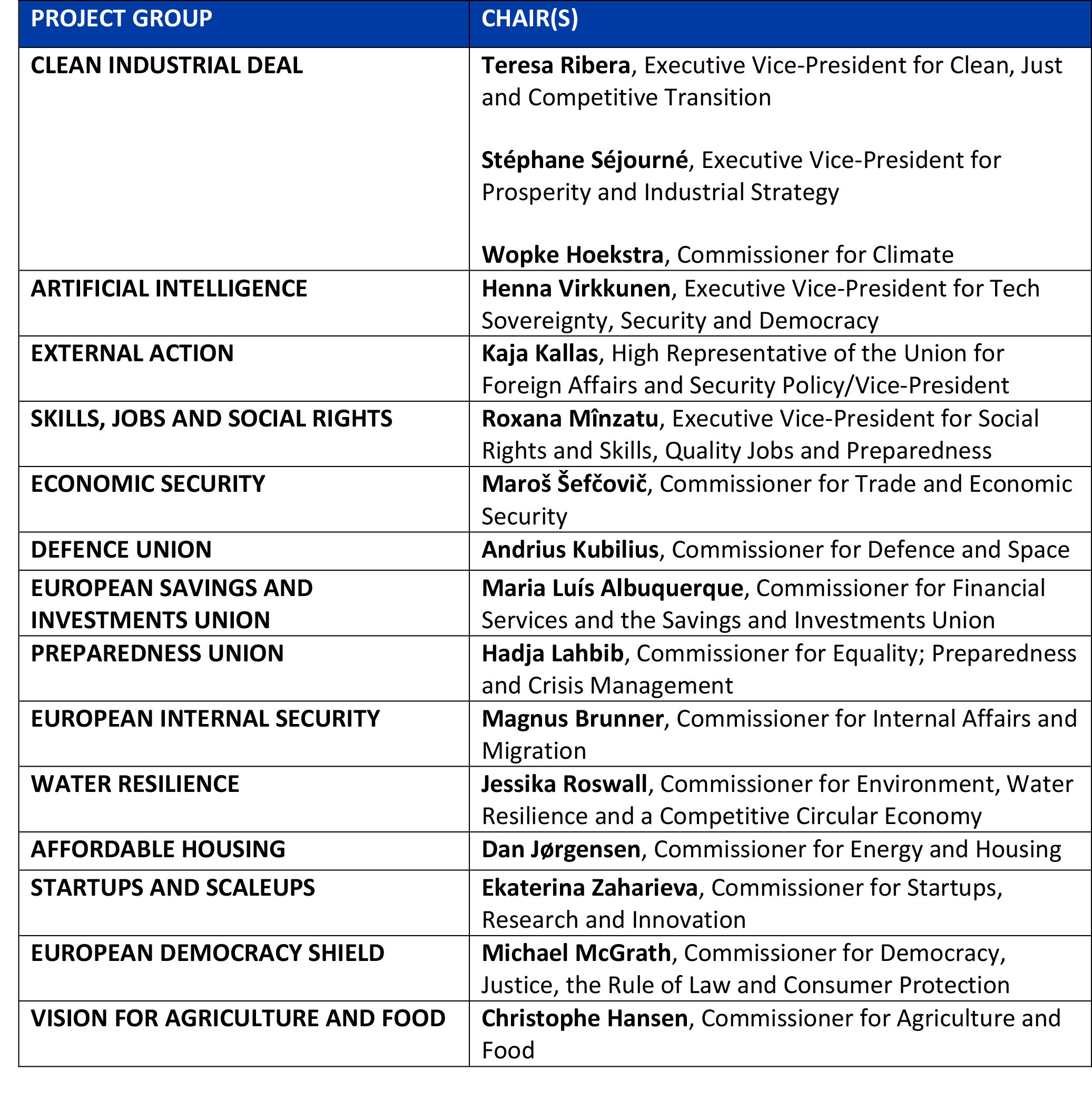 Council of the European Union
Meeting of Directors-General for Cohesion Policy: 15-16 January 2025
This meeting will be attended by high-level experts from EU institutions and Member States to debate the elements of the post-2027 cohesion policy, which will form the basis of the Council Conclusions of the General Affairs Council on 28 January 2025. Experts will discuss issues such as enhancing the role of cohesion within the EU strategic framework, enhancing the EU’s competitiveness and resilience through cohesion, a governance model for post-2027 cohesion policy, its effectiveness and efficiency, and the territorial dimensions of EU policy.
Meeting of Directors-General for European Affairs: 16-17 January 2025
As is customary at the beginning of each Presidency of the EU Council, an informal meeting of the Directors-General for European Affairs will be held to discuss the key topics of the current European agenda. In its first session on Thursday, 16 January 2025, the meeting will focus on the future of Europe in the context of the upcoming pre-enlargement policy reviews, which will be published by the European Commission in early 2025. The second session on Friday, 17 January 2025, will explore ways to further strengthen democratic resilience within the EU.
European Parliament
Committee on Foreign Affairs: 13-14 January 2025
On Monday, 13 January 2025, the EP Committee on Foreign Affairs, along with the Subcommittee on Security and Defence and the Delegation for relations with the NATO Parliamentary Assembly, will hold an exchange of views with Mark Rutte, Secretary General of NATO. The following day, the Committee will hold another exchange of views with Marta Kos, Commissioner for Enlargement.
Articles and Press Releases of Interest
- Commission disburses first €3 billion to Ukraine of its part of the G7 loan, to be repaid with proceeds from immobilised Russian assets
- German election 2025: Who’s ahead in the polls? Financial Times
- 4 things to watch for as French PM Bayrou faces first big test in parliament Politico
- Polish presidency of EU Council wants to strengthen EU’s influence and partnerships to deal with crises Agence Europe
- Armenia takes first step to EU accession as government approves bill Euronews
6 – 10 January 2025
Activities in the EU Institutions
European Commission
The European Commission has identified the European Union’s main priorities and milestones for 2025, which will be led by the new European Parliament under the aegis of EP President, Roberta Metsola, and the new European Commission under the leadership of Ursula von der Leyen, which commenced their new five-year term of office on 1 December 2024. The New Year saw Hungary pass the baton to Poland for the Presidency of the Council of the EU, which also meant the beginning of a new trio Presidency composed of Poland (January – June 2025), Denmark (June – December 2025), and Cyprus (January – June 2026).
Events in the European Union in 2025 kicked off on 1 January with Austria, Finland, and Sweden commemorating their 30th anniversary as EU Member States. On the same day, Bulgaria and Romania officially became full members of the Schengen Area, which will be celebrating its 40th anniversary this year. 2025 will also mark 75 years since the Schuman declaration, which proposed the creation of the European Coal and Steel Community (ECSC) and laid the foundations for today’s European Union.
At the December 2024 European Council, European Union leaders agreed that the EU will remain steadfast in its support to Ukraine and will cover most of Ukraine’s financing gap for 2025 via the Ukraine Facility and G7 loan. Furthermore, they discussed critical issues on the EU agenda in 2025: the Middle East, crisis prevention, and migration. The new President of the European Council, Antonio Costa, indicated the geopolitical compass for the EU in 2025, stating that the EU plans to focus on the Middle East, particularly Syria, where it hopes to support the transition of power and increase its diplomatic presence. The EU also plans to build a strong pragmatic transatlantic relationship with the new US administration and explore the new buoyancy in EU-UK relations. Costa warned against the use of over-simplified concepts, such as the Global South, and called for the adoption of a more nuanced approach to third country alliances, examining the policy trade-offs and accommodations that might be needed with partners from Latin America, the Indo-Pacific, and Africa. He also flagged an informal meeting of EU leaders on defence on 3 February 2025 and stated that the March 2025 meeting of the European Council will have a strong focus on competitiveness, prosperity, trade, and jobs.
Policy makers now await the publication of the Commission’s annual Work Programme for 2025, which will set out the list of the most important actions it will take in the year ahead. The work programme will contain new policy and legislative initiatives across all six headline ambitions of President von der Leyen's political guidelines. The upcoming months will focus on improving the EU’s competitiveness, sustainability, defence, security, and digital technology, and at making progress on the next Multiannual Financial Framework (2028-2034). The political negotiations on the next EU’s Multiannual Financial Framework are expected to begin in the second half of 2025, once the European Commission has laid out its legislative proposal for the EU’s budgetary structure and priorities for the period starting in 2028. Member States will then have to unanimously approve the new budget before the end of 2027. In her 2024-2029 Political Guidelines, the Commission President outlined major changes to the EU’s long-term budget as we know it, which includes a shift from a programme-based to a policy-based approach. She also foresees reducing the number of EU funding programmes, linking EU spending to national reforms in each country, and creating a new European Competitiveness Fund. Budget and decision making will be important in 2025, as the cost of enlargement, support for Ukraine, and enhancing European border security will require the EU to improve its capacity to develop policy packages across policy fields.
Council of the European Union
On 3 January 2025, an official gala at the Polish National Opera marked Poland’s takeover of the Presidency to the Council of the European Union from Hungary. Polish Prime Minister, Donald Tusk, and the President of the European Council, António Costa, each delivered a speech. Prime Minister Tusk emphasised the significance of Poland’s leadership and called for rediscovering the meaning of freedom and what Europe represents. He also outlined the main priorities of the Presidency, which centre around strengthening European security as a response to the consequences of Russia’s invasion of Ukraine, increasing geopolitical tensions, the erosion of the rules-based international order, hybrid attacks on European democracy and security. Poland has identified seven security dimensions it will focus on during its Presidency:
- Defence and security, with emphasis on boosting Europe’s defence readiness, military spending, and defence industry and strengthening the EU’s cooperation with NATO.
- Ensuring internal security through the protection of people and borders, specifically addressing the challenges of migration and security at the EU’s external borders, reducing irregular migration, ensuring an effective return policy, and responding to hybrid threats, such as the instrumentalization of migration.
- Resistance to foreign interference and disinformation by strengthening the resilience of democracy, curbing polarization and radicalization, fighting disinformation, and modernising and securing digital services.
- Ensuring security and freedom of business, including deepening the Single Market, reducing bureaucratic burdens, and restoring fair competition for EU industry in the global arena.
- Energy transition, focusing on the reliability of the supply of energy resources and a full withdrawal from imports of Russian energy sources.
- Competitive and resilient agriculture with a strong Common Agricultural Policy and a strengthened farmers’ position in value chains.
- Health security, which will include focusing on the digital transformation of healthcare, diversifying medicines supply chains, and supporting the production of medicines in the EU.
President Costa referred to Poland as “one of the greatest success stories of enlargement” and “the best geostrategic investment Europe has made to guarantee freedom and democracy.”
Articles and Press Releases of Interest
- Bulgaria and Romania join the Schengen Area
- German election 2025: Who’s ahead in the polls? Euronews
- How could Trump's policies impact Europe's economy and politics? Euronews
- After new incident in Baltic Sea at end of 2024, EU considers new sanctions against Russian fleet Agence Europe
9 – 20 December 2024
Activities in the EU Institutions
European Parliament
European Parliament Plenary: 16 – 19 December 2024
The European Parliament will hold the final Plenary meeting of 2024 to address important recent developments both within the Union and internationally.
On Monday, 16 December 2024, the Plenary will discuss recommendations to the Council on the EU priorities for the 69th session of the UN Commission on the Status of Women, which will take place in New York from 10 to 21 March 2025.
On Tuesday, 17 December 2024, the Plenary will discuss the toppling of the Syrian regime, its geopolitical implications, and the humanitarian situation in the region, followed by a discussion on the crackdown on peaceful pro-European demonstrators in Georgia. In the afternoon, the Plenary will also address the use of rape as a weapon of war in the Democratic Republic of the Congo and Sudan, Russia’s disinformation and historical falsification to justify its war of aggression against Ukraine, and the situation of female politicians in EU candidate and neighbouring countries facing harassment and cyber violence.
On Wednesday, 18 December 2024, the key debates will centre around the preparation of the European Council of 19-20 December 2024 and the EU-Western Balkans Summit on 18 December 2024. MEPs will also discuss cases of breaches of human rights, democracy and the rule of law, particularly in Azerbaijan, Kyrgyzstan, and regarding the occupation of the Autonomous Republic of Crimea. Furthermore, a debate will be held on the need for an impact assessment on the Green Deal policies in the context of EU competitiveness. A vote will also be held to appoint the Chair of the Anti-Money Laundering Authority (AMLA).
On Thursday, 19 December 2024, key debates will focus on updating the European strategy for the rights of persons with disabilities, followed by two Commission statements on the right to clean drinking water in the EU and on the inclusion of outstanding proposals on animal welfare in the European Commission’s work plan for 2025.
European Commission
The European Commission and four MERCOSUR countries – Argentina, Brazil, Paraguay, and Uruguay – have reached a political partnership agreement on a new trade deal, which will increase bilateral trade and investment, lower trade barriers for small- and medium-sized enterprises, create stable rules for trade and investment in the areas of intellectual property rights, food safety standards, and competition, and promote sustainable development by strengthening worker’s rights, fighting climate change, and upholding high food safety standards.
MERCOSUR, also known as the Southern Common Market, is a regional integration process in South America that promotes generating business and investment opportunities through the competitive integration of national economies into the international market. The EU is MERCOSUR’s number one trade and investment partner, exporting €56 billion in goods in 2023. It is also the biggest foreign investor in MERCOSUR, with a stock of €340 billion in 2021.
Council of the European Union
On 17 and 18 December 2024, Hungary will officially hand over the six-month Presidency of the Council of the European Union to Poland. A key priority of the Polish Presidency is set to be strengthening European security in all its dimensions – external, internal, information, economic, energy, food, and health. In this context, Poland has identified 7 security dimension it will focus on during it’s Presidency of the Council of the EU:
- Defence and security
- Protection of people and borders
- Resistance to foreign interference and disinformation
- Ensuring security and freedom of business
- Energy transition
- Competitive and resilient agriculture
- Health security
The full programme of the Polish Presidency can be found here: Programme of the Presidency
Justice and Home Affairs Council: 12 December 2024
The Council will convene to discuss the adoption of the decision to lift checks on persons at the internal land borders with and between Bulgaria and Romania. In this respect, Ministers will also take stock of the overall state of the Schengen area and increasing overall security through digitalisation. The Council will also receive an update from the European Commission on the implementation of the Pact on Migration and Asylum, which is currently in the preparatory stages in applying its laws throughout Member States from June 2026.
Foreign Affairs Council: 16 December 2024
The December Foreign Affairs Council will be chaired for the first time by the new EU High Representative for Foreign Affairs and Security Policy, Kaja Kallas. It will focus on four areas of high importance for the European Union:
After an exchange of views with Ukraine’s Minister of Foreign Affairs, Andrii Sybiha, the Council will discuss Russia’s continued aggression against Ukraine.
The Council will also exchange views on the latest developments in Georgia.
Focusing on Syria and Lebanon, the latest developments and crisis in the Middle East will be discussed.
Lastly, EU Ministers will exchange views on Belarus, ahead of its presidential election on 26 January 2025.
General Affairs Council: 17 December 2024
Ministers will continue their preparations for the European Council meeting on 19-20 December 2024 and discuss its draft conclusions. The discussions will focus on the Commission’s work programme for 2025 and multiannual programming and the 18-month programme of the Council of the European Union (1 January 2025 – 30 June 2026). The incoming Polish Presidency will also present the roadmap for the 2025 European Semester. Furthermore, Ministers will approve conclusions on EU enlargement, exchange views on EU-UK relations, and take stock of EU-Swiss relations.
European Council: 19 – 20 December 2024
EU leaders will meet in Brussels to discuss Ukraine, the EU in the world, the Middle East, resilience and preparedness, and migration and foreign policy. Volodymyr Zelenskyy, President of Ukraine, will be attending the meeting, and the EU-Western Balkans Summit will take place ahead of the European Council meeting on Wednesday, 18 December 2024.
On Ukraine, EU leaders will discuss Russia’s continued war of aggression in all its dimensions and the comprehensive support for Ukraine by the EU and its Member States, which has amounted to €124 billion to date. The further provision of military equipment and strengthening Ukraine’s energy sector and other civilian infrastructure will also be discussed.
Next, EU leaders will discuss the fast-evolving situation in the Middle East, including the EU’s possible contributions to de-escalation efforts, the ceasefire agreement between Israel and Lebanon, and the latest developments in Syria.
EU leaders will also hold a strategic discussion on how the Union can consolidate its role on the international stage, defend its interest, and promote is positions. Specific focus will be placed on ensuring mutually beneficial strategic relationships, including with the United Kingdom, the United States, and fostering a wider network of partners at a global level.
Strengthening the EU’s resilience, preparedness, crisis prevention, and response capacities will be discussed in the context of the report by former President of the Republic of Finland, Sauli Niinistö, entitled “Safer Together: A Path Towards a Fully Prepared Union”. The discussion will focus on the impact of an evolving threat landscape and the increasing number of natural disasters due to climate change.
On migration, EU leaders will take stock of the progress made in implementing past conclusions, particularly on strengthening the EU’s external borders, cooperating with third countries of origin and countries of transit, and increasing returns from the EU.
Lastly, the Council may address specific foreign policy issues, including developments in Georgia and Moldova.
Articles and Press Releases of Interest
- Statement by the European Commission on the occasion of Bulgaria and Romania becoming fully part of Schengen
- EU Council agreement on ‘Reform and Growth Facility for Moldova’ Agence Europe
- EU Home Affairs ministers divided on Syrian refugees' status Euronews
- Council of Europe urges its member states to avoid hasty return of Syrian refugees Agence Europe
- Brussels blesses Poland's plan to temporarily suspend asylum right Euronews
- Macron says he’ll name new PM in next 48 hours Politico
- German election 2025: Who’s ahead in the polls? Financial Times
2 – 6 December 2024
Activities in the EU Institutions
European Parliament
Committee on Foreign Affairs: 2 & 3 December 2024
The Committee will convene on Monday, 2 December 2024, to exchange views with Sven Koopmans, EUSR for the Middle East Peace Process, on the implementation of a two-states solution in association with the Delegations for relations with Israel and Palestine. The committee will also discuss the decline of democracy in Africa with Jonas Jonsson, Head of Division for East Africa at the EEAS.
On Tuesday, 3 December 2024, the Committee will discuss the outcome of the US elections and their impact on EU-US cooperation. In light of the first macro-financial assistance package for Egypt, which was approved in March 2024, the Committee will exchange views with Rosamaria Gili, EEAS Deputy Managing Director for the Middle East and North Africa, on EU-Egypt relations. Lastly, the Committee will meet with representatives from the Ukrainian Parliament to discuss EU sanctions against Russia and its allies and the use of Russian frozen assets.
European Commission
Following a statement made by Irakli Kobakhidze, Prime Minister of Georgia, on Georgia’s decision not to pursue the opening of accession negotiations with and rejecting financial support from the EU until 2028, the European Commission issued a response in which it noted that the announcement marks a shift from the policies of previous Georgian governments. The Commission also reminded that the decision goes against the European aspirations of the majority of Georgian people, which are also enshrined in the Constitution of Georgia.
Prime Minister Kobakhidze’s statement comes after the EU’s decision to halt the accession process and financial assistance for the country in June 2024 due to democratic backsliding, including irregularities during the recent Parliamentary elections.
Nevertheless, the European Commission reiterated that the door to the EU remains open and can continue if the Georgian leadership chooses to recommence the adoption of necessary reforms and values of the European Union.
Council of the European Union
Employment, Social Policy, Health and Consumer Affairs Council: 2 December 2024
The Council will convene to discuss combatting unfair traineeships, comprehensive solutions to demographic challenges, such as an ageing population and low birthrate, the labour and skills shortages in the EU, the social inclusion of persons with disabilities, and gender equality in the workforce.
Other News
The French government has collapsed after Prime Minister Michel Barnier received a no-confidence vote. Only three months after he was appointed by President Emmanuel Macron, Members of the French Parliament overwhelmingly voted against the Prime Minister in a motion which was tabled due to his attempt at forcing through his budget without a vote. With 288 votes needed for the motion to pass, 331 MPs supported the motion.
The decision marks the first time the French Government has collapsed in a no-confidence vote since 1962, and is predicted to further France’s political instability, which was initially shaken by the snap elections in the summer that led to no group having a majority in parliament.
Barnier must now present the resignation of his government, though he will likely remain a caretake prime minister until President Macron chooses a successor. The budget which triggered his downfall is now no longer in effect, as well.
Articles and Press Releases of Interest
- Commission, online platforms and civil society increase monitoring during Romanian elections
- Romania blames Russia for election meddling Financial Times
- Political crises in France and Germany spell more trouble for Europe's ailing economy Euronews
- Donald Trump’s rise to power could be an opportunity for EU to boost its economic competitiveness, says Christine Lagarde Agence Europe
- Hungary to lose €1B in EU funds by year-end Politico
- Secretary General of Council of Europe remains determined to support Georgia’s European aspirations and announces visit to country Agence Europe
18 – 22 November 2024
Activities in the EU Institutions
European Parliament
Commissioners-designate Confirmation Hearings
The European Parliament has concluded the hearings of Commission President Ursula von der Leyen’s 26 commissioner nominees. However, there remains no concrete agreement on the official setup of the European Commission, which was planned to commence on 1 December 2024.
While the European Parliament has approved 19 of the 26 Commissioners-designate, it has yet to decide the fate of Hungary’s Olivér Várhelyi and the six executive vice presidents (Kaja Kallas, Raffaele Fitto, Roxana Mînzatu, Stéphane Séjourné, Teresa Ribera and Henna Virkkunen). A decision is unlikely before Wednesday, 20 November, and the EPP has made it a precondition for Spain’s Teresa Ribera to appear before her national parliament to answer questions about her role as ecological transition minister during the recent floods in Valencia.
There are currently two options for the remaining Commissioners-designate to pass; the first is to secure a two-third majority in the committees in charge of their hearings, and the second is to gain a (secret) majority vote from the MEPs. It is becoming increasingly likely for the new Commission to begin work in 2025, as the European Parliament also has to vote on the package of 27 Commissioners as a whole.
Committee of Foreign Affairs: 18 November 2024
MEPs will partake in an exchange views on the situation in Georgia after the parliamentary elections on 26 October 2024. Then, the current Commissioner for Neighbourhood and Enlargement, Oliver Varhelyi, will present the 2024 Enlargement Package.
European Parliament Plenary: 19 November 2024
The EP will hold an extraordinary Plenary session in light of 1000 days of Russia’s full-scale invasion of Ukraine. Ukraine’s President Volodymyr Zelenskyy and EP President Roberta Metsola will address the Parliament.
European Commission
EU Annual Budget 2025
On 16 November 2024, the European Commission welcomed an agreement between the Council of the European Union and the European Parliament on the annual EU budget for 2025, which will amount to 199.4 billion€. It will provide the European Union the financial means to deliver on its political commitments and address urgent domestic crises, such as the recent flooding in Southern Europe. The Budget will allocate the highest amount of money (€78 billion) to the EU’s cohesion, resilience and values, followed by natural resources and environment (€56.7 billion), and the Single Market, innovation and digital (€21.5 billion).
SME Assembly: 18-20 November 2024
In collaboration with the Hungarian Presidency of the EU Council, the European Commission will host the European SME Assemble, a high-level political forum on European enterprise development policy. The Assembly will focus on increasing the EU’s competitiveness, supplier development, upscaling SMEs into large enterprises, the defence industry, the green transitions, the rise of AI, and others.
Council of the European Union
Foreign Affairs Council: 18-20 November 2024
HRVP Josep Borrell will chair the November Foreign Affairs Council, which will discuss:
- Russia’s aggression against Ukraine with an informal exchange of views with the Minister of Foreign Affairs of Ukraine, Andrii Sybiha.
- The current situation in Georgia in light of the parliamentary elections held on 26 October 2024.
- Transatlantic relations in the context of the outcome of the US presidential and parliamentary elections on 5 November 2024.
- Latest developments in the Middle East and the Horn of Africa.
In its defence configuration on 19 November 2024, the Councill will discuss EU military support to Ukraine, the EU’s defence readiness and preparedness, and the EU Rapid Deployment Capacity.
On 20 November 2024, the Council will focus on trade, with an exchange of views on the future of the EU’s trade policy. EU ministers will also discuss the state of play of the trade relations with the United States.
General Affairs Council: 19 November 2024
Ministers will begin preparations for the European Council meeting on 19-20 December 2024, discuss the rule of law situation in Malta, the Netherlands, Austria, and Poland, and take stock of development regarding respect for EU values in Hungary as part of the Article 7(1) TEU procedure. In the margins of the General Affairs Council, ministers will also have an informal lunch to discuss the role of cohesion policy in enhancing the EU’s competitiveness.
Articles and Press Releases of Interest
- EU annual budget 2025: pursuing our political priorities and addressing crises
- Opening remarks by Commissioner Hoekstra at the first COP29 EU press conference, together with the Hungarian Presidency
- Borrell proposes to suspend EU-Israel political talks over Gaza war Euronews
- Scholz under growing pressure to send long-range missiles to Ukraine Financial Times
11 – 15 November 2024
Activities in the EU Institutions
European Parliament
European Parliament Plenary: 13 – 14 November 2024
The European Parliament will hold a two-day Plenary meeting to address important recent developments both within the Union and internationally.
On Wednesday, 13 November, the Plenary will begin with a joint statement by the Council of the EU and the European Commission on the conclusions of the European Council meetings of October and November 2024, which will be followed by a statement on EU-US relations in light of the outcome of the US presidential elections. Then, the discussion will focus on the UN Climate Change Conference 2024 in Azerbaijan (COP29). The day will conclude with a statement by the European Commission on listing Russia as a high-risk third country active in the EU in the context of the fight against money laundering and terrorist financing.
On Thursday, 14 November, the meeting will focus on defence, specifically on enhancing Europe’s civilian and defence preparedness and readiness, which will be followed by MEPs voting on EU actions against the Russian shadow fleets[1] and ensuring a full enforcement of sanctions against Russia.
European Commission
EU – Ukraine Investment Conference: 13-14 November 2024
The European Commission will host the first-ever EU-Ukraine Investment Conference to mobilise private investment towards Ukraine’s recovery, reconstruction and modernisation. The three high-level panels will discuss:
- Leveraging Ukraine’s EU accession for economic recovery, investment and business reforms,
- mobilising private investment,
- municipal recovery, connectivity and public-private partnerships.
Six workshops will also take place throughout the Conference, including on attracting foreign direct investment from the EU, war insurance in Ukraine, and on EU accession as a big chance for Ukrainian companies.
Council of the European Union
7th Ministerial Conference of the Budapest Process: 11-12 November 2024
Hungary is a co-chair of the Budapest Process, which was launched in 1993 and is the only cooperation that involves the EU in a dialogue on migration issues with the countries of the Silk Routes region. The conference on 11-12 November will adopt a ministerial declaration setting out the principles and priorities for the next 5 years of the migration dialogue. The documents seek to address the strengthening of cooperation and dialogue and the migration challenges facing the region.
Legal Competitiveness Conference: 11-12 November 2024
As the improvement of the EU’s competitiveness is one of the key priorities of the Hungarian Presidency, a conference on the legal instruments for a more competitive Europe will take place on 11-12 November 2024 in Budapest with a view to addressing shortfalls in this area. The conference will analyse better law-making and deregulation and the relationship between new technologies and civil law in the context of competitiveness, acknowledging that economic competitiveness is inseparable from a stable legal framework and predictable application of the law.
Economic and Financial Affairs Council (Budget): 15 November 2024
The Council will meet in preparation for a Conciliation Committee meeting on the same day to reach an agreement with the European Parliament on the EU’s annual budget for 2025. The 21-day conciliation period began on 5 November 2024 and will last until 18 November 2024. If the two branches of the budgetary authority do not find an agreement on the 2025 budget by Monday, 18 November 2024, the budgetary process will restart.
Other News
Meeting of the European Political Community: 7 November 2024
EU leaders met for the fifth meeting of the European Political Community in Budapest, Hungary, where they discussed Europe’s security challenges, irregular migration, and issues related to economic security and connectivity in terms of energy, transport, IT, and global trade. In light of the US president elections, EU-US relations were also discussed. 42 Heads of State and Government took part in the meeting, while the European Union was represented by the President of the Council of the EU, Charles Michel.
The next European Political Community meetings will take place in Albania and Denmark in 2025.
In the margins of the meeting, the heads of the EU Council, European Commission, UK, France, Italy, Romania, and Poland met with Moldovan President Maia Sandu, where they commended her commitment to maintaining Moldova on the European path and discussed ways to enhance cooperation in supporting Moldova’s economy and reform efforts.
The Budapest Declaration
On 8 November 2024, EU leaders adopted the Budapest Declaration on a New European Competitiveness Deal at the Informal Meeting of Heads of State and Government in Budapest. Welcoming the reports by Enrico Letta and Mario Draghi, the Declaration highlights the urgent need to make the EU more competitive through a new European competitiveness deal and takes a strategic view of the future of EU competitiveness, stating that a business-as-usual strategy is no longer an option for the EU.
Following the European Council, Charles Michel stated that there was a very broad consensus to consider reducing fragmentation and strengthening integration by deepening the internal market, particularly the digital technology and services sectors, and by reducing the fragmentation of the capital market.
He commented that the Budapest Declaration clearly identifies the milestones from which the EU leaders will continue to work, and the sense of urgency involved.
An important factor, in his view, is exploring new instruments, commenting that, although there had been no consensus on the topic, the debate is on the table and will take place over the next few months as EU leaders prepare the next multiannual framework. The use of the European Investment Bank, as a powerful tool to invest more and support more innovation; the Capital Markets Union; and own resources, all come into play and will, he said, require a lot of work.
Finally, European Council President Michel, recalled the terms European sovereignty and strategic autonomy with regard to the need to enhance the EU’s security and defence capabilities.
This was the last meeting of EU leaders chaired by Charles Michel, as his term of office ends on 30 November and his successor, former Portuguese Prime Minister Antonio Costa, is scheduled to assume the role of President of the European Council on 1 December.
The 29th Conference of the Parties to the UN Framework Convention on Climate Change (COP29): 11 – 22 November 2024
COP29 has kicked off in Baku, Azerbaijan, to accelerate action on tackling the climate crisis against a backdrop of record-high global temperatures and extreme weather events. A key focus of the conference will be on financing the trillions of dollars needed to reduce greenhouse gas emission and protect those impacted by increased climate change. COP29 will also provide the opportunity for countries to present their updated national climate action plans under the Paris agreement, which are due by early 2025.
The European Union is currently the largest provider of international climate finance and contributed nearly €29 billion in public climate finance in 2023 and mobilised an additional €7.2 billion of private financing to support developing countries in reducing their greenhouse gas emissions and adapt to the impacts of climate change. At COP29, the EU will focus on setting ambitious expectations for the Nationally Determined Contributions and concluding the negotiations on international carbon markets.
Articles and Press Releases of Interest
- Opening remarks by President von der Leyen at the joint press conference with President Michel and Hungarian Prime Minister Orbán following the informal meeting of Heads of State or Government of 8 November 2024
- MEPs postpone decision on Hungary’s Olivér Várhelyi Politico
- Statement by President von der Leyen on the results of the US presidential election
- Trump’s in. Here’s what it means for Europe Politico
- What does the German government break down mean for Europe? Euronews
- Court again rejects Giorgia Meloni’s migrant camps in Albania Financial Times
- Strengthening Turkey’s membership prospects is in Europe’s interest, argues Recep Tayyip Erdoğan Agence Europe
[1] Shadow fleets are unregistered or fraudulent vessels that use concealing tactics to smuggle sanctioned goods, such as oil, iron, luxury good, weapons and defence technologies.
4 – 8 November 2024
Activities in the EU Institutions
European Parliament
Commissioners-designate Confirmation Hearings 2024: 4 – 12 November 2024
The hearings for the new batch of Commissioners have kicked off today in the European Parliament and will continue until next Tuesday, 12 November 2024. The 26 Commissioners-designate will each take part in a 3-hour hearing where they will present their programme to the committee and prove their expertise and integrity, which was preceded by the candidates answering written questions from MEPs on parliamentary committees related to their portfolios. Then, the committee and group chairmen will decide on accepting the Commissioner or not. If a Commissioner-designate is rejected, their Member State must nominate another candidate. If they are accepted, the new Commission must receive approval from the European Parliament Plenary session before being appointed by the European Council.
Micheal McGrath’s confirmation hearing for Commissioner for Democracy, Justice and the Rule of Law is scheduled for 9.00a.m. on Tuesday, 5 November 2024 and will be broadcast live on the European Parliament’s website.
European Commission
The European Commission has adopted the 2024 enlargement reports, offering an assessment of the state of play and progress made by the candidate countries seeking to join the European Union, and key reform priorities for each country. While many candidates have made considerable progress on their path towards EU accession, the European Commission has highlighted the need for further reforms in their economic sectors. Above all, focus should be placed on accelerating structural reforms to enable sustainable growth and meet the economic criteria for membership, which includes ensuring functioning market economies and the ability to withstand the competitive pressures of the EU market. The candidates’ economic policies should also align with the Union’s green and digital transition goals.
The European Commission has also published the 2024 Climate Action Progress Report, which shows that net EU greenhouse gas (GHG) emissions fell by 8.3% in 2023 compared to the previous year. This marks the second largest annual drop in decades, surpassed only by the exceptional circumstances of 2020 during which the Covid-19 pandemic led to a 9.8% cut in emissions. The Report also continues to prove the lack of connection between emissions and economic growth, as the EU’s GHG emissions are currently 37% below 1990 levels while its
GDP has grown by 68% over the same period. The EU remains on track to achieve its goal of reducing emissions by 55% by 2030.
Council of the European Union
Economic and Financial Affairs Council: 5 November 2024
The Council will convene to take stock of the implementation of the Recovery and Resilience Facility, receive an update on the economic and financial impact of Russia’s aggression against Ukraine, and seek a political agreement on legislation on value added tax (VAT) in the digital age that sets out to tackle VAT fraud, support businesses and promote digitalisation. The Council is also expected to publish the 2023 international climate finance figures and the Presidency of the Council of the EU will present the state of play of legislative proposals in the field of financial services.
Articles and Press Releases of Interest
- How to watch the commissioner hearings like a pro Politico
- Joint Statement by the European Commission and High Representative Josep Borrell on the second round of Presidential Elections in Moldova
- EU braces for two-front trade war with US, China Politico
- How the US election may unsettle Europe Financial Times
- Eurogroup’s political priorities for boosting EU’s economic competitiveness Agence Europe
28 October – 1 November 2024
Activities in the EU Institutions
European Parliament
Commissioners-designate Confirmation Hearings 2024
The European Parliament has released the full programme for the confirmation hearings of the Commissioner-designate. The hearings will begin next week and take place from 4 to 12 November 2024, beginning with Slovakia’s Maroš Šefčovič, whose proposed portfolios are Trade and Economic Security and Interinstitutional Relations and Transparency, and ending with Finland’s Henna Maria Virkkunen for Tech Sovereignty, Security and Democracy.
Micheal McGrath’s confirmation hearing for Commissioner for Democracy, Justice and the Rule of Law is scheduled for 9.00a.m. on Tuesday, 5 November 2024 and will be broadcast live on the European Parliament’s website.
MEPs’ visit to the United Kingdom: 28 – 30 October 2024
A delegation of MEPs from the Committee on Foreign Affairs and Subcommittee on Security and Defence will meet with their UK counterparts in London from 28 to 30 October 2024. The discussions will centre around strengthening the EU-UK partnership in the security and defence field and in response to global and regional issues, such as Russia’s invasion in Ukraine, the situation in the Middle East, and tensions in the Indo-Pacific.
European Commission
On Tuesday, 29 October 2024, the European Commission is set to finalise discussions on a competition cooperation agreement between the European Union and the United Kingdom, which would supplement the EU-UK Trade and Cooperation Agreement. The new competition cooperation agreement would allow the European Commission, Member States’ national competition authorities, and the UK Competition and Markets Authority to cooperate in competition investigations and help avoid conflicts between jurisdictions.
Council of the European Union
EU-Western Balkan Ministerial Forum: 28 – 29 October 2024
As is tradition with the Presidencies of the Council of the EU, the Hungarian Ministers of Justice and Home Affairs and the Commissioner for Justice and Home Affairs of the European Commission will meet with their counterpart from the Western Balkans at the annual EU-Western Balkans Ministerial Forum. Representatives from the European External Action Service, the Council of Europe, and the upcoming Presidencies of the Council of the EU from Poland and Denmark will also attend.
The agenda will be divided into two sections, with the first day focusing on home affairs and the second on justice.
Within the home affairs section, Ministers will discuss cooperation in migration, asylum, fighting organised crime, and strengthening border management. The discussion will be carried out in the context of the implementation of the EU’s Western Balkans Action Plan, which aims to strengthen the cooperation on migration and border management with partners in the Western Balkans considering their EU accession perspective.
The Forum’s second day will see Ministers discussing digital justice and cross-border judicial cooperation in criminal matters. They will focus on the opportunities and challenges of digitalisation and AI, including in cross-border access to electronic evidence, and on the transfer of criminal proceedings and victims’ rights in cross-border cases. Finally, the EU will present Eurojust’s coordination activities in the investigation and prosecution of international crimes in Ukraine.
The incoming Polish Presidency will also have the opportunity to present its programme at the Forum.
Articles and Press Releases of Interest
- Statement by the European Commission and the High Representative Josep Borrell on the Parliamentary elections in Georgia
- EU enlargement is a “necessity” to “strengthen Europe’s influence in world”, says Albanian Deputy Minister Olta Manjani Agence Europe
- How contested votes and foreign influence are rocking EU accession Financial Times
- How will future European Commissioners be "vetted"? Euronews
- Macron’s trade-off: Western Sahara for migrant returns Euractiv
21 – 25 October 2024
Activities in the EU Institutions
European Parliament
The European Parliament will be in plenary session from 21 to 24 October 2024.
On Monday, 21 October, Enrico Letta will present his “Much More Than a Market” report, which will be followed by a Parliament statement on empowering the Single Market to deliver a sustainable future and prosperity for all EU citizens.
On Tuesday, 22 October, debates will centre around the General Budget of the European Union for the financial year 2025. In the afternoon and evening, the European Commission will make statements on Azerbaijan’s relations with Armenia, China’s provocations around Taiwan, and Iran’s state-sponsored terrorism in light of recent attacks in Europe.
On Wednesday, 23 October, the Plenary will discuss managing migration through fostering returns; the continued war crimes committed by Russia and ensuring a full enforcement of sanctions against Russia, and the need to strengthen the EU’s resilience and internal security with regards to foreign interference and hybrid attacks.
On Thursday, 24 October, the session will begin with a debate on supporting the green and digital transition to ensure inclusive growth and competitiveness in line with the Draghi report. The Plenary will also discuss the persistent threats to marine protected areas in the EU and the need to protect our oceans.
European Commission
On Monday, 21 October 2024, the European Commission is to grant over €380 million to 133 new projects under the LIFE Programme for environment and climate action, which contributes to reaching the European Green Deal’s goals, including becoming climate-neutral by 2050.
Council of the European Union
Last week’s European Council meeting, which took place on 17 – 18 October 2024, addressed several key issues, including Ukraine, the Middle East, competitiveness, and migration. The main conclusions of the meeting are outlined below.
On Ukraine, EU leaders stressed that no initiative about Ukraine can be taken without Ukraine. Reviewing progress on military support for Ukraine, they called for an accelerated delivery of air defence systems, ammunition and missiles. EU leaders also agreed on a loan of up to €35 billion and a loan cooperation mechanism to support Ukraine, which will stem from the interest on Russia’s frozen assets. The need to increase Ukraine’s energy security, humanitarian and civil protection was also acknowledged. Lastly, the Council welcomed the adoption of a new EU sanctions regime in response to Russian hybrid threats, which includes new sanctions and import tariffs on Russian and Belarusian products, and new sanctions against Iran that target those involved in Iran’s ballistic missile and drone programmes.
On the Middle East, EU leaders strongly condemned the Iranian attacks on Israel and called for an immediate ceasefire on the Lebanese-Israeli border. Regarding the situation in Gaza, the Council pointed to the unacceptable number of civilian casualties and the imminent risk of famine. EU leaders called for an immediate ceasefire, urgent access to humanitarian assistance, and the full implementation of the orders of the International Court of Justice.
On competitiveness, a call was made on all EU institutions, Member States and stakeholders to advance work on the challenges identified in Enrico Letta’s and Mario Draghi’s reports.
On migration, EU leaders called for strengthening the EU’s external borders, intensifying cooperation with third countries or origin and countries of transit and increase returns from the EU. They also requested the Commission submit a new legislative proposal on returns.
On Moldova, EU leaders expressed their support for Moldova and the country’s efforts to become a Member State. They commended their commitment to the reform process required for EU accession and invited them to pursue reforms and strengthen the country’s stability and resilience. They also condemned Russia’s persistent attempts to use foreign information manipulation and interference to undermine democratic elections and the choice of the Moldovan people.
Finally, the meeting also addressed Georgia’s upcoming parliamentary elections, the humanitarian situation in Sudan, and the human rights violations that followed the presidential elections in Venezuela.
Articles and Press Releases of Interest
- Opening remarks by President von der Leyen at the joint press conference with President Michel following the meeting of the European Council of 17 October 2024
- Moldova votes yes to EU membership as president Sandu claims Moscow meddled Euronews
- Playing with ‘electoral rocket fuel’: How Poland’s Donald Tusk hopes to weaponize migration Politico
- Barely launched, the system for transferring asylum seekers to Albania in Italy is already experiencing its first legal setback Agence Europe
14 October – 18 October 2024
Activities in the EU Institutions
European Parliament
Last week’s EP Plenary session, where the Hungarian Presidency to the Council of the EU presented its programme of activities, caused division within the Parliament and concerns regarding Hungary’s respect for democracy and rule of law. Some MEPs called Prime Minister Orbán an autocrat and dictator, while he received praise from most right-wing MEPs due to his strict approach to migration and defence of traditional family structures.
Several committee meetings are taking place in the European Parliament this week. On Monday, 14 October 2024, the Committee on Foreign Affairs will receive a draft report on the implementation of the Common Foreign and Security Policy, while the Committee on Budgets will adopt the draft report on the general budget of the EU for the financial year 2025.
Council of the European Union
This week’s focus is on the European Council, which will take place on 17 – 18 October 2024, and will address several key issues, including Ukraine, the Middle East, competitiveness, and migration.
On Ukraine, EU leaders will discuss Russia’s ongoing war of aggression against Ukraine, with particular focus on the delivery of military support, the progress on the use of extraordinary revenue from Russia’s frozen assets, strengthening Ukraine’s energy sector and critical infrastructure, and implementing further sanctions on Russia.
On the Middle East, the discussion will centre around the current escalation of violence in the region, including at the Lebanese-Israeli border and in Gaza. The security situation in the West Bank and the Red Sea will also be touched upon.
The recent reports written by Enrico Letta and Mario Draghi will feed the discussion about enhancing EU competitiveness and the need to reduce Europe’s dependencies in strategic sectors.
On migration, leaders will take stock of the implementation of the comprehensive approach on migration, which was agreed at the special European Council meeting on 9 February 2023. They will focus on external action, strengthening EU’s external borders, increasing and accelerating returns, and the fight against human trafficking and smuggling of migrants.
Finally, the meeting will also briefly address preparations for COP29 in Azerbaijan and may discuss current developments in Georgia, Moldova, Venezuela, and Sudan.
Ahead of the European Council meeting, EU leaders will also meet with their counterparts from the Gulf region in the first EU-Gulf Cooperation Summit on 16 October 2024.
Environment Council: 14 October 2024
EU Environment Ministers will meet in Luxembourg to approve the conclusions for two upcoming Conference of the Parties; COP29 to the UN Framework Convention on Climate Change, which will take place in Baku, Azerbaijan from 11 to 22 November 2024, and COP16 to the Convention on Biological Diversity, which will take place in Cali, Colombia from 21 October to 1 November 2024. Furthermore, ministers will exchange views on plastic pollution and the implementation of the EU chemical strategy. The climate and environmental policy aspects of the Draghi report will also be discussed.
Foreign Affairs Council: 14 October 2024
EU Foreign Affairs Ministers will convene in Luxembourg to discuss Russia’s aggression against Ukraine and recent developments in the Middle East. Under current affairs, ministers will be informed about the Moldovan presidential election on 20 October 2024 and the Georgian parliamentary elections on 26 October 2024.
General Affairs Council: 15 October 2024
Ministers will continue preparations for the European Council meeting on 17 and 18 October 2024. Furthermore, they will discuss a newly drafted declaration on fostering Jewish life and combating antisemitism, EU-Switzerland relations, the follow-up to the European Parliament elections, and the latest developments in EU-UK relations.
European Commission
The European Commission will host the 10th Just Transition Platform Conference from 15 to 17 October 2024, which will facilitate an exchange of views between stakeholders from national, local and regional authorities regarding the just transition towards a climate-neutral Europe.
Articles and Press Releases of Interest
- The Recovery and Resilience Facility continues to deliver, Commission third annual report shows
- EU Issues New Sanctions Against Iran for Missile Support to Russia Euronews
- Orbán threatens to mess with Ukraine aid to help Trump Politico
- Suspending the right to asylum goes against EU law, Brussels tells Warsaw Euronews
- ‘Real risk’ that climate aid talks will fail, key COP29 negotiator warns Politico
- Albania is due to open its first negotiation chapter on 15 October, during the second Intergovernmental Conference with the EU Agence Europe
7 October – 11 October 2024
Activities in the EU Institutions
European Parliament
The European Parliament will be in plenary session from 7 to 10 October 2024.
On Monday, 7 October, the debates will focus on the reintroduction of internal border controls in several Member States and its impact on the Schengen Area, the need to fight the systemic gender-based violence in Europe, dealing with disinformation in the EU, and the need for further climate action mitigation in the aftermath of the extreme wildfires in Southern Europe.
On Tuesday, 8 October, preparations for the 17-18 October European Council will take place, along with a discussion about the escalation of violence in the Middle East and the situation in Lebanon. In the afternoon, debates will focus on EU membership candidates, Moldova and Georgia, specifically on strengthening Moldova’s resilience against Russian interference and the democratic backsliding and threats to political pluralism in Georgia.
On Wednesday, 9 October, the Hungarian Presidency to the Council of the EU will present its programme of activities, followed by debates on strengthening the security of Europe’s external borders and the EU’s support to the G20 Presidency’s proposal to end poverty by taxing the super-rich.
On Friday, 10 October, the session will begin with a debate on the rise of religious intolerance in Europe, followed by votes on cases of breaches of human rights, democracy and the rule of law in Türkiye, China, and Iran. The Plenary will end with a debate on the importance of the Amazon for climate change.
Council of the European Union
Economic and Financial Affairs Council: 8 October 2024
Ministers will take stock of the implementation of the Recovery and Resilience Facility (RRF), discuss the economic and financial impact of Russia’s aggression against Ukraine, aim to approve the conclusions on climate finance in view of COP29, which will take place in Baku, Azerbaijan from 11-22 November, and receive a debrief by the Council and the Commission on the main results of the G20 meeting of finance ministers and central bank governors that took place in July 2024. The Presidency of the Council will also present the state of play of legislative proposals in the field of financial services.
Justice and Home Affairs Council: 10 October 2024
The European Commission will present the Schengen Barometer, a report that reviews developments and emerging threats within the Schengen Area. The discussion will focus on increasing the resilience of the EU’s external borders, while also addressing the state of play of the full application of the Schengen acquis in Bulgaria and Romania. Ministers will also exchange views on the implications of external conflicts for the EU and the Presidency’s priorities in the fight against drug trafficking and organised crime.
European Commission
All eyes are fixed on the proposed dates for the hearings by the European Parliament of the Commissioners-designate which were due to be decided by the Conference of the Presidents of the European Parliament on 10 October but which EP President, Roberta Metsola has tweeted will be held from 4-12 November 2024.
The European Commission will host a week-long European Week of Regions and Cities, which showcases the implementation of the EU’s Cohesion Policy, reflects on its past achievements and discusses how the Policy can best continue to fulfil its EU Treaty mission of promoting economic, social, and territorial cohesion across the EU.
Articles and Press Releases of Interest
- European Commissioner hearings confirmed for November Politico
- A group of 17 European countries call for a 'paradigm shift' to deport rejected asylum seekers Euronews
- Joint Statement by President von der Leyen and High Representative/Vice-President Borrell on the European Court of Justice judgements relating to Morocco
- EU top court upholds cancellation of EU-Morocco trade deals over disputed Western Sahara Euronews
- 22nd European Week of Regions and Cities takes stock of achievements and looks ahead to the future of Cohesion Policy
30 September – 4 October 2024
Activities in the EU Institutions
Council of the European Union
EU Presidency Conference on Intellectual Property: 1-2 October 2024
As part of the Hungarian Presidency programme, the Hungarian Intellectual Property Office is organising a high-level international conference entitled “Intellectual Property in the Age of Artificial Intelligence”. The discussion will focus on AI as it relates to industrial property and transparency, enforcement, copyright challenges, and others. These topics will be explored from a social, economic, and technological perspective, as well as from a policy standpoint.
9th International Evaluation and Monitoring Conference: 2-4 October 2024
The Hungarian Presidency of the Council of the European Union will host the 9th International Evaluation and Monitoring Conference on 2-4 October 2024 in Budapest. The conference will discuss the results and challenges of cohesion policy, aiming to improve the implementation of the 2021-2027 EU co-funded programmes. Experts from the European Commission, Member States, and international organisations, such as OECD and the European Investment Bank, will also present their strategic approaches for the future challenges post-2027.
Meeting of Directors-General for the Environment: 2-3 October 2024
A meeting of the DGs responsible for the environment will take place in Budapest to discuss the EU’s preparation for the upcoming international environmental conferences, including COP16.
European Commission
The European Commission is organising the 17th European Nuclear Energy Forum on 30 September – 1 October 2024, co-hosted by Czechia. The Forum offers a platform for discussion about the opportunities and risks associated with nuclear energy, with this year’s conference focusing on the role of nuclear energy towards meeting the EU’s 2040 climate targets and related energy and industrial policy goals. Topics will include financing investments, nuclear safety, public engagement, and harnessing synergies in supply chain.
European Parliament
On Monday, 30 September 2024, the Committee on the Internal Market and Consumer Protection will hold an exchange of views on the future of European competitiveness based on the report by Mario Draghi.
On Thursday, 3 October 2024, the European Parliament will hold a technical briefing on the schedule, rules and structure of the confirmation hearings of the new European Commission[1]. Following legal clearance of the Commissioners-designate, each Commissioner will be invited to participate in a robust public hearing, where MEPs from the Committees relevant to their portfolios may question them.
Other News
Austria’s far-right party, the Freedom Party (FPO), led by Herbert Kickl, secured a strong victory in the general elections last Sunday with a vote of 29.2% over the outgoing government of the People’s Party (OVP) led by Karl Nehammer, which polled in second place at 26.5%. The Social Democrats came third with 21% at the expense of the outgoing government coalition partner, and the Green party polled only 8%. The Freedom Party is an anti-migration, pro-Kremlin party that dates back to the post-war period. The results reflect a powerful anti-migration sentiment amongst the Austrian population, though the party is unlikely to be able to form a government in the short term due to the long-standing cordon sanitaire, which precludes non-democratic parties from government. Still, the results reflect a Pan-European trend of a shift to the right, evident in recent regional elections in Germany and France. The consensus amongst commentators is that while the influence of the far-right may be apparent in the debates in the EP and topics put on the agenda in the Commission, it will not seriously affect policy-making in the EU because of the far-right’s fragmentation in the EP. While far-right parties play a role in coalition governments in Finland, Italy, Czechia, Croatia and the Netherlands, Hungary remains the only far-right party in government in the EU.
Articles and Press Releases of Interest
- Speech by President von der Leyen at the second meeting of the Ukraine Compact
- European Parliament finalises organisation of hearings of European Commissioners-designate Agence Europe
- Why tensions with neighbours have stalled North Macedonia’s EU bid Euronews
- Podgorica could be fully integrated into European single market by 1 January Agence Europe
- Red lines remain as Starmer and von der Leyen attempt to reset UK-EU relations Financial Times
- Orbán rallies China and Brazil in renewed Ukraine peacemaking push Euronews
[1] See IIEA Timeline, which sets out the next steps in the procedures to form a new Commission.
EU Review: 23 September – 27 September 2024
Activities in the EU Institutions
- The European Commission
The transition of leadership in the EU institutions is highly political and is likely to dominate the autumn period in Brussels, as the new College of Commissioners and Kaja Kallas, the new High Representative of the Union for Foreign Affairs and Security Policy (HR/VP), are presented and approved by the European Parliament and António Costa, the new President of the European Council, assumes his new role on 1 December 2024.
President of the Commission, Ursula von der Leyen, announced the long-awaited presentation of the new College of Commissioners on Tuesday, 17 September 2024. Since the announcement, many observers have been pouring over the mission letters and dissecting the structure and responsibilities of the Commissioners (and who the ‘winners’ and ‘losers’ have been).
Over the coming week, several incumbent Commissioners will be in New York to attend High-Level Week at the UN. According to the Commission website, these include: Commission President von der Leyen, Executive Vice-President Vestager, HR/VP Borrell, Vice-President Šuica, and Commissioners Kyriakides, Reynders, Johansson, Lenarčič, Urpilainen, Simson and Hoekstra. Of particular note:
- Commission President von der Leyen, HR/VP Borrell, and Commissioner Urpilainen, together with President of the European Council Charles Michel, will represent the EU in a trilateral meeting with the African Union and the United Nations and hold bilateral talks with the UN Secretary General Guterres;
- HR/VP Borrell will address the UN Security Council during the high-level meeting on Ukraine; and
- Commission President von der Leyen and HR/VP Borrell will attend the opening session of the UN General Assembly.
Back in Berlaymont, Alexandre Adam has joined von der Leyen’s cabinet as its deputy head. While being a member of the Conseil d’État, Mr Adam is a close confident of President Macron, serving as his Europe Advisor for a number of years. He is also well-integrated into the EU sphere as a Visiting Professor at the College of Europe and board member of the Brussels Institute for Geopolitics. His appointment, along with that of that of Stéphane Sejourné as Executive Vice-President, potentially signifies an increase in France’s influence in the policymaking of the second von der Leyen Commission.
- The Council of the EU and the European Council
Several Council configurations will meet in Brussels over the coming week. Of particular interest is the General Affairs Council on 24 September 2024. At this meeting, Ministers from Member States will discuss Hungary’s priorities for its Presidency of the Council, the rule of law situation in a number of Member States, and developments in a number of candidate countries.
On Thursday, 26 September 2024, the Competitiveness Council will meet to discuss the report prepared by Mario Draghi on EU competitiveness that was published earlier this month. It will also discuss state aid frameworks and challenges facing small- and medium-sized businesses in Europe.
On the European Council, President Charles Michel will also attend High-Level Week at the UN in New York and address the general debate of the General Assembly and the Summit of the Future on behalf of the EU. ‘Multilateral Solutions for a Better Tomorrow’ is the motto of the UN Summit of the Future which will take place on 22-23 September. The aim of the summit is to adopt a Pact for the Future that will take up pressing issues of international importance, speed up the implementation of the 2030 Agenda, and induce UN reform.
- The European Parliament
Over the course of the week, Hungarian politicians will go before several Committees of the European Parliament to discuss the priorities for specific policy fields of Hungary’s Presidency of the Council of the EU, which it assumed on 1 July 2024. These engagements with Committees come a week after a broader debate in the plenary on the Presidency’s priorities.
This week, Roberta Metsola, President of the European Parliament, will be in New York to attend the opening session of the UN General Assembly. While in New York, President Metsola is scheduled to meet with a number of global leaders, including Edi Rama, Prime Minister of Albania, and Tony Blair, former Prime Minister of the United Kingdom.
On Thursday, 26 September 2024, before a joint meeting of the European Parliament’s Committee on Foreign Affairs, Committee on Development and Subcommittee on Human Rights, the political groups will present their nominations for the 2024 edition of the Sakharov Prize for Freedom of Thought.
Other News
Two and a half months and an Olympic Games later, Emmanuel Macron, President of the French Republic, has appointed a new Prime Minister. In July, his presidential majority was eroded at the expense of the left-wing New Popular Front coalition, who won the most seats but fell short of a majority, and the far-right National Rally, which under-performed in comparison to pre-election polls but saw their number of deputies greatly increase.
In the role of Prime Minister, President Macron appointed Michel Barnier. Mr Barnier is best known internationally for his role as Chief Negotiator for the European Commission during the negotiations for the UK’s departure of the EU. His nomination to the Matignon was not without controversy, as his party, The Republicans, came a distant fourth in the legislative elections and garnered its worst election result in the party’s history.
While Barnier was announced as Prime Minister on 5 September 2024, he only formed his government on 21 September. The government includes a mix of familiar names from the last administration, several conservative newcomers and first-time centrist appointees. Many commentators observed that the new government signified quite a shift to the right. The Republicans, Barnier’s conservative party, which holds 47 of 577 seats in the French National Assembly, secured several key Cabinet positions at the expense of Macron’s centrists. Particularly of note in this respect was the appointment of Bruno Retailleau as Minister of the Interior, a conservative right-wing politician who formerly led The Republicans in the Senate. Jean-Noël Barrot of the centrist liberal MoDem party was appointed Minister of Europe and Foreign Affairs. Mr Barrot was previously Secretary of State for European Affairs in the Attal Government and briefly President of the Foreign Affairs Committee of the National Assembly.
President Macron urged his Prime Minister to build a government which would lean towards ‘national unity’, but the result has done quite the opposite – with the announcement of Barnier’s government precipitating national protests and even discontent amongst the left-wing of Macronie.
The French political crisis is not limited to Metropolitan France. In Martinique, an overseas department in the Caribbean, violent riots have erupted in response to high costs of living. In New Caledonia, in an atmosphere of heightened tensions after large disturbances and rioting erupted in May 2024, a strict curfew has been imposed as the 171st anniversary of the French colonial conquest approaches on 24 September.
Meanwhile in Germany, regional election results in Brandenburg saw the SPD of German Chancellor Scholz receive a well-needed, if marginal, win over the far-right AfD party. The SPD won 30% of the vote, the AfD 29.2%, BSW 13%, and the CDU 12.1%. The Greens and the Left will no longer be represented in the regional parliament, after failing to reach the necessary electoral threshold, which narrows the choice of coalition options for Chancellor Scholz’s SPD. BSW will enter the regional parliament for the first time with fourteen seats. This was the third regional election this September, following those in Thuringia and Saxony, with the results are seen as a barometer for the political temperature in the states of former East Germany ahead of the general elections in 2025.
To the Alpine south, the Austrian general election on 29 September is expected to yield a success for far-right Freedom Party of Austria. The party’s leader, Herbert Kickl, is in prime position to top the polls, with the Social Democratic Party and current coalition partners of the conservative People’s Party and Green Party trailing.
- Austria election brings into focus Russian gas addiction – EURACTIV
- EU defence commissioner calls for obligatory ammunition stockpiles – Financial Times
- Europe’s battery champion slashes jobs amid slowing EV sales – POLITICO Europe
- France asks Brussels for extra delay on spending plans – Financial Times
- Future of EU defence committee now in limbo over battle of the groups – EURACTIV
- How Teresa Ribera became the second-most-powerful person in Brussels – POLITICO Europe
- Incoming environment commissioner likely to face tough MEP questions on chemical rules revision – EURACTIV
- Jean-Noël Barrot, a newcomer to France's foreign affairs ministry – Le Monde International
- Russia-friendly groups' surge leaves Scholz's party few options after regional vote – Reuters
- Sweden and Finland want to tie EU farm subsidies to rule of law – Euronews
- UN Secretary-General's remarks at the opening of the Summit of the Future's Action Days – United Nations
16 September – 20 September 2024
Activities in the EU Institutions
- The European Commission
The transition of leadership in the EU institutions is highly political and is likely to dominate the autumn period in Brussels, as the new College of Commissioners and Kaja Kallas, the new High Representative of the Union for Foreign Affairs and Security Policy (HR/VP), are presented and approved by the European Parliament and António Costa, the new President of the European Council, assumes his new role on 1 December 2024.
The long-awaited presentation of the new College of Commissioners was postponed last week, its future composition remains unclear. Commission President, Ursula von der Leyen, is now expected to unveil the composition and policy portfolios on Tuesday, 17 September 2024.
Tensions rose on Monday, 16 September 2024, following Thierry Breton’s dramatic public resignation from his position as European Commissioner for the Internal Market after pressure exerted by Commission President von der Leyen on French President Emmanuel Macron led him to nominate another candidate for Commissioner. In place of Breton, President Macron has put forward his close ally, Stéphane Séjourné, the current Minister of Foreign Affairs and former Leader of Renew Europe in the European Parliament. The departure of Foreign Minister Séjourné for Brussels, in turn, presents a problem for Michel Barnier, the new Prime Minister of France, as he attempts to form a government that can survive the political fragmentation and polarisation of Paris. With the exit of Breton – together with the departure of social democrats Josep Borrell of Spain, Paolo Gentiloni of Italy, and Nichols Schmit of Luxembourg from the Commission – the main internal critics of President von der Leyen’s during her first mandate are now all out of contention for a second term.
- The European Parliament
This week, MEPs will descend on Strasbourg for the first plenary session after the summer. From 16-19 September, MEPs are scheduled to debate an array of topics. These include agricultural policy; the energy union; migration and the Schengen Zone; and several external relations topics, such as Afghanistan, Israel and Palestine, Ukraine, and Venezuela. Further, a special debate will focus on the recent ruling by the Court of Justice of the EU on the Apple competition case. Additionally, there will be two presentations: one by Mario Draghi on his recently published report on EU competitiveness, published 9 September 2024, and a second on the priorities of Hungary’s Presidency of the Council of the EU, which it assumed on 1 July 2024. The Prime Minister of Hungary, Viktor Orbán, was originally scheduled to do the latter presentation, but has withdrawn due to the flooding emergency in Hungary and other Central and Eastern European states.
The European Parliament is also preparing to vet Commissioner-designates, once the College has been announced by President von der Leyen. While ANSA have reported no red lines for the centre-left Socialist and Democrats group (S&D) on Raffaele Fitto, the Italian nominee for the European Commission who is a member of the post-fascist Fratelli d’Italia party of Prime Minister Georgia Meloni, S&D, the centrist liberal Renew Europe, and the Greens/European Free Alliance (G/EFA) remain unconvinced of his suitability for a Vice-Presidency of the Commission.
Other News
On Monday, 9 September 2024, Nancy Fraser, the social democratic Minister of the Interior of Germany, announced the introduction of temporary border checks along its land border with its nine
neighbours – effectively suspending the state’s obligations under the 1985 Schengen Agreement. This was followed two days later by a speech on migration by Chancellor Olaf Scholz before the Bundestag. These new checks came into effect on 16 September 2024 and will continue until 15 March 2025.
The announcement divided opinions, garnering praise from the likes of Marine Le Pen, Viktor Orbán, and Gert Wilders while being harshly criticised by Greek Prime Minister Kyriakos Mitsotakis, who claimed Germany was playing with ‘the unilateral abolition of Schengen’, and Polish Prime Minister Donald Tusk, who called the move ‘unacceptable’.
While the measures officially are in response to ‘security risks related to irregular migration’, many see the German government’s move as a reaction to the AfD’s electoral gains in the territory of the former-German Democratic Republic. Regardless of the true motive, there is no doubt that the Chancellor and the Government are seeking to appear tough on migration and security in anticipation of next year’s Federal election – even if this does mean coopting migration discourses and policies from the far-right and putting the Schengen Area as we know it at risk.
Institutional Transitions in NATO
Alongside the EU institutions, NATO will also see a changing of the guard with its Secretary General, Jens Stoltenberg, being replaced by Mark Rutte, former Prime Minister of the Netherlands, on 1 October. Jens Stoltenberg is due to replace the incumbent Christoph Heusgen as the first non-German head of the Munich Security Conference.
- Brazil asks EU to hold off on implementing deforestation law – EURACTIV
- Brussels questions whether Starmer really wants a Brexit reset – POLITICO Europe
- Draghi report splits German government, receives pushback from Netherlands – EURACTIV
- ECB hawk sees room for more interest rate cuts - The Irish Times
- EU defends track record in Tunisia amid pre-election crackdown – EUObserver
- European ‘naivety’ could trigger industrial collapse, warns new Econ Committee Chair – EURACTIV
- Italy’s Salvini risks six years in prison in migrant rescue prevention case – EURACTIV
- Germany's Schengen abdication — a structural policy failure not a quick fix – EUObserver
- Global carbon pricing needed to avert trade friction, says WTO chief – Financial Times
- Map | How Germany’s border closures jeopardize the Schengen Area – El País
- Spain’s Pedro Sánchez calls on EU to ‘reconsider’ Chinese EV tariffs – Financial Times
- Starmer set to contribute €4.75 million to Meloni's anti-irregular migration initiative – Euronews
- We don’t want your EVs, Brazil tells EU as trade talks hit crunch time – POLITICO Europe
- Wind and solar have risen to ‘new highs’ in the EU overtaking fossil fuels for the first time ever – Euronews
9 September – 13 September 2024
Activities in the EU Institutions
- The European Commission
Tensions are rising in Brussels this week as the presentation of the structure of the new European Commission by the Commission President Ursula von der Leyen, which was scheduled for Wednesday, 11 September 2024, has been postponed until next Tuesday, 17 September 2024. This is due to changes to the list of nominees after a request by Ursula von der Leyen for more female nominees from the Member States. Consequently, the Slovenian Parliament decided to switch to a female nominee, diplomat Marta Kos. Other considerations are coloured by political manoeuvring. However, an unofficial document suggests members of the centre-right EPP will claim the most sought-after policy portfolios, including competitiveness, trade, security, and agriculture. Liberal party nominees are expected to secure the home affairs portfolio and financial services, which will likely go to Ireland’s Michael McGrath. Spain’s Teresa Ribera is expected to become executive Vice President for the digital green transition, while other socialist candidates might land portfolios such as fisheries and intergenerational issues. The document also suggests that the European Parliament is likely to reject Hungary’s choice of the incumbent Commissioner Oliver Varhelyi.
The long-awaited report on the future of European competitiveness by former ECB president Mario Draghi was presented on Monday, 9 September 2024. It examines the context and challenges that European industry and EU companies face and aims to contribute to the European Commission’s new plan for Europe’s sustainable prosperity, competitiveness, and the development of the Clean Industrial Deal. To stem Europe’s economic decline, which has placed the Union behind the US and China in productivity and growth, Mr Draghi suggests an investment of an additional €800 billion yearly.
- The European Parliament
Political groups will prepare for the 16-19 September plenary session, where MEPs are expected to discuss the programme for Hungary’s six-month Council Presidency that started on 1 July 2024. They will also lay out their position and demands for the EU’s 2025 budget, discuss various foreign affairs topics and decide on the appointments to Parliament’s interparliamentary delegations.
Other News
On Thursday, 5 September 2024, President Macron appointed former EU Brexit negotiator and right-wing Les Républicains (LR) member Michel Barnier as the new Prime Minister of France. This comes after two months of political turmoil following snap elections that saw no party winning an absolute majority in parliament. Mr Barnier has since said that he will form his new government in the week of 16 September 2024 and must face a vote of confidence by MPs to be able to stand as prime minister. Though the elections saw a rise in seats for Marine Le Pen’s far-right Rassemblement national (RN), Marine Le Pen has said her party will not be part of a government led by Mr Barnier.
Articles and Press Releases of Interest
- Ursula von der Leyen delays presentation of new team of European Commissioners Euronews
- Statement by President von der Leyen at the joint press conference with Mario Draghi on the report on the future of EU competitiveness
- Which EU Commissioner nominees are in danger of being rejected? Euronews
- EU ministers defend a strong and responsive Common Agricultural Policy after 2027 Agence Europe
- Barnier promises respect for ‘all political forces’ as French PM Financial Times
2 September – 6 September 2024
Activities in the EU Institutions
- The European Commission
After the long summer break, the European Parliament elections in June 2024 and the election of the candidates for three top jobs in the EU institutions at the June European Council, momentum is already gathering in Brussels as the next phase of the so-called ‘institutional cycle’ for 2024-2029 commences with the selection of Commissioners for the 2024-2029 College of Commissioners. The deadline for submission by Member States of nominees for the new College of Commissioners was Friday, 30 August 2024. The selection is made following extensive negotiations with Member State governments, balancing political, geographical, and gender representation. Each candidate chosen by Commission President von der Leyen will receive a mandate for their portfolio and the candidates will submit to hearings in the European Parliament in late September and October before approval is granted by the Parliament. All going well, the new College of Commissioners will be presented in November 2024. However, if one candidate is rejected, the date could be pushed back to 1 December.
The following are each Member State’s candidates:
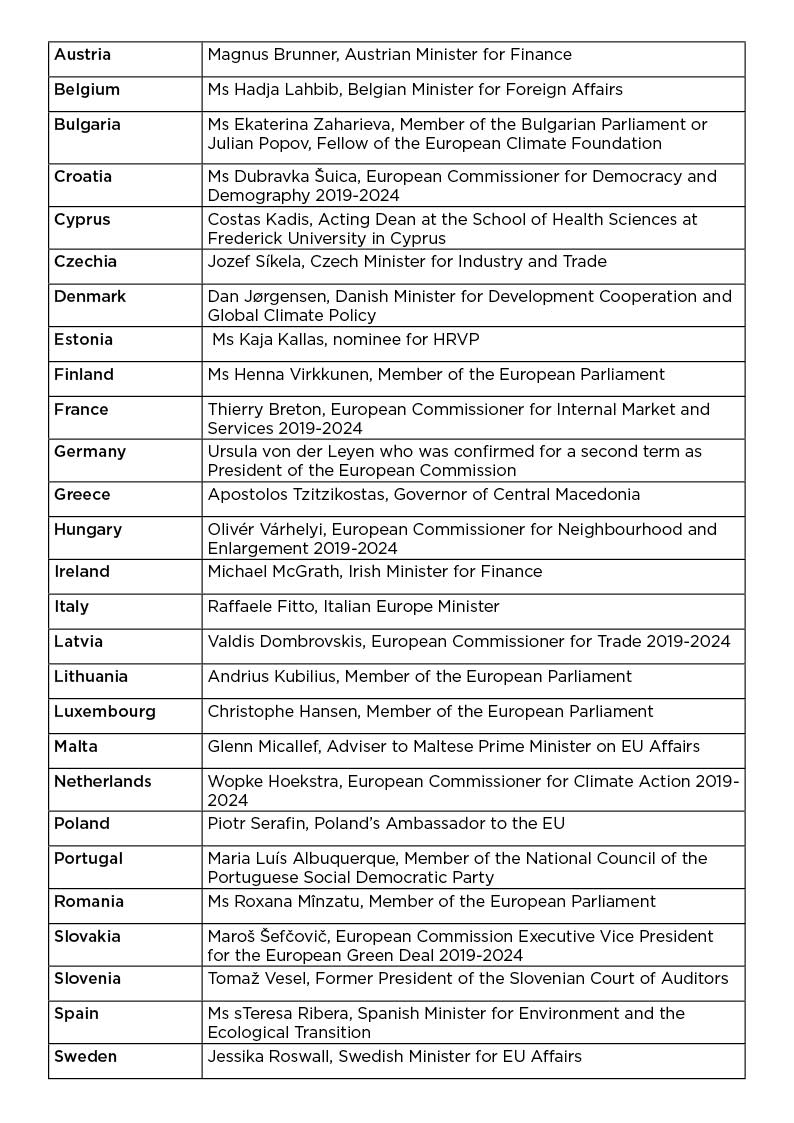
- Council of the European Union
An Informal Meeting of the General Affairs Council will be held on 2 – 3 September to address two interlinked priorities of the current Hungarian Presidency: boosting the EU’s competitiveness and tackling demographic challenges. The Council will look at the possibilities of enhancing competitiveness and rule of law through better law-making, examine the different aspects of competitiveness, and address demographic challenges during a working lunch.
- The European Parliament
On Wednesday, 4 September 2024, the committee in charge of environment, public health and food safety will discuss the EU’s emergency response actions to the outbreak of Mpox with the European Commission and the European Centre for Disease Prevention and Control (ECDC).
On the same day, the Budgetary Control Committee will discuss EU fraud and corruption investigations with Director-General of EU’s Anti-Fraud Office, Ville Itälä. The main fraud schemes detected in 2023 included collusion, the manipulation of procurement procedures, conflicts of interest, inflated invoices, the evasion of customs duties, and the illicit tobacco product trade by criminal networks.
The Parliament will also focus on the EU 2025 budget, as each committee will vote on their respective input to the Budget Committee’s draft report for the 2025 EU Agenda next week. MEPs hope for robust funding of EU programmes and sufficient money to be set aside for internal and external security and unforeseen challenges. The European Parliament will adopt its position in October and aims to reach an agreement with Member States before the end of 2024.
Lastly, EP President Roberta Metsola will preside over the Conference of Presidents meeting on Wednesday, 4 September 2024, where Mario Draghi will present his long-awaited report on the future of Europe’s competitiveness. The Conference consists of the President of the European Parliament, chairs of the political groups, and a representative of the Non-Inscrits (independent members).
President Metsola will attend the G7 Speakers’ Conference in Italy from 5 – 7 September 2024, which will focus on critical global issues including security, development, and the digital transition. She will deliver an opening address aimed at fostering international cooperation. The meeting will conclude with the adoption of a final Declaration, highlighting the shared commitments of the G7 nations.
Articles and Press Releases of Interest
- Economic portfolios are key in talks to choose new EU commissioners Euronews
- Von der Leyen pressures EU countries to swap women in as commissioner picks Euronews
- Defence firms need full access to EU cash as Putin haunts Europe, Draghi says Politico
- Renewed tensions between Belgrade and Pristina, EU deplores unstable situation Agence Europe
- 'European Court of Auditors' points to slow consumption of funds from EU's post-Covid-19 recovery plan Agence Europe
- The far-right’s disturbing success in eastern Germany Financial Times
29 July – 2 August 2024
This is the final EU Review before the summer break. The Institute of International and European Affairs would like to thank the readers for their loyal following and wish them happy summer holidays.
Activities in the EU Institutions
- The European Parliament
On Tuesday, 23 July 2024, the final vote on the distribution of committee chairs took place in the European Parliament. The 20 committees are responsible for drafting the Parliament’s positions on legislative proposals, preparing reports, organising expert hearings, and other tasks in their respective policy areas. The chairs are elected for two and a half years and ensure the smooth running of the committees’ work.
The following is a list of standing committees with their respective chairperson.
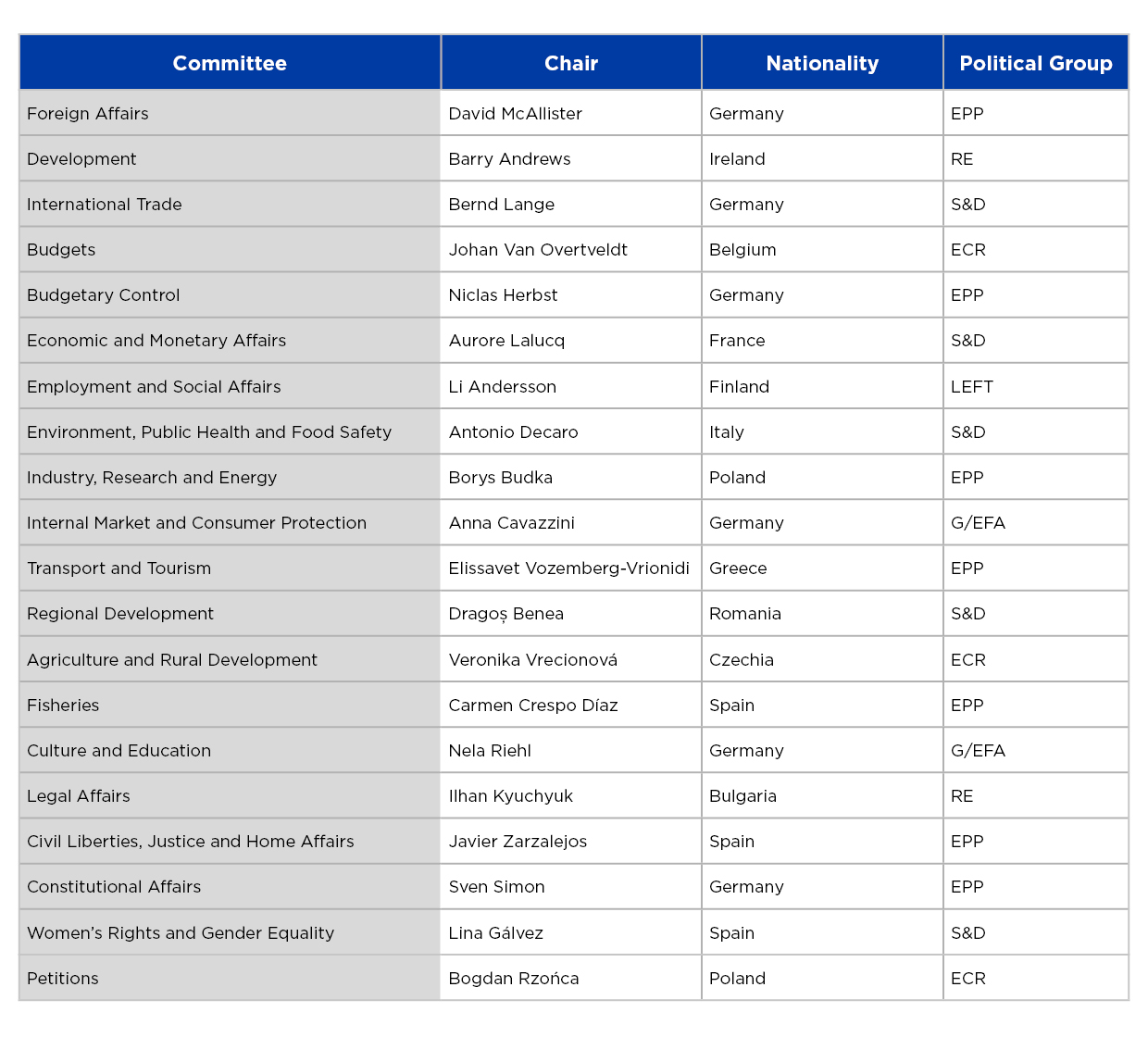
The timeline of further EU leadership renewal until the end of 2024 can be found here: Timeline to new EU institutional leadership (europa.eu)
The European Parliament will be in recess over the summer holidays from 25 July until 21 August 2024.
- The European Commission
On Friday, 26 July 2024, the European Commission made available the first payment of €1.5 billion in support of Ukraine generated on the interest of Russian frozen assets. The money will be channelled through the European Peace Facility, an off-budget funding mechanism for EU actions with military and defence implications under the CFSP, and the Ukraine Facility, a financial support mechanism that allows the EU to help Ukraine in its recovery, reconstruction and modernisation efforts.
The immobilisation of the Russian Central Bank's assets is a result of EU sanctions against Russia, which were adopted in the wake of its war of aggression against Ukraine. The extraordinary revenues generated will support Ukraine’s military capabilities and reconstruction.
- Council of the European Union
During last week’s Foreign Affairs Council meeting on 22 July 2024, EU HRVP Josep Borrell announced that the 28-29 August informal meeting of Foreign Affairs Ministers, also known as the Gymnich meeting, would be held in Brussels instead of Budapest. The step came in response to Hungarian Prime Minister Viktor Orbán’s controversial “peace missions,” which have included international trips and meetings with Vladimir Putin, Xi Jinping, and Donald Trump, and have resulted in several EU Member States deciding to downgrade their participation in informal meetings planned in Budapest during Hungary’s EU Presidency. Defending its position, Hungary has accused the European Union of having a “pro-war policy” by maintaining military and financial support for Ukraine.
Similarly, President von der Leyen has decided that the European Commission will be represented at senior civil servant level only during informal meetings of the Council and has called off the College of Commissioners’ visit to the Presidency, confirming that Brussels will not engage at the highest level in many events hosted in Budapest.
Articles and Press Releases of Interest
- 2024 Rule of Law Report: EU better equipped to face rule of law challenges European Commission
- Hungary brushes off ministerial no-shows at EU Council health summit Euronews
- Peace agreement with Russia would be a 'deal with the devil', top Ukrainian adviser says Euronews
- Russia’s surprising consumer spending boom Financial Times
- Tánaiste insists Michael McGrath is Ireland’s nominee for EU commissioner as Von der Leyen calls for male and female candidates Irish Independent
22 – 26 July 2024
Activities in the EU Institutions
- The European Parliament
On Tuesday, 16 July 2024, MEPs re-elected Roberta Metsola as President of the European Parliament for a second term until 2027. She won the election in the first round of voting with an absolute majority of 562 votes out of 699. There were two candidates for the position in total, the second one being Vice-Chair of the Left group, Irene Montero, who received 61 votes. After her election, President Metsola addressed the Parliament with pledges to step up border efforts and returns to curtail migration, boost Europe’s industry, enhance the EU’s competitiveness, and protect women’s rights. She also reaffirmed that Russia’s war of aggression against Ukraine remains at the top of the Parliament’s agenda.
Furthermore, the Parliament’s political groups reached a provisional agreement on the distribution of committee chairmanships, with the final vote taking place on Tuesday, 23 July 2024. There are 20 committees in the European Parliament, responsible for drafting the Parliament’s positions on legislative proposals, preparing reports, organising expert hearings, and other tasks in their respective policy areas. The chairs are elected for two and a half years and ensure the smooth running of the committees’ work.
While the results are still provisional, each political group is hoping and expected to win the chairmanship of the following committees:
- European People’s Party (EPP): Foreign Affairs; Civil Liberties; Budgetary Control; Industry, Research and Energy; Fisheries; Constitutional Affairs.
- Socialists & Democrats (S&D): Environment, Public Health and Food Safety; International Trade; Economic and Monetary Affairs; Regional Development; Women’s Rights and Gender Equality.
- Patriots for Europe: Transport and Tourism; Culture and Education.
- European Conservatives and Reformists (ECR): Budget; Petitions; Agriculture.
- Renew Europe: Development; Legal Affairs.
- Greens/EFA: Internal Market and Consumer Protection.
- Left: Employment and Social Affairs.
The timeline of further EU leadership renewal until the end of 2024 can be found here: Timeline to new EU institutional leadership (europa.eu)
The European Parliament will be in recess over the summer holidays from 25 July until 21 August 2024.
- The European Commission
On Thursday, 18 July 2024, Ursula von der Leyen was re-elected for a second term as President of the European Commission, receiving 401 votes in favour and 284 against in the European Parliament. The large majority support for her second five-year time is in contrast with her first election in 2019, where the minute margin of those in favour was only 9 votes. The re-election is a culmination of days of closed-door meetings with the Parliament’s main groups. While the European People’s Party (EPP), the Socialists & Democrats (S&D), and Renew Europe held enough seats for von der Leyen’s reappointment, disagreements within the groups caused her to seek additional support from the Greens and the European Conservatives and Reformists (ECR). Negotiations with the latter proved a controversial move for some progressives, who saw it as a threat to the centrist coalition, forcing von der Leyen to decline any structured cooperation with the hard-right and recommit to the Green Deal.
Along with strong references to climate action, Von der Leyen’s speech before the European Parliament on Thursday also featured plans for a new Commissioner for housing, a roadmap for women’s rights, a European Defence Fund, and a three-fold increase in Frontex personnel.
In response to Hungarian Prime Minister Viktor Orbán’s controversial “peace missions,” which have included international trips and meetings with Vladimir Putin, Xi Jinping, and Donald Trump, von der Leyen called for Europe to protect its own democracy instead of controlling dictators worldwide. Similarly, she said Europe has no influence over foreign elections and should instead invest in its own security and defence.
President Von der Leyen’s next step is to interview candidates for Commissioners and decide the structure of her new executive. Once the College is formed, the European Parliament will have to vote on its confirmation later this year.
- Council of the European Union
Foreign Affairs Council: 22 July 2024
Chaired by the EU HRVP Josep Borrell, the agenda of this Foreign Affairs Council will focus on the following three topics:
- Russia’s aggression against Ukraine: Ministers will hold an informal exchange of views with Ukrainian Minister of Foreign Affairs, Dmytro Kuleba.
- Situation in the Middle East: The Council will have a discussion on recent developments in the Middle East, focusing on EU’s humanitarian support for Palestinians.
- Current affairs: Ministers will touch on digital diplomacy, particularly the priorities for stronger EU action in global digital affairs, which were agreed on 26 June 2024. The digital diplomacy priority actions were decided in response to the rapid development of disruptive technologies and the need for the EU to protect its strategic interests and promote its human-centric approach to digital transition.
Conferences and Meetings of Experts
4th European Political Community Summit
On Thursday, 18 July 2024, the UK hosted the fourth European Political Community Summit in Blenheim Palace. European Leaders expressed their continued support for Ukraine, while many voiced concerns over the direction of the United States and whether the US would remain a reliable ally if Donald Trump won a second presidency. The security-focused Summit also discussed migration, energy security, and the threat from Russia, while newly elected UK Prime Minister Keir Starmer sought to rebuild relations between the UK and its EU neighbours. Besides taking a more active role in Ukraine’s fight against Russia’s invasion, Prime Minister Starmer’s priority is also to address the people-smuggling gangs that organise irregular migration. For this, he plans on working closely with Europol to enhance border security following his decision to scrap the Conservatives’ plans of sending UK migrants to Rwanda. He urged other European leaders to combine resources and share intelligence and tactics to shut down smuggling routes.
Articles and Press Releases of Interest
- Statement at the European Parliament Plenary by President Ursula von der Leyen, candidate for a second mandate 2024-2029
- MEPs approve numerical composition of committees and delegations Agence Europe
- Zelenskyy dismisses Orbán's 'peace mission' at big European summit Euronews
- Charles Michel reminds Viktor Orbán that rotating Presidency of EU Council does not represent Union internationally Agence Europe
- Keir Starmer’s Brexit reboot Politico
15 – 19 July 2024
Activities in the EU Institutions
- The European Commission
On Monday, 15 July 2024, the European Commission will hold a ceremony in Brussels, Belgium to designate 15 July as the EU Day for the Victims of the Global Climate Crisis. The day honours those affected by the climate crisis and serves as a call to action to minimise the impact of climate change and build resilience to protect the planet.
- The European Parliament
The European Parliament will hold a Plenary from Tuesday, 16 July 2024, to Friday, 19 July 2024.
Tuesday’s sitting will be dedicated to the election of the President and Vice-Presidents of the Parliament. As the incumbent President is the only candidate for the position, the decision will likely be taken by acclamation, in which case Roberta Metsola remains President of the European Parliament for another two and a half years. However, the new far-right groups of Patriots for Europe (PfE) and Europe of Sovereign Nations (ESN) could still propose a candidate by 15 July. Decisions on the number of MEPs that will be sitting in each parliamentary committee will also be taken at the Plenary session.
On Wednesday, 17 July, the Parliament will release a statement on the need for the EU’s continuous support for Ukraine, followed by the election of the Quaestors of Parliament. In the European Parliament, the Quaestors oversee the administrative and financial matters that directly affect MEPs, while the Parliament’s Rules of Procedure can also assign other duties.
On Thursday, 18 July, the sitting will focus entirely on the election of the President of the Commission, which will include a statement made by the candidate, current President Ursula von der Leyen. Commission President von der Leyen was proposed as candidate for a second term during the European Council meeting held on 27 June 2024. If MEPs do not elect Ursula von der Leyen as head of the Commission, their next opportunity to do so would be the 8 – 11 September 2024 session.
Friday’s sitting will see the Parliament announce the appointments to committees.
- Council of the European Union
Economic and Financial Affairs Council: 16 July 2024
As this is the first Economic and Financial Affairs Council of the Hungarian Presidency, Hungary’s priorities and work programme will be presented.
Then, ministers will take stock of the implementation of the Recovery and Resilience Facility, an instrument that provides grants and loans to support reforms and investment in Member States, which was established in response to the economic and social impact of the Covid-19 pandemic.
An update on the state of play of the economic and financial impact of Russia’s aggression against Ukraine will be provided, followed by an exchange of views on the Commission’s and ECB’s Convergence Reports, which examine whether Member States outside the euro area satisfy the necessary conditions to adopt the single currency.
The Council will also discuss the excessive deficit in the Stability and Growth Pact in Belgium, France, Italy, Hungary, Malta, Poland, and Slovakia. This Pact provides a set of rules to ensure Member States pursue sound public finances and coordinate their fiscal policies. The spotlight will also be placed on Romania, which has been under an excessive deficit procedure since 2020 and has not yet taken remedial action.
Conferences and Meetings of Experts
4th European Political Community Summit
On Thursday, 18 July 2024, the UK will host the fourth European Political Community Summit in Blenheim Palace to discuss Europe’s political and strategic future. The bi-annual 47-country forum will be hosted by the new British Prime Minister, Keir Starmer, to discuss the impediments to European security and prosperity. Notably, NATO, the OSCE, and the Council of Europe will attend for the first time ever, attesting to the importance of unity when responding to conflict and instability in Europe’s neighbourhood. Leaders will also discuss illegal migration and energy. On the outskirts of the Summit, PM Starmer will meet with Taoiseach Simon Harris and French President Emmanuel Macron as his new government seeks to rebuild relationships with key European partners.
Articles and Press Releases of Interest
- Joint statement by High Representative/Vice-President Borrell and Commissioner Várhelyi on the 29th anniversary of the Srebrenica genocide
- Moldova signs the EU's Joint Procurement Agreement to deepen health cooperation with the EU European Commission
- European security not possible without engaging Russia, claims Hungarian minister Euronews
- EU to boycott Hungary’s foreign affairs summit Politico
- MEPs will re-elect Roberta Metsola as President of European Parliament and vote on Ursula von der Leyen’s candidacy for Commission President Agence Europe
8 – 12 July 2024
- The European Commission
On Thursday, 11 July 2024, the European Commission will launch an event on the European Migration Network’s Annual Report on Migration 2023. The report outlines the key developments in the areas of migration and asylum for 2023, with the event providing an opportunity to analyse the 2023 migration trends further. Topics for discussion will include the Pact on Migration and Asylum, the sharp increase in irregular migration in the EU, the extension of the Temporary Protection Directive in response to the ongoing war in Ukraine, and others.
- The European Parliament
This week, political groups will be preparing for the opening of the Parliament’s tenth legislative term, which will take place on 16-19 July 2024. The session will begin with the election of the President of the European Parliament, which will be followed by MEPs electing their Bureau and deciding on the number of MEPs and composition of each parliamentary committee and delegation.
On Thursday, 11 July 2024, the political groups will hold a debate with Ursula von der Leyen, candidate for the Commission Presidency, and will then vote on her election in a secret ballot. The European Parliament is also expected to assess the outcome of the 27 June EU summit along with European Council President Charles Michel on Wednesday, 10 July 2024.
Parliament’s Conference of Presidents will decide the final draft agenda for the plenary session on Thursday, 11 July 2024.
- Council of the European Union
As of 1 July 2024, Hungary has taken over the Presidency of the Council of the European Union for the second time, which will end on 31 December 2024. Hungary, led by the Eurosceptic Prime Minister Viktor Orbán, will guide the work of the Council for the next six months and represent all Member States in negotiations with other EU institutions.
Hungary’s Presidency programme outlines 7 priorities:
- New European Competitiveness
Deal Given the recent economic difficulties the European Union has faced, including inflation, public debt, and high energy prices, it is crucial for the Union to improve its productivity and competitiveness to stimulate growth. The Hungarian Presidency aims to place a strong emphasis on improving European competitiveness and will integrate this objective into all policies. With the adoption of a New European Competitiveness Deal, Hungary hopes to improve economic development, sustainable growth, the internal market, support for small and medium-sized enterprises, the green and digital transition, employment sustainability, etc.
- The reinforcement of European defence policy
Bearing in mind the ongoing and emerging conflicts in Europe and its vicinity, the Hungarian Presidency hopes to improve its defence capabilities through strengthening the European Defence Technological and Industrial Base, including defence innovation and the enhancement of defence procurement cooperation between Member States.
- A consistent and merit-based enlargement policy
To preserve one of the most successful policies of the European Union, Hungary hopes to keep EU enlargement merit-based, balanced, and credible. Emphasis will be placed on the Western Balkans, the integration of which would benefit the EU’s economy, security, and geopolitical standing. Proposals include closing most chapters with Montenegro, opening a new cluster with Serbia, and setting up an intergovernmental conference with North Macedonia and Albania. However, according to media sources, there is little hope of progressing enlargement negotiations with Ukraine during the Hungarian Presidency.
- Stemming illegal migration
Given the migratory pressures Europe has been facing, the incoming Presidency aims to pay attention to the external dimension of migration including efficient cooperation with relevant third countries, more effective returns, and innovative solutions for rules on asylum. Furthermore, Hungary will highlight the importance of external border protection and the need for EU funds for this purpose.
- Shaping the future of cohesion policy
The Hungarian Presidency will work to reduce regional disparities and secure economic, social, and territorial cohesion throughout the Union. A well-structured and balanced cohesion policy is the key instrument in this regard.
- A farmer-oriented EU agricultural policy
The European agriculture is facing increasing challenges, including extraordinary weather conditions, growing costs, increased imports from third countries, and stringent production rules, all of which decrease the competitiveness of the sector. For this reason, the Hungarian Presidency will guide the new Commission in formulating the rules of the Union’s post-2027 agricultural policy for a competitive, crisis-proof and farmer-friendly agriculture. 7. Addressing demographic challenges Finally, Hungary wishes to draw attention to the challenges of an increasingly ageing European society, unsustainable social welfare systems, rural depopulation, and labour shortages.
Conferences and Meetings of Experts
Informal Meeting of Environment Ministers: 11 – 12 July 2024
This informal meeting will focus on climate and environmental issues, such as preparations for COP29, circular economy competitiveness, resilient water management, and water and air pollution.
Articles and Press Releases of Interest
- How France voted: Charts and maps Politico
- Far-right Patriots group springs to third force in European Parliament Euronews
- Europe's innovation performance steadily improving but at different speeds between Member States European Commission
- Viktor Orbán’s trip to Moscow is met with incomprehension by Europeans and Allies Agence Europe
- Spain’s far-right party Vox joins Viktor Orbán’s ‘Patriots for Europe’ Agence Europe.
1 – 5 July 2024
- The European Commission
On Tuesday, 2 July 2024, the European Commission announced an additional €1.2 billion investment package for infrastructure and support to entrepreneurship in the Western Balkans. This is the EU’s sixth investment package for the region under its Economic and Investment Plan for the Western Balkans. The package will support new flagship investments in water supply and sanitation, wastewater treatment, rail support, and innovation and green transformation in small and medium enterprises, all of which fall under three priorities of the Economic and Investment Plan: (i) Environment and Climate, (ii) Sustainable transport, and (iii) Support to the business sector.
- Council of the European Union
A European Council meeting was held on 27 & 28 June 2024, where EU leaders reached an agreement on the appointments and nominations for the EU’s leadership positions and adopted the 2024-2029 Strategic Agenda, among others.
António Costa, former Prime Minister for Portugal was elected as President of the European Council.
Current President of the European Commission, Ursula von der Leyen, was proposed as candidate for a second term. She will next need to be elected by the European Parliament by a majority of its members.
Kaja Kallas, current Primer Minister of Estonia, was chosen as the appropriate candidate for High Representative of the Union for Foreign Affairs and Security Policy. Her formal appointment is contingent upon the agreement of the president-elect of the European Commission.
The newly adopted Strategic Agenda, which was published on 27 June 2024, will aim to make Europe more sovereign in the 2024-2029 period and better equipped to deal with future challenges. It is based on three pillars: (i) a free and democratic Europe, (ii) a strong and secure Europe, (iii) a prosperous and competitive Europe.
Furthermore, EU leaders discussed the Union’s continued support for Ukraine, specifically calling for urgent increased support for its energy sector. Russia’s assets will remain frozen until it ends its war against Ukraine, while the Council also welcomed the swift disbursement of €1.89 billion in pre-financing to help with Ukraine’s recover and reconstruction. On Ukraine accession negotiations, EU leaders welcomed the adoption of the negotiating framework and agreed to work closely with Ukraine on its path towards EU membership.
Two other aspects of EU enlargement were discussed. Firstly, EU leaders addressed Georgia’s newly adopted law on the transparency of foreign influence, which led to the halting of its accession process. Secondly, a roadmap on future work on internal EU reforms to prepare the Union for enlargement was adopted, which includes protection of the rule of law, policies to ensure the EU’s long-term competitiveness, budget, and governance.
The latest developments in the Middle East were discussed, with EU leaders calling on all parties to take steps towards protecting civilian lives. Concern was expressed about the loss of civilian life due to the ongoing ground operation in Rafah. The leaders also welcomed the adoption of the UN Security Council resolution 2735, which outlines a three-phase ceasefire deal to end the war in Gaza and reaffirmed the urgent need for full access to humanitarian aid in Palestine.
On competitiveness, EU leaders reviewed progress made on initiatives to enhance competitiveness, secure economic resilience, and achieve the full potential of the single market. Specifically, they called for more work to be done on creating integrated markets and capital markets union.
Articles and Press Releases of Interest
- Opening remarks by President von der Leyen at the joint press conference with President Michel and Belgian President De Croo following the meeting of the European Council of 27 June 2024
- EU further extends the scope of sanctions on Belarus to fight circumvention European Commission
- Viktor Orbán, Herbert Kickl and Andrej Babiš announce their intention to form a new group in European Parliament Agence Europe
- Hungary's Orban announces plan to form new far-right bloc in European Parliament Euronews
- The Hungarian presidency: Let the games begin Politico
24 – 28 June 2024
- The European Commission
On Wednesday, 19 June, the European Commission proposed an annual EU budget of €199.7 billion for 2025, which will allow the Union to meet its political priorities and integrate the changes agrees in the mid-term revision of the Multiannual Financial Framework (MFF) in February 2024.
In order to create a more resilient Europe fit for the future, the EU will foster the green and digital transition, create new jobs while strengthening Europe's strategic autonomy and global role, and support key critical technologies.
In line with the MMF, the budget will also provide continued support for Syrian refugees in Türkiye, the Southern Neighbourhood, the Western Balkans, and Ukraine.
The Commission has proposed to allocate approximately €54 billion for the Common Agricultural Policy, €50 billion for regional development and cohesion, €16 billion to support EU partners and interests globally, and €13.5 billion for research and innovation, among others.
- Council of the European Union
Foreign Affairs Council: 24 June 2024
The 27 EU Foreign Ministers will meet at the Foreign Affairs Council, chaired by Josep Borrell, the EU High Representative for Foreign Affairs and Security Policy. The following topics have been placed on the agenda:
- Russia’s aggression against Ukraine, where Ukraine’s Minister of Foreign Affairs Dmytro Kuleba will join virtually to provide updates on the latest developments on the ground and most pressing needs. Furthermore, the Council will discuss further restrictions on the Russian economy and how to make the circumvention of EU sanctions more difficult.
- Situation in the Middle East, focusing on the humanitarian situation in Gaza, risk of spill over in the region, and the possibility of a ceasefire. In this context, the United States and France have been leading regional mediation efforts in Lebanon and Cyprus, which have been threatened by Hezbollah, and have mitigated confrontation between Israel and Hezbollah. Furthermore, US President Biden has tabled a roadmap to a ceasefire.
- Western Balkans, where an informal discussion will be held on strengthening common engagement on foreign and security policy.
- Georgia, particularly the political developments in the country, which includes the adoption and enforcement of the law on transparency of foreign influence. Ministers will also discuss next steps in case of a deterioration in the situation.
- Great Lakes Region, where Ministers will exchange views about the ongoing crisis in the Eastern DRC and its regional and geopolitical implications.
European Council: 27 – 28 June 2024
The most important topics on this European Council’s agenda will be the Strategic Agenda 2024-2029 and the next institutional cycle, Ukraine, the Middle East, security and defence, and competitiveness.
EU leaders will adopt the 2024-2029 policy plan that sets the EU’s direction and goals, also known as the Strategic Agenda. President Michel has led discussions throughout the year on the challenges and priorities to be included, which he based on three pillars: (i) a free and democratic Europe, (ii) a strong and secure Europe, and (iii) a prosperous and competitive Europe. A roadmap on internal reforms will also be adopted, which will run in parallel with the enlargement process.
Furthermore, leaders will decide the appointments for the next institutional cycle, including electing the President of the European Council, nominating the President of the European Commission, and appointing the High Representative of the Union for Foreign Affairs and Security Policy (HRVP). The frontrunners for these posts are former Portuguese Prime Minister Antonio Costa for the role of President of the European Council, Ursula von der Leyen for a second term as Commission President, and Estonian Primer Minister Kaja Kallas for the role of HRVP.
EU leaders will also discuss Russia’s war of aggression against Ukraine, the EU’s military support for Ukraine, and the use of Russia’s frozen assets for Ukraine’s reconstruction. Considering the first accession conference on 25 June 2024, Ukraine’s path towards EU membership will also be addressed.
In the context of the Middle East, EU leaders will discuss the situation in Gaza and the most important priorities including humanitarian assistance, an immediate and sustainable ceasefire, and the unconditional release of all hostages.
On security and defence, focus will be placed on the increase of the EU’s overall defence preparedness and capability and a strengthened defence technological and industrial base.
Competitiveness remains of great importance to the European Union, which will review progress made in securing economic resilience and achieving the full potential of the single market.
Conferences and Meetings of Experts
Accession Conferences with Moldova and Ukraine: 25 June 2024
The first two separate meetings of the Conference on Accession of the Republic of Moldova and Ukraine to the European Union will be held in Luxembourg at ministerial level. The EU will present both candidates with a general Negotiating Framework, which establishes the guidelines and principles for the accession negotiations
Accession Conference with Montenegro: 26 June 2024
This conference will take stock of Montenegro’s progress in meeting the interim benchmarks of the chapters on Rule of Law, Judiciary and Fundamental Rights, and Justice, Freedom and Security. Ministers will also provide guidance for the work ahead.
Articles and Press Releases of Interest
- Statement by President von der Leyen on opening accession negotiations with Ukraine and Moldova
- EU adopts 14th package of sanctions against Russia for its continued illegal war against Ukraine, strengthening enforcement and anti-circumvention measures
- Negotiators seal EU top jobs deal for von der Leyen, Costa and Kallas Euronews
- Macron warns of ‘civil war’ if far left or far right wins Politico
- EU High Representative threatens Tbilisi with measures Agence Europe
- Josep Borrell reiterates need for Western Balkans countries to align with EU’s Common Security Policy Agence Europe
17 – 21 June 2024
Activities in the EU Institutions
- The European Parliament
Following the results of the 2024 European elections, the European Parliament’s Conference of Presidents have met to assess the outcome. According to EP President Roberta Metsola, the 2024 European elections saw the highest voter turnout in 30 years, with participation rates increasing in 14 Member States since the last elections. The centre-right European People’s Party, which will continue to represent the largest political group in the Parliament, has confirmed that their lead candidate for the next Commission President is the incumbent, Ursula von der Leyen. President von der Leyen will attend the next EP Conference of Presidents’ meetings on 20 and 26 June for consultations ahead of the 27 – 28 June European Council. If an agreement is reached on a candidate, the EP Political Group leaders will exchange views on 2 July to determine the candidate’s ability to achieve the qualified majority in the Parliament to become the next Commission President.
Informal meeting of leaders: 17 June 2024
Following the European Parliament elections, EU Heads of State and Government will discuss the next institutional cycle 2024 – 2029. The European Council will designate the next high-profile EU-level roles, namely electing the President of the European Council, nominating the President of the European Commission, and appointing the High Representative of the European Union for Foreign Affairs and Security Policy. Three considerations: political affiliations, gender, and geographical balance will be taken into account in the deliberations on the distribution of the key posts. As the EPP got the best results in the European Parliament elections, it is expected that an EPP candidate will get the top job of President of the European Commission. Although Ursula von der Leyen was and is considered the front-runner, there has been no agreement yet on a candidate for the post of Commission President. The final decisions are more likely to be taken at the summit of EU leaders on 27 – 28 June.
For an overview of the major milestones in the decision-making process for the new leadership posts in the EU, please see the IIEA timeline here: Changing the Guard: A Timeline of Changes to the Leadership in EU Institutions in 2024 | IIEA
- The European Commission
On Wednesday, 19 June, the European Commission is set to provide policy guidance to EU Member States under the 2024 European Semester Spring package to help build robust and future-proof economies. The European Semester is a yearly exercise that helps identify EU countries’ most pressing economic and social challenges, along with policy responses. This year, the Commission’s focus is on the Union’s and Member States’ long-term global competitiveness, prosperity, and leadership. The package will take stock of the implementation of recovery and resilience plans and cohesion policy programmes, which will include country-specific recommendations on addressing socio-economic challenges and boosting EU competitiveness.
- Council of the European Union
Environmental Council: 17 June 2024
EU Environment Ministers will meet in Luxembourg to adopt the Nature Restoration Law, the first-of-its-kind regulation that aims to put measures in place to restore at least 20% of the EU’s land and sea areas by 2030 and all ecosystems in need of restoration by 2050. Specific measures include protecting pollinators and grassland butterflies, protecting urban green spaces and planting at least three billion additional trees by 2030 at the EU level.
General Affairs Council: 18 June 2024
Ministers in charge of cohesion policy will meet in Luxembourg to discuss the link between cohesion policy and the EU strategic agenda for 2024 – 2029, which is set to be adopted by the European Council on 27 June 2024. Ministers will discuss how to ensure cohesion policy continues to contribute to the EU’s strategic objectives and how to ensure all regions can participate in this process.
The Council will also approve the conclusions of the Commission’s communication on the 9th Cohesion Report, which assesses the state of play of the EU’s economic, social, and territorial cohesion. While highlighting upward economic and social convergence in many parts of the EU, it also points to the remaining disparities and challenges.
Conferences and Meetings of Experts
On track to 2030? Delivering on the Sustainable Development Goals in the EU: 18 June 2024
Since the UN’s adoption of the 2030 Agenda for Sustainable Development, the EU has been a frontrunner in implementing the 17 Sustainable Development Goals. Recently, the European Commission published the first-ever EU Voluntary Review on the implementation of the 2030 Agenda.
The high-level conference aims to increase political ownership of the SDGs at all governance levels, take stock of progress during the current Commission mandate, draw lessons from the EU Voluntary Review, discuss the next steps, and raise awareness about sustainable development as a priority for EU citizens.
G7 Summit: 13 – 15 June 2024 - Outcomes
At the G7 meeting in Italy, leaders identified today’s key challenges: (i) supporting Ukraine’s fight for freedom and driving up the costs of Russia’s war, (ii) pushing back on unfair economic practices, (iii) tackling the climate crisis and food and health insecurity, (iv) harnessing critical technologies for the benefit of all, and (v) working with partners around the world to support developing countries investing in their futures.
Focusing on Ukraine, G7 leaders announced a plan to provide $50 billion in new financing by bringing forward the interest earned on immobilised Russian sovereign assets held in the European Union and other jurisdictions. This new financing will provide critically needed support for Ukraine’s military, budget, and reconstruction needs.
Articles and Press Releases of Interest
- Speech by President von der Leyen at the opening plenary of the Summit on Peace in Ukraine
- Ukraine heading for accession impasse during Hungary’s EU Council presidency Euronews
- French far right: We won’t govern without an absolute majority Politico
- A Member State is not obliged to automatically recognise refugee status granted in another EU country, rules Court of Justice Agence Europe
- Russia overtook US as gas supplier to Europe in May Financial Times
10 – 14 June 2024
Activities in the EU Institutions
- The European Parliament
With voting stations for the European Parliament elections closed across the European Union, the provisional results have begun trickling in.
Pre-voting predictions expected a dramatic far-right surge, and although the far-right made significant gains, most of the EU ultimately did not follow that trajectory. The far-right emerged as victors in Austria, France, Germany, and Italy but underperformed in Hungary, the Netherlands, Sweden, and Portugal compared to pre-election predictions. However, the impact of the elections will be felt Union-wide. The top of the pyramid will remain largely unchanged, with the centre-right European People’s Party (EPP) remaining the largest group in the Parliament, followed by the centre-left Socialists and Democrats (S&D) in second and the liberal Renew Europe in third place.
The biggest change comes from decreased support for the Group of the Greens/European Free Alliance (Greens/EFA), which will move from fourth to sixth place, overtaken by the European Conservatives and Reformists Group (ECR) and the Identity and Democracy Group (ID). This wider arc of the far-right has collectively won 131 out of 720 seats.
While the far-right has achieved historical gains, the centre will continue to hold the majority. However, a more right-leaning legislature will likely shift the EU’s overall political centre towards the right. This could lead to more national control over key policies and a hardening of the EU’s position on issues such as immigration, Ukraine, and the green transition, with the Union’s ambitious climate agenda particularly under threat.
- The European Commission
On Wednesday, 12 June, the European Commission will present the EU Common Implementation Plan for the Pact on Migration and Asylum. After the Commission adopts the Pact, work will begin on translating the set of agreed legislative acts into an operational reality by mid-2026. The Common Implementation Plan will serve as a template for National Plans, which will be adopted by Member States by December 2024. Divided into ten building blocks, it includes a common migration and asylum data-storing system, a new system to manage migration at the EU’s external borders, fair and efficient asylum and return procedures, resettlement, inclusion, and integration, among others.
- Council of the European Union
Justice and Home Affairs Council: 13 – 14 June 2024
This meeting of home affairs and justice ministers will be separated into two sessions:
- HOME AFFAIRS
- The Presidency of the EU Council will provide an update on a legislative proposal to combat child sexual abuse, which would require internet companies to report online child sexual abuse on their platforms.
- Ministers will discuss extending temporary protection for those who fled Ukraine due to the war, which was activated in March 2022 and allows displaced Ukrainians to reside in the EU until March 2025.
- Following the recent adoption of the pact on asylum and migration, the European Commission will share its implementation plan to guide Member States in this process.
- The Presidency will report on progress in fighting drug trafficking and organised crime, as well as present priorities and achievements in preventing violent extremism and terrorism.
- JUSTICE
- The Presidency will brief ministers on efforts against drug trafficking and organised crime and will also aim to agree on a negotiation mandate for a directive on combatting corruption. This proposal, based on prevention, detection, and sanctions, unifies rules on corruption across public and private sectors at the EU level.
- The Council will seek approval for conclusions on enhancing and protecting free, open, and informed democratic debate. Additionally, the Presidency will provide a progress report on implementing the Istanbul Convention, which opposes violence against women and domestic violence.
Conferences and Meetings of Experts
G7 Summit: 13 – 15 June 2024
The G7 summit, hosted by this year's Italian G7 Presidency, is taking place in Apulia, Italy.
The EU will be represented by the President of the European Council, Charles Michel, and the President of the European Commission, Ursula von der Leyen.
The Summit will provide an opportunity for G7 leaders to demonstrate their strong determination to uphold the international order based on the rule of law, and to strengthen their engagement with developing nations.
A key issue will be whether the profits of Russian frozen assets should be used to support the defence of Ukraine.
The Summit will consist of 6 working sessions:
- Africa, climate change and development
- The ongoing situation in the Middle East
- Russia’s war of aggression against Ukraine
- Migration
- The Indo-Pacific and economic security
- Artificial Intelligence, energy, Africa-Mediterranean
Articles and Press Releases of Interest
- Commission proposes to extend temporary protection for people fleeing Russian aggression against Ukraine until March 2026
- Putin promises 'immediate' peace if Ukraine drops NATO bid and gives away Russian-occupied areas Euronews
- Le Pen, Wilders and allies meet in Brussels for talks on forming far-right EU supergroup Euronews
- Listed: Europe’s new MEPs Politico
- China’s support for Russia is ‘long-term threat’ to European security, warns G7 Financial Times
- Hungary fined by Court of Justice for unprecedented and “exceptionally serious” breach of EU law Agence Europe
- Macron calls snap elections as opposition declares his ‘crushing defeat’ Euractiv
27 – 31 May 2024
Activities in the EU Institutions
- The European Parliament
In the run-up to the European elections on 6-9 June 2024, the European Parliament has published some practical details on the election days and night. Several activities will take place at the European Parliament throughout the week, including daily media briefings, which will provide background information about the European elections and useful facts and figures about the Parliament. The EP will disclose details on its services to estimate results, measures to guarantee the elections’ integrity, transition to the next parliamentary term, including on pending legislative work, the election of the Commission President, and the procedure to appoint the next College of Commissioners.
On election night, there will be a special programme on EBS and streaming on Parliament’s Multimedia Centre starting at 4.30p.m., which will include a first set of available national estimates, the first projection of the new Parliament based on national estimates and pre-election polls, and the provisional results from some EU Member States.
Provisional European election results can only be published after 10.00p.m. (Dublin time), when the last voting polls in Italy have closed. Before then, estimations will be issued at approximately 7.30p.m. (Dublin time) based on pre-election and exit polls.
- The European Commission
European Commissioner for Cohesion and Reforms, Elisa Ferreira, will be visiting Germany to discuss the impact of Cohesion Policy funds on the ground and the future of the Policy. She will give a speech at the German Bundestag recounting how Cohesion Policy has reduced economic, social, and territorial disparities across the EU, and has been a key driver for economic growth.
- Council of the European Union
Foreign Affairs Council: 27 – 28 & 30 May 2024
Chaired by Josep Borrell, EU High Representative for Foreign Affairs and Security Policy, the Council’s agenda for the first day will highlight three pressing topics. EU Foreign Ministers will discuss:
- Russia’s aggression against Ukraine, which will include an informal exchange of views with the Minister of Foreign Affairs of Ukraine, Dmytro Kuleba, who will provide updates on the latest developments on the ground and Ukraine’s current priorities.
- Current affairs, specifically in Venezuela and its ongoing electoral process before the presidential elections on 28 July 2024, and in Georgia.
- The situation in the Middle East, where they will also informally exchange views with the Ministers of Foreign Affairs of Egypt, Jordan, Qatar, Saudi Arabi, and UAE, as well as the Secretary General of the League of Arab States.
On the second day, the Council will meet in its defence configuration to discuss the following:
- EU support to Ukraine, where Ministers of Defence will take stock of ongoing military initiatives in Ukraine and informally exchange views with NATO Secretary General Jens Stoltenberg and Rustem Umerov, Minister of Defence of Ukraine.
- Under current affairs, they will review the EU’s CSDP engagements, the EU Rapid Deployment Capacity, and the Permanent Structured Cooperation (PESCO), a treaty-based framework to deepen defence cooperation among Member States.
- Defence readiness with a focus on reinforcing the EU’s Defence Technological and Industrial Base and improved access to financing.
On 30 May, the Council will reconvene do discuss trade. Ministers will focus on:
- Trade and competitiveness and the future of EU trade policy against the backdrop of Enrico Letta’s high-level report on ‘Much More than a Market’ and in preparation for the next Draghi report on Europe’s competitiveness.
- EU-Africa trade and investment relations in their current states and how to deepen them towards a mutually beneficial partnership. They will also discuss partnerships on critical raw materials and synergies created through the Global Gateway strategy.
Articles and Press Releases of Interest
- Statement by the High Representative with the European Commission on the final adoption of the law on transparency of foreign influence in Georgia
- European elections: What do voters want? What do candidates promise? Euronews
- Top jobs timeline: What happens after the EU election Politico
- EU Policy. Climate action will boost energy security in Europe by 8% by 2030, IMF Euronews
- European energy ministers continue their work for a definitive exit from Russian fossil fuels Agence Europe
- Migration, Ukraine, competitiveness, defence and demography are the priorities of the future Hungarian Presidency of the Council of the EU Agence Europe
Tánaiste statement on Ireland’s formal recognition of the State of Palestine.
13 – 24 May 2024
Focus on Democracy
On 9 May every year, the EU Member States celebrate Europe Day, the anniversary of the signing of the Schuman Declaration in 1950. It is regarded as a day of reflection on the benefits of cooperation, which have brought peace and prosperity to the EU. This year, Europe Day took place ahead of the European Parliament elections, shifting the focus to democracy in Europe, which is seen as a legacy from previous generations, but which now needs to be protected against the rise of the right. In partnership with the European Parliament Liaison Office in Dublin, the Houses of the Oireachtas will lit up Leinster House and other locations to remind people of the importance of voting in the European Parliament elections, as the EP is a European Union legislative body directly elected by the people.
Activities in the EU Institutions
- The European Parliament
This week's EU Review will focus on the European Parliament elections rather than policy developments, as the EP held the last plenary session of its 9th term on 22-25 April 2024. MEPs have now left Brussels for their native countries to prepare for the elections on 6-9 June, when voters will choose the 720 members of the next legislature. Member States will hold their elections on different dates, with Irish voters going to the polls on 7 June. The IIEA has prepared a series of infographics which provide an easy visual guide to inform the public about the EP elections. Election results will be available on 9 June 2024. The European Parliament will continuously publish election results data from all Member States throughout the election night. The data will be composed of publicly available information from the Member States, made available in a harmonised format on the official election result website. The first plenary session of the new European Parliament after the elections is scheduled for 16-19 July 2023, when the EP has to approve the new Commission President proposed by the European Council by an absolute majority before breaking for the summer in August.
- European Commission
Impact of Climate Change on Security Practitioners: 21 May 2024
The European Commission will organise a workshop on the inevitable impact of climate change on international and domestic security affairs and related policy implications. It will include three panel discussions on the impact of climate change on communities and its consequences, on crime structures and rates, and on security practitioners’ business models.
Eurovision debate between lead candidates for the Commission presidency: 23 May 2024
The European Broadcasting Union will organise a debate between the lead candidates for the presidency of the European Commission.
The confirmed lead candidates are:
- Walter Baier, Austria, European Left
- Sandro Gozi, Italy, Renew Europe Now
- Ursula von der Leyen, Germany, European People’s Party
- Terry Reintke, Germany, European Greens
- Nicolas Schmit, Luxembourg, Party of European Socialists
The five candidates will answer questions on several key topics asked by the debate moderators, Martin Řezníček (Czech TV) and Annelies Beck (VRT, Belgium), the audience in the plenary chamber, and viewers watching from events organised by the Parliament’s Liaison Offices in the EU Member States. Further information and analysis is available on the IIEA website.
- Council of the European Union
General Affairs Council: 21 May 2024
Ministers will discuss the draft agenda in preparation for the upcoming European Council meeting on 27 – 28 June 2024. The European Council meeting will address the ongoing invasion of Ukraine, security and defence, competitiveness, the Union’s external relations, and the next institutional cycle. Furthermore, following the European Commission’s recent conclusion that there is no longer a risk of breach of the rule of law in Poland, the Council will also review developments related to the Article 7(1) TEU procedure concerning Poland. Related to this, an exchange of views will be held on the rule of law situation in Cyprus, Latvia, Lithuania, and Luxembourg as part of the annual rule of law dialogue. Lastly, in the run-up to the June 2024 European elections, the Presidency of the Council of the European Union will inform Ministers about its ongoing work related to foreign interference in the elections.
Conferences and Meetings of Experts:
- EU Defence Policy Directors Meeting: 17 May 2024
EU Defence Policy directors and representatives of various EU institutions will meet to discuss current security issues and the implementation of the Strategic Compass, a plan of action for strengthening the EU’s security and defence policy by 2030, which was approved by Member States in 2022 after the return of high-intensity war in Europe.
- 3rd Forum on the Mission on Adaptation to Climate Change: 23 May 2024
This annual forum aims to support EU regions, cities, and local governments in building resilience to the impacts of climate change, with a goal to guide 150 European regions towards climate resilience by 2030. The event is organised in cooperation with the European Commission and the Belgian Presidency and will discuss how Member States can support regional adaptation of solutions, how to integrate different funding sources, and risk assessment and preparedness.
Articles and Press Releases of Interest
- Speech by Taoiseach Simon Harris as Ireland recognises the State of Palestine
- Commission welcomes new sanctions against disinformation and war propaganda
- Statement by High Representative Josep Borrell with the European Commission on the adoption of the “transparency of foreign influence” law in Georgia*
- Europe's far right gathers in Madrid to kick off unofficial elections campaign Euronews
- EU mobilises assistance for Gaza via Cyprus Maritime Corridor
- EU split over ICC’s Israel and Hamas arrest warrants bid Financial Times
- How Russian disinformation could skew EU election — and whether Europe can fight it Politico
- Ukraine and EU push to start membership talks in June Politico
6 – 10 May 2024
Europe Day
On 9 May every year, the EU Member States celebrate Europe Day, the anniversary of the signing of the Schuman Declaration in 1950. It is regarded as a day of reflection on the benefits of cooperation, which have brought peace and prosperity to the EU. This year, Europe Day takes place ahead of the European Parliament elections, shifting the focus on democracy in Europe, which is seen as a gift from previous generations that now needs to be protected against the rise of the right. In partnership with the European Parliament Liaison Office in Dublin, the Houses of the Oireachtas will light up Leinster House and other locations to remind people of the importance of voting in the European Parliament elections, as the EP is a European Union legislative body directly elected by the people.
Activities in the EU Institutions
- The European Parliament
This week's EU Review will not refer to policy developments in the European Parliament, as the EP held the last plenary session of its 9th term on 22-25 April 2024. MEPs are now heading back to their native countries to prepare for the elections on 6-9 June, when voters will choose the 720 members of the next legislature. Member States will hold their elections on different dates, with Irish voters going to the polls on 7 June. The IIEA has prepared a series of infographics which provide an easy visual guide to inform the public about the EP elections. Election results will be available on 9 June 2024. The European Parliament will continuously publish election results data from all Member States throughout the election night. The data will be composed of publicly available information from the Member States, made available in a harmonised format on the official election result website. The first plenary session of the new European Parliament after the elections is scheduled for 16-19 July 2023, when the EP has to approve the new Commission President proposed by the European Council by an absolute majority before breaking for the summer in August.
- European Commission
Working Party on Enlargement and Countries Negotiating Accession to the EU: 7 May 2024
This meeting will focus on a presentation by the European Union Intelligence and Situation Centre (INTCEN) on Türkiye’s progress towards EU accession. Then, the Commission will provide information on the Technical Support Instrument pilot project aimed at accompanying efforts of candidate countries in tackling reform challenges by offering them technical expertise to enhance their capacity to carry out reforms and to foster the exchange of good practices across the EU. Lastly, the Commission will provide an update on the Leaders’ Summit on the Growth Plan, which will take place in Kotor, Montenegro, on 16 May 2024.
- Council of the European Union
Foreign Affairs Council in its development configuration: 7 May 2024
EU Development Ministers will convene to discuss the situation in Ukraine and the Ukraine Plan, which aims to unblock the disbursement under the first pillar of the Ukraine Facility for 2024-2027 – financial support in the form of €5.2 billion in grants and €33 billion in loans towards the reconstruction and modernisation of Ukraine as part of its accession process. The disbursement is conditional on the progress made on Ukraine’s reform and investment agenda. If approved, ECOFIN will take the implementing decision on 14 May. The next agenda item will be on the latest developments in Palestine and the call for an immediate humanitarian pause leading to a sustainable ceasefire.
In advance of the Council, EU High Representative Jossep Borell said that, to his knowledge, the President of the Commission had not responded to the letters from Ireland and Spain to call for a review of the EU/Israel Association agreement. EU Representative for Human Rights, Olaf Skoog, is in touch with the United Nations Special Representative regarding the situation on the ground and will present a report on this to the Council.
Lastly, Ministers will touch upon the EU’s relationship with Africa, emphasising the importance of an equal and respectful partnership with the continent. The Belgian Presidency will provide a briefing on a strengthened approach to global health and is expected to discuss preparations for the UN Summit of the Future on 22-23 September in New York on the margins of the United Nations General Assembly.
Conferences and Meetings of Experts:
- EU-Ukraine Defence Industry Forum: 6 May 2024
EU Institutions, Ministers and the defence industry will meet with their Ukrainian counterparts to explore ways to strengthen defence industrial cooperation between the EU and Ukraine. They will particularly focus on production capacity, the integration of the Ukrainian Defence Technological and Industrial Base into the European one, and cooperation in defence innovations. The overall aim of the conference is to contribute to the EU’s long-term support for Ukraine.
Articles and Press Releases of Interest
- Press statement by President von der Leyen following the trilateral meeting with French President Macron and President of the People's Republic of China Xi Jinping
- Speech by President von der Leyen in Katowice at the 16h European Economic Congres
- Commission intends to close Article 7(1) TEU procedure for Poland
- Moldova fights to free itself from Russia’s AI-powered disinformation machine Politico
- Georgia: The next domino to fall in the Kremlin’s undemocratic direction Politico
Council adopts Interinstitutional Agreement on the Growth Plan Agence Europe
22 – 26 April 2024
Activities in the EU Institutions
- The European Parliament
A European Parliament Plenary will take place from 22 to 25 April 2024 in Strasbourg, beginning with debates on prohibiting products made with forced labour on the EU market and on preventing and combatting the trafficking of human beings. The following day, 23 April 2024, discussions will focus on the conclusions of recent European Council meetings, particularly the new European Competitiveness Deal and the EU Strategic Agenda 2024-2029. Debates will also be held on the EU’s response to the killings of civilians, journalists, and humanitarian aid workers by the Israel Defence Force in the Gaza Strip, the use of Russian-frozen assets to support Ukraine’s reconstruction, and establishment of the Reform and Growth Facility for the Western Balkans. On Wednesday, 24 April 2024, the key debate will be on Iran’s unprecedented attack against Israel and the need for de-escalation and an EU response. A formal sitting will take place to celebrate the 20th Anniversary of the 2004 EU Enlargement. Frequently referred to as the Big Bang Enlargement, the following 10 countries were simultaneously welcomed as new Member States on 1 May 2004 during Ireland’s presidency of the Council of the European Union: Cyprus, Czechia, Estonia, Hungary, Latvia, Lithuania, Malta, Poland, Slovakia, and Slovenia. In the afternoon, the Parliament will hold a discussion on the far-right and conservative attempts to destroy the Green Deal, followed by debates on the directive, regulation, and establishment of the new Anti-Money Laundering Authority. On the final day of the Plenary, 25 April 2024, focus will be placed on the EU internal pre-enlargement reforms and policy reviews.
- European Commission
38th European Gas Regulatory Forum: 25 – 26 April 2024
The European Commission will host this expert meeting with EU national governments, gas suppliers, transmission system operators, and other stakeholders to discuss opportunities and challenges related to further development and decarbonisation of the internal EU gas market and its integration with other energy sectors. The European Commission will provide an update on the latest policy developments in the energy sector and introduce the EU legislation for hydrogen as adopted in the Gas Directive and Gas Regulation, which defines under which conditions hydrogen can be considered a renewable fuel and provides a methodology for calculating greenhouse gas emissions. A session will also be dedicated to taking stock of the situation the gas market finds itself in following the energy crisis, how far it has recovered, the role of gas storage, and whether there is a risk of market fragmentation.
- Council of the European Union
Foreign Affairs Council: 22 April 2024
In a joint session gathering the 27 EU Foreign Affairs Ministers and Ministers of Defence, the Council will discuss Russia’s aggression against Ukraine, which will include updates by the Ukrainian Ministers of Foreign Affairs and of Defence, Dmytro Kuleba and Rustem Umerov. After, the Council will discuss the situation in the Middle East and Sudan, the latter with the UN Envoy for Sudan, Ramtane Lamamra.
Conferences and Meetings of Experts:
- Unlocking Resilience in Belgium and Europe through Climate and Environment Risk Assessment: 22 April 2024
This conference will draw on the publication of the European Climate Risk Assessment report, which highlights the climate impacts and risks for Europe with the aim of supporting strategic policymaking. The conference will emphasise the importance of the report for enhancing the Union’s climate resilience and safety. It will also engage with various risk assessment centres across Europe to address shared challenges and opportunities.
Articles and Press Releases of Interest
- Statement by President von der Leyen at the joint press conference with Belgian Prime Minister De Croo and Enrico Letta
- Opening remarks by President von der Leyen at the joint press conference with President Michel following the meeting of the special European Council of 18 April 2024
- Enrico Letta - Much more than a market (April 2024)
- EU companies grapple with expiry of Russia sanctions carve-out Financial Times
- Germany arrests EU Parliament aide over bombshell China spying claims Politico
- Top EU diplomats put Serbia against the wall with Kosovo Euronews
- Georgia not ready for EU, says ruling party Politico
15 – 19 April 2024
Activities in the EU Institutions
On Thursday, Ireland’s new Taoiseach, Simon Harris, met EP President Roberta Metsola, Commission President, Ursula von der Leyen and European Council President, Charles Michel, in Brussels. Topics for discussion involved the situation of farmers in the EU, the agri-food industry, and the situation in Palestine. He also travelled to Warsaw, where he met with European Council President, Charles Michel, and Polish Prime Minister Donald Tusk for a discussion on the new Strategic Agenda in advance of the next Special European Council.
Enlargement remains a key topic on the EU Agenda in the run towards the European Parliament elections on 6-9 June. While the geostrategic importance of enlargement has seen renewed momentum in the Eastern neighbourhood and the Western Balkans, issues such as migration and the necessary reforms in both the EU and the candidate countries remain contentious. On 8 April, Minister of State at the Department of Tourism, Culture, Arts and the Gaeltacht, Thomas Byrne, TD, spoke at a conference at Charles University in Prague on EU Enlargement as a Success Story: The Cases of Ireland, Greece, and Lithuania. Ireland will be part of a Trio of Presidencies of the Council of the EU, commencing in the latter half of 2026, and the conference provided three geographically diverse perspectives on the benefits of enlargement for the three countries since their accession to the EU.
- The European Parliament
Last week, on 10 April 2024, the European Parliament approved the adoption of the EU Pact on Migration and Asylum, a set of new rules for migration management and establishing a common asylum system across the Union. First proposed to the Commission in September 2020, the Pact focuses on ensuring four main objectives: (i) secure external borders, (ii) fast and efficient procedures, (iii) an effective system of solidarity and responsibility, and (iv) embedding migration in international partnerships. In essence, it will regulate how EU Member States deal with people arriving at their borders, the processing of asylum claims, and the identification of those arriving from third countries.
The Pact also includes mandatory solidarity for EU Member States recognised as being under migratory pressure to improve burden-sharing, noting that some Member States receive disproportionate numbers of claimants. The new ‘fair share’ principle, based on 50% population and 50% GDP, will require less-burdened Member States to either provide financial contributions or offer relocations.
Helen McEntee, Irish Minister for Justice, welcomed the political Agreement, stating it will provide a balance between effective asylum and return procedures and protection for those who seek asylum. It will also ensure that applications from illegal migrants who are not entitled to protection will be processed swiftly, and those who are entitled can access their rights and protections in shorter timeframes. Such accelerated asylum processing was introduced in Ireland in November 2022 with new regulations for the fast processing of applicants from designated ‘safe’ countries of origin. Following the approval of the Pact by the European Parliament, Minister McEntee sought approval from the Government for Ireland to opt into the Pact measures in the first quarter of 2025. The Pact was described by Minister Mc Entee as an absolute game changer, as it will involve repealing the 2015 International Protection Act and introducing a new legally binding time frame for making decisions on international protection applications and appeals. There will be a greater focus on efficient return for unsuccessful applicants and quicker processing of those with no documents or those applying from safe countries arriving in ‘secondary movements’ from other Member States where they have already received asylum. She added that the enhanced screening and security checks, coupled with better information sharing via the Eurodac database, will enable the government to understand who the applicants are and where they come from and to ensure that those who genuinely need help will get it.
Committee on Foreign Affairs: 16 April 2024
The European Parliament and the European University Institute will host two panels: one on expectations for the EU enlargement process in 2024-2029 and its benefits for EU citizens, and one on the implications of future enlargement for the EU’s institutional reforms and Europe’s security. Afterwards, the Committee will hold an exchange of views with Mr Milojko Spajić, Prime Minister of Montenegro, on Montenegro’s accession to the Union, the functioning of its democratic institutions, the fight against organised crime and corruption, and the promotion of the rule of law and protection of fundamental freedoms.
Committee on the Environment, Public Health and Food Safety: 18 April 2024
The committee will hold an exchange of views on the Agreement Under the United Nations Convention on the Law of the Sea on the Conservation and Sustainable Use of Marine Biological Diversity of Areas Beyond National Jurisdiction, which was adopted in New York on 19 June 2023 and became open for signature on 20 September 2023. While all 27 Member States are signatories to the Agreement, the committee will hold a vote after the debate on the adoption of its draft recommendations.
- Council of the European Union
Special European Council: 17 – 18 April 2024
EU Heads of State and Government will meet to discuss four main topics of concern: (i) competitiveness and the single market, (ii) Ukraine, (iii) Türkiye, whose accession process was meant to be discussed at the European Council meeting on 21-22 March 2024, and (iv) the Middle East.
- Enrico Letta, the President of the Jacques Delors Institute, will join the Council for the first agenda item to present an independent report on the future of the single market. Leaders will then discuss how to enhance Europe’s economic, manufacturing, industrial and technical base, the opportunities for a climate-neutral, digital and circular economy, the capital markets union, and competitive, sustainable and resilient agriculture.
- In the context of the latest developments in Ukraine, EU leaders will address Russia’s continued air and missile attacks against Ukraine’s civilians and critical infrastructure, including the recent intensified targeting of the energy sector.
- The Council will also conduct a strategic debate on EU-Türkiye relations, particularly the state of play of their political, economic, and trade relations.
- Lastly, EU leaders will discuss the latest developments in the Middle East after calling for an immediate ceasefire in Gaza, the unconditional release of all hostages and the provision of humanitarian assistance at the previous European Council in March 2024. The recent Iranian drone and missile attacks against Israel will also be addressed, which the EU has warned are an unprecedented escalation and threat to regional security.
Informal Meeting of Energy Ministers: 15 – 16 April 2024
During the informal meeting, ministers will discuss advancing sustainable energy infrastructure and related challenges. The meeting will include three plenary session which will focus on coordinated grid planning, financing and de-risking infrastructure investments, and the scale- and speed-up of energy infrastructure.
Conferences and Meetings of Experts:
- Expert Conference on Effective Identity Management in the Area of Migration: 18 April 2024
This conference will bring together European experts in identity management, migration procedures, and combatting identity fraud to exchange information and best practices on security and migration, along with identifying challenges, to ensure efficient border management, legal migration, and return procedures.
Articles and Press Releases of Interest
- Statement by President von der Leyen at the joint press conference with President Metsola and Belgian Prime Minister De Croo on the adoption of the Pact on Migration and Asylum
- Statement of Commissioner for Energy Kadri Simson on record post-winter gas storage levels in Europe
- EU’s sanctions regime in turmoil after oligarchs win legal battle Financial Times
- How Russian state assets could yield tens of billions in cash for Kyiv Euronews
- Hungary won't rule out using veto during EU Council presidency Euronews
- MEPs reiterate their concerns about the situation in Slovakia Agence Europe
8 – 12 April 2024
Activities in the EU Institutions
- The European Commission
Anthony Whelan, who has worked as the Digital Advisor in the cabinet of Commission President Ursula von der Leyen since 2019, will temporarily assume the duties of Bjorn Seibert as chef de cabinet for the Commission President on 6 April 2024. Mr Seibert has taken temporary leave to manage Ursula von der Leyen’s campaign for a second term as President of the European Commission, returning to his post on 10 June after the European Parliament elections. Although von der Leyen is considered the frontrunner for the position, EU leaders must nominate her after the European Parliament elections, and a majority of MEPs must support her in a secret vote.
The Working Party on Frozen and Immobilized Assets will meet on 8 April to discuss progress on the use for the reconstruction of Ukraine. Following the March 2024 European Council, EU leaders agreed that the interest generated from frozen Russian assets could be disbursed to Ukraine for military purposes, reconstruction and peacekeeping missions globally. However, the €195 billion of capital held in a Belgian securities depository, Euroclear, is not being considered.
On Thursday, 4 April 2024, the European Commission welcomed the political agreement reached between the European Parliament and the Council of the European Union on the €6 billion Reform and Growth Facility for the Western Balkans. This unprecedented offer will allow the region to access some benefits of EU membership before accession and provide increased financial assistance in exchange for socio-economic and fundamental reforms in the rule of law and public administration. It is designed to assist the Western Balkans with economic convergence, better integration into the EU’s Single Market, and accelerated progress towards EU accession. The funds will consist of €2 billion in grants and €4 billion in concessional loans and will be released twice a year. Half of the loans will be dedicated to infrastructure investment and connectivity, such as transport, energy, and green and digital transitions. However, the payments by the European Commission are contingent on progress on necessary internal reforms and setting aside historical disputes. The political agreement now awaits formal approval by the Parliament and Council.
- Council of the European Union
Economic and Financial Affairs Council: 12 April 2024
EU Ministers will seek to adopt conclusions on the implementation of the Recovery and Resilience Facility, an EU initiative to mitigate the economic and social impacts of COVID-19. They will then discuss the state of play of the economic and financial impact of Russia’s aggression against Ukraine and seek to approve the Union’s mandate for the G20 2nd Finance Ministers and Central Bank Governors Meeting on 18 April 2024.
- European Parliament
The European Parliament will hold a Plenary on 10 and 11 April 2024.
On Wednesday, 10 April 2024, the Parliament will hold a joint debate on the Migration and Asylum package. The discussion will centre around screening of third-country nationals at EU’s external borders, asylum and migration management, and establishing a return border procedure and standards for the reception of applicants for international protection.
The Irish government has decided to opt into the Asylum and Migration pact and is one of only two EU member States that can do so, the other being Denmark under Article 3 of Protocol 21 attached to the TEU. Irish Minister for Justice secured Government approval to seek the agreement of the Oireachtas to opt into these measures. Once approved, Ireland will have two years to implement the legislation.
The European Commission will also make a statement about Russia’s undemocratic presidential elections and their illegitimate extension to the occupied territories. Later in the day, votes will be held on methane emissions reduction in the energy sector and strengthening CO2 emission performance targets. After voting, the Council of the European Union and the European Commission will make two statements on Chinese police activity in Europe and on the ongoing hearings against Hungary to determine whether there exists a breach of EU fundamental values of rule of law, civil liberties, and democracy within the Member State.
On Thursday, 11 April 2024, a joint debate will be held on the reform of the energy and electricity markets, particularly to establish common rules for the internal markets for renewable gas, natural gas and hydrogen, and to create stronger regulation of the Union’s electricity market design. A statement by the Council and Commission will follow on attempts to dismantle the rule of law and media freedom in Slovakia.
Conferences and Meetings of Experts:
- Multilingualism in the 21st Century: Challenges and Opportunities: 8 April 2024
This conference will bring together European experts specialising in linguistic and cultural diversity. Four round-table discussions will be held to discuss (i) multilingualism, democracy and interculturality, (ii) how to promote linguistic diversity and multilingualism within European institutions, (iii) the impacts and possibilities of AI in linguistic diversity, and (iv) young people as the future of linguistic diversity in Europe.
Articles and Press Releases of Interest
- Commission statement on Israeli commitments related to the opening of further humanitarian aid access points
- EU and US continue strong trade and technology cooperation at a time of global challenges
- EU’s power sector emissions plummet as renewables surge Politico
- EU warns candidate country Georgia over disputed ‘foreign agent’ law Politico
Cyprus declares migration crisis, calls for EU to help Agence Europe
2 – 5 April 2024
Activities in the EU Institutions
- European Commission
Good news on competitiveness, as the European Commission has selected 170 projects under the Technical Support Instrument (TSI) to help Member States design and implement more than 300 reforms in 2024, which will help strengthen their competitiveness, boost resilience, and enable modernisation. The reform areas are wide-ranging, including Artificial Intelligence application in businesses and public administration, the Green Deal Industrial Plan implementation, tackling brain drain, and supporting gender equality. The TSI programme was first introduced in 2021 and aimed at providing tailor-made technical expertise to EU Member States to help them mitigate the economic and social consequences of COVID-19. 780 projects and 1200 reforms have been implemented since then, with this year’s programme focusing on improving Member States’ administrative capacity, facilitating the digital transition and transition to a net-zero economy and strengthening collaboration among countries and regions. Ireland has received approval for support for 10 projects under the TSI in 2024.
- European Parliament
Committee on Employment and Social Affairs: 3 April 2024
The Committee will hold an exchange of views with the Moldovan Minister of Labour and Social Protection, Alexei Buzu, and a Member of Parliament of the Republic of Moldova, Marina Morozova. A debate will also be held on improving the working conditions of trainees within EU institutions.
Committee on the Internal Market and Consumer Protection: 3 April 2024
The Committee will discuss the implementation of the Digital Markets Act, an EU law aiming to make markets in the digital sector fairer and contestable. The discussion will centre around compliance with the Act and on app stores. Then, the European Union Agency for Fundamental Rights will present a report on “Enforcing consumer rights to combat greenwashing”. Greenwashing is a form of deceptive advertising or marketing an organisation uses to persuade the public that its products, aims, or policies are environmentally friendly.
- Council of the European Union
Informal Meeting of Transport Ministers: 3 – 4 April 2024
The 27 EU Ministers for Transport will hold an informal meeting to discuss greening transport, active mobility and cycling, and rail connectivity between European cities. A session will also take place about enhancing the resilience and financing of the trans-European transport network.
EU – US Trade and Technology Council: 4 – 5 April 2024
The Belgian Presidency of the Council of the European Union will host the sixth meeting of the Trade and Technology Council (TTC), which was founded in June 2021 and serves as a platform for the United States and the European Union to coordinate approaches to key global trade, economic, and technology issues. It also aims to deepen trade and economic relations based on their shared democratic values.
This year’s Council will focus on:
- The defence of transatlantic values as a response to Russia’s aggression against Ukraine. This includes discussing sanction enforcement in Russia, battling disinformation, and ensuring new technologies support democracy and the rule of law.
- Resilience and identifying countries whose technologies and investments should be avoided, particularly China.
- Competitiveness, which is often regarded as a domestic economic matter and risks pitting the EU and the US against each other. Still, considering they are the most integrated international economic partnership in the world and are based on high levels of mutual investment, the US and the EU are considering strengthening competitiveness to be a joint undertaking. This will also largely depend on their success in transitioning to a green economy.
European External Action Service
On 4 April, Sweden will attend a meeting of NATO foreign ministers as the most recent Member State to join the Organisation, bringing the total number of Allies to 32. The discussion will focus on the current situation in three key regions: (i) the Black Sea in the context of Russia's aggression against Ukraine, (ii) the Red Sea, where the EU has deployed mission EUNAVFOR ASPIDES and (iii) the South China Sea. Under the heading of the Indo-Pacific region, and following on from the recent veto by Russia at the United Nations Security Council to control North Korean ballistic missiles, a discussion will be held on Russian cooperation with North Korea to secure weapons to attack Ukraine.
Conferences and Meetings of Experts:
- Connecting Europe Days: 2 – 5 April 2024
This conference will bring together politicians, financial institutions, industry representatives, transport stakeholders and the European Commission to discuss concrete measures and exchange best practices on creating a decarbonised, resilient, seamless, and digital transport and mobility network in Europe, which would be in line with the European Green Deal.
Articles and Press Releases of Interest
- Bulgaria and Romania join the Schengen area
- 9th Cohesion Report shows that Cohesion Policy continues to narrow the gaps in EU regions and Member States
- Speech by President von der Leyen at the Annual Conference of the Forum for the Future of Agriculture
- 82% of Common Agricultural Policy (CAP) payments undermine EU climate targets, according to Nature Food Agence Europe
- Europe’s new energy risk: Trading Russia for America Politico
EU exits winter with gas storage at record levels Financial Times
25 – 29 March 2024
Activities in the EU Institutions
As reported last week, a European Council meeting was held on 21 and 22 March 2024 to discuss the most pressing issues facing the European Union, ranging from EU enlargement to the situations in Ukraine and the Middle East. Below are the conclusions adopted by EU leaders.
- The Council discussed Russia’s ongoing war of aggression against Ukraine and reaffirmed the Union’s unwavering political, financial, economic, humanitarian, military, and diplomatic support for Ukraine. EU leaders agreed to speed up and intensify military assistance, reviewed the progress made towards directing extraordinary revenues stemming from Russia’s immobilised assets for the benefit of Ukraine, and adopted the 13th package of sanctions against Russia. They also called on the High Representative and the Commission to prepare further sanctions against Belarus, North Korea, and Iran. Lastly, the European Council expressed its support for establishing a tribunal for the prosecution of the crime of aggression against Ukraine, welcomed the recent strengthening of the EU Advisory Mission in Ukraine, which will allow for the scaling up of reform in the context of it EU accession process, and agreed to continue to support Moldova and Georgia in strengthening their resilience and addressing the challenges they face as a consequence of Russia’s destabilising activities in the region.
- On security and defence, EU leaders expressed their commitment to increase their overall defence readiness and capabilities, including reducing their strategic dependencies, increasing defence expenditure, and improving the defence industry’s access to public and private finance.
- In the context of the situation in the Middle East, the Council called for an immediate humanitarian pause leading to a sustainable ceasefire, the unconditional release of all hostages, and the provision of humanitarian assistance. It welcomed the Amalthea Initiative opening a maritime route for emergency assistance from Cyprus to Gaza, which supplements land routes. The European Council also urged the Israeli government not to undertake a ground operation in Rafah, which would worsen the already catastrophic humanitarian situation and prevent the urgently needed provision of basic services and humanitarian assistance. It stressed that all parties must respect international law, including international humanitarian and human rights law, and the importance of respecting and implementing the 26 January 2024 order of the International Court of Justice, which is legally binding.
- Discussing EU enlargement, the Council agreed to address internal reforms at an upcoming meeting with a view to adopting conclusions on a roadmap by Summer 2024. Building on the Commission’s recommendation of 12 March 2024, the Council also decided to open accession negotiations with Bosnia and Herzegovina. Still, concerns were expressed about Bosnia and Herzegovina backsliding in reforms, particularly democracy and rule of law, though EU leaders inevitably agreed that the negative consequences of leaving the candidate outside of the European Union would be far greater than supporting its accession. Many also reiterated their concerns about the influence and activities of Russia and China in the Western Balkan region. Lastly, the Council welcomed Ukraine and Moldova’s progress in advancing on the necessary reforms and called on Georgia to advance on its outstanding priority reforms.
- EU’s external relations were touched upon, beginning with welcoming the newly agreed strategic and comprehensive partnership with Egypt and Mauritania. Furthermore, the Council expressed concern about the deteriorating situation in Haiti following waves of violence and welcomed the release of €20 million in humanitarian support. Focusing on Russia, the Council called for the release of all political prisoners and declared the Russian authorities responsible for the death of Alexei Navalny. Concern was also expressed over the deteriorating human rights situation in Belarus and the local elections on 25 February, which did not meet basic democratic standards.
- On migration, EU leaders noted that over 90% of irregular migrants enter the EU with the assistance of smugglers, leading them to support the Commission’s resolve to counter human trafficking and smuggling.
- In light of recent and ongoing farmers’ protests across the Union, the European Council underlined the importance of a resilient and sustainable agricultural sector for food security and the Union’s strategic autonomy. It called for simplified administration for farmers, strengthening their position in the food supply chain, and ensuring additional financial support and fair competition globally and in the internal market. Lastly, the Council agreed to address issues related to the Autonomous Trade Measures for Ukraine, which proved a very sensitive topic for many who contested the decision to renew the Measures until June 2025. Above all, EU leaders emphasised the need for finding a better balance between showing solidarity to Ukraine and supporting EU farmers.
- In the context of the evolving threat landscape, the Council underlined the need for enhanced and coordinated military and civilian preparedness and strategic crisis management. It called on the Commission and the High Representative to propose actions to strengthen preparedness and crisis response at EU level.
- Lastly, EU leaders addressed priorities for the 2024 European Semester, the EU’s annual exercise to coordinate economic, fiscal, employment and social policies. In this context, they endorsed the recommendation on the economic policy of the euro area, which was approved by the Council on 16 January 2024. It suggests that careful policy coordination is needed to support the smooth disinflation under way and to keep in place the conditions for a gradual recovery of the Euro-area economy. At the same time, more investment and innovation are considered essential to spur long-term growth and enhance productivity and competitiveness in the ongoing green transition.
A Special European Council will be held on 17 and 18 April 2024 to discuss EU competitiveness and address Türkiye’s accession prospects.
- Council of the European Union
Environment Council: 25 March 2024
EU ministers in charge of environment and climate will meet in Brussels to hold two policy debates on waste and on the proposal for a regulation on preventing plastic pellet losses to reduce microplastic pollution. An exchange of views on Europe’s 2040 climate targets will follow the debates.
Political and Security Committee: 26 & 27 March 2024
Over the course of the two days, the Committee will convene to discuss EU Security and Defence Partnerships with Norway, Albania, and North Macedonia, and assistance measures under the European Peace Facility to support the Armed Forces of Armenia, Georgia, Benin, and Ivory Coast. The Committee will also conduct a strategic review of the EU Training Mission in Mali and discuss the authorisation of the EU military operation in the Mediterranean.
Conferences and Meetings of Experts:
- Towards a Climate Neutral and Resilient Society in 2050: 26 March 2024
This informal ministerial meeting will foster a debate on post-2030 EU climate policy and encourage reflections among Member States on the European Commission’s assessment for a 2040 climate target for the EU, which was presented in February 2024. In it, the Commission recommends reducing the EU’s net greenhouse gas emissions by 90% by 2040 relative to 1990. In comparison, the 2030 climate target aims to reduce greenhouse gas emissions by at least 55%.
Articles and Press Releases of Interest
- Opening remarks by President von der Leyen at the joint press conference with President Michel following the meeting of the European Council of 22 March 2024
- As it happened: EU leaders discuss Ukraine aid, Gaza cease-fire in high-stakes summit Politico
- EU Member States decide to open accession negotiations with Bosnia and Herzegovina Agence Europe
- Radical right now unstoppable in EU's Inner Six, Euronews polls show Euronews
- Farmer fury puts EU support for Ukraine to the test Politico
- Commission proposes increased tariffs on Russian and Belarusian grain products
Future of Nature Restoration Law uncertain amid further dela
18 – 22 March 2024
Activities in the EU Institutions
The highlight of this upcoming week will be the European Council meeting on 21 and 22 March 2024. The following agenda items will be the focus of the two-day summit:
- EU leaders will discuss Russia’s ongoing war of aggression against Ukraine and reaffirm the Union’s unwavering political, financial, economic, humanitarian, military, and diplomatic support for Ukraine, which has amounted to €138 billion so far.
- On security and defence, the discussion will centre around Europe’s need to increase its defence readiness, how to strengthen the EU’s defence technological and industrial base, and further steps to make the defence industry more resilient and competitive.
- Following on from the European Council on 26-27 October 2023, the situation in the Middle East will be addressed to call for rapid, safe, and unhindered humanitarian access to the Gaza strip and stress the need for cooperation with partners in the region to avoid regional escalation.
- After EU leaders agreed to open accession negotiations with Ukraine and Moldova during the European Council on 14-15 December 2023 and expressed readiness to do the same with Bosnia and Herzegovina, once it achieves the necessary compliance with the membership criteria, this week’s Council will discuss EU enlargement policy and the latest developments in all three countries. The European Commission has also been invited to report on progress made thus far.
- EU leaders will also hold a discussion on migration, particularly on addressing its root causes, opportunities for legal migration, the effective control of EU external borders, partnering with countries of origin and transit, etc.
- In light of recent and ongoing farmers’ protests across the Union, an EU response to the current concerns in the agricultural sector will be discussed.
- Lastly, EU leaders will address priorities for the 2024 European Semester, the EU’s annual exercise to coordinate economic, fiscal, employment and social policies. In this context, they will be invited to endorse the recommendation on the economic policy of the euro area, which was approved by the Council on 16 January 2024. It suggests that careful policy coordination is needed to support the smooth disinflation under way and to keep in place the conditions for a gradual recovery of the Euro-area economy. At the same time, more investment and innovation are considered essential to spur long-term growth and enhance productivity and competitiveness in the ongoing green transition. The Irish Minister for Finance, Michael McGrath T.D., has welcomed the publication and the Commission’s Opinion on Ireland’s Draft Budgetary Plan, which states that Ireland is in line with the fiscal guidance provided by the European Council and its structural balance is projected to improve from -0.2 per cent of GDP in 2023 to 0.1 per cent in 2024.
EU leaders will also meet with their counterparts in the European Economic Area – Iceland, Norway, and Liechtenstein – to mark the 30th anniversary of their relationships.
- European Parliament
Subcommittee on Human Rights: 18 March 2024
In association with the European Parliament's Delegation to the Caribbean, an exchange of views will be held on the human rights situation in Haiti, notably in relation to migration.
Committee on Foreign Affairs: 20 March 2024
The Parliament will firstly vote on measures to facilitate consular protection for unrepresented citizens of the Union in third countries. Then, it will hold two debates on EU-UK foreign policy cooperation post-Brexit and joint efforts with the National Parliament of Ukraine to maximise sanction effectiveness and achieve the transfer of Russian assets to Ukraine.
- Council of the European Union
Foreign Affairs Council: 18 March 2024
Chaired by Josep Borrell, the EU High Representative for Foreign Affairs, the meeting will facilitate an informal exchange of views between the 27 EU foreign affairs ministers and the US Secretary of State, Antony Blinken. Special focus will be placed on Russia’s aggression against Ukraine, the situation in the Middle East, and the approach towards China and the Indo-Pacific. Ukraine’s Minister of Foreign Affairs, Dmytro Kuleba, will join the first part of the meeting to update his EU counterparts on the latest developments on the ground and Ukraine’s current priorities.
The Council is also expected to discuss the concept of green diplomacy, affirm the EU’s commitment to promoting a just and inclusive green transition, address the climate and security network in the context of the accelerating triple planetary crisis of climate change, biodiversity loss, and pollution, which is seen as both an existential threat and a security concern.
General Affairs Council: 19 March 2024
Ministers will prepare for the European Council meeting on 21-22 March 2024 and discuss its draft conclusions, focusing on the situation in Ukraine, security and defence, the Middle East, EU enlargement and the internal reforms needed for enlargement, and agriculture. Ministers will also review a report on the Council contributions to the 2024 European Semester, the EU’s framework for coordinating socio-economic policies.
Political and Security Committee: 19 & 20 March 2024
The Committee will convene on 19 March 2024 to review the European Union Advisory Mission to Ukraine, the updated CFSP Budget Report, and the military advice on the EU Programme of Exercises under the CFSP 2024-2028.
On 20 March 2024, HR/VP Josep Borrell’s proposal for a Council decision on an assistance measure to support the Georgian Defence Forces under the European Peace Facility will be discussed.
Conferences and Meetings of Experts:
- Convergence in Asylum Decision-Making – Taking stock and charting paths: 18 March 2024
This conference will bring together representatives from national determining authorities and judicial bodies to debate actionable steps for advancing the common asylum system, ensuring its fairness and efficiency, while fostering greater convergence as an attainable goal. The discussion is particularly pertinent in the context of the New Pact on Migration and Asylum, a set of regulations and policies to create a fairer, efficient, and more sustainable migration and asylum process for the European Union, which was agreed between the European Parliament and the Council in December 2023.
Articles and Press Releases of Interest
- Commission proposes to open EU accession negotiations with Bosnia and Herzegovina and updates on progress made by Ukraine and Moldova
- Ukraine prepares to join the EU club — but Brussels doesn’t want to talk about it Politico
- Commission proposes targeted review of Common Agricultural Policy to support EU farmers
- Foreign ministers back new Russia sanctions following Navalny’s death Politico
- EU reaches 'political agreement' to sanction Israeli settlers: Borrell Euronews
- Statement by High Representative Josep Borrell and EU Commissioner for Crisis Management, Janez Lenarčič, on famine in Gaza.
- Speech by President von der Leyen at the third Summit for Democracy
11 – 15 March 2024
Activities in the EU Institutions
- European Parliament
The European Parliament will hold a Plenary session from 11 to 14 March 2024. Preparations for the European Council meeting of 21 and 22 March 2024 are at the top of the agenda, including discussing EU’s continued support for Ukraine, security and defence, the unfolding situation in the Middle East, enlargement, external relations, migration, agriculture, and the European Semester, which coordinates the Union’s economic and social policies.
On Tuesday, 12 March 2024, the Plenary will hold sessions on pre-enlargement reforms and policy reviews, EU governments’ preparedness to combat foreign interference, and on climate risk assessment.
On Wednesday, 13 March 2024, debates will be held on the need to address urgent concerns regarding Ukrainian children forcibly deported to Russia and the implementation and outcomes of the Cohesion policy 2014 – 2020. The Plenary will also discuss the current international cases of breaches of human rights, democracy, and the rule of law: the immediate risk of mass starvation in Gaza and attacks on humanitarian aid deliveries, the repressive environment in Afghanistan, including public executions and violence against women, and political prisoners in Venezuela.
- Council of the European Union
Economic and Financial Affairs Council: 12 March 2024
The Council will hold a debate on social investment and reforms for resilient economies, discussing the impact of social investment on economic growth and fiscal sustainability. Then, Ministers will take stock of the Recovery and Resilience Facility (RFF), EU’s post-pandemic financial support programme, which has disbursed €224 billion to the Member States so far. An examination of the economic and financial consequences of Russia’s aggression against Ukraine will also take place, along with a discussion about implementing the Ukraine Facility, which will provide €50 billion to Ukraine until 2027. Finally, the Councill will start preparation for next year’s EU budget.
Political and Security Committee: 12 March 2024
The Committee will discuss the negotiation of a security and defence partnership between the EU and the Republic of Moldova and will review the first progress report on human rights and gender mainstreaming in the Common Security and Defence Policy (CSDP).
- European Commission
On 11 March 2024, the European Commission will hold a Debrief of the 13th WTO Ministerial Conference, which was discussed last week. Its purpose is to present the outcomes of the World Trade Organisation’s 13th Ministerial Conference and exchange views with EU civil society organisations. The Ministerial Conference took place in Abu Dhabi from 26 – 29 February 2024 to review the functioning of the multilateral trading system and take action on the future work of the WTO. After a week of intense engagement, EU negotiators secured important agreements on e-commerce, new rules to improve global services in trade, environmental cooperation, and strengthening the position of developing countries in the global trading system but failed to get agreement on agriculture and fisheries and on the reform of the now defunct dispute resolution mechanism.
Conferences and Meetings of Experts:
- Open Food Conference: 11 – 13 March 2024
On 11 March, during the Open Food Conference, the Commission will publish the Transition Pathway for the agri-food industrial ecosystem, which focuses specifically on the food processing industry as a key part of the food systems value chain. The pathway has been co-created by the Commission, Member States, and stakeholders such as industry associations and NGOs.
Taking a food systems approach, the pathway identifies challenges and opportunities specifically for this part of the value chain and proposes actions to boost its contribution to a competitive, sustainable, resilient, and fair EU agri-food system. It highlights that the food system's competitiveness and resilience require fair returns for all players in the value chain, smart sustainability investments to limit food inflation, support for the international attractiveness of EU agri-food exports, and implementation of circular business models.
- High Representative/Vice-President Josep Borrell travels to the United States: 11 – 15 March 2024
HR/VP Borrell will travel to New York and Washington D.C. to reaffirm the strength and dynamism of the EU-UN partnership and to strengthen EU-US relations. He will meet with UN Secretary-General António Guterres to discuss the situation in the Middle East and the latest developments of Russia’s aggression against Ukraine. On Tuesday, 12 March 2024, he will make his annual address to the UN Security Council on cooperation between the United Nations and the European Union, who remain the strongest partners in the field of peace and security. Mr Borrell will then travel to Washington D.C. to meet with US Secretary of State, Antony Blinken, to discuss the situation in the Middle East and reaffirm the EU and US’ joint support to Ukraine. Lastly, he will co-chair the EU-US Energy Council with EU Commissioner for Energy, Kadri Simson, US Secretary of State, Antony Blinken, and US Secretary of Energy, Jennifer Granholm.
Articles and Press Releases of Interest
- Speech by EPP lead candidate Ursula von der Leyen at the EPP Congress
- Europe's centre-right party clears path for von der Leyen’s re-election, despite some objection Euronews
- European socialists elect Nicolas Schmit as lead candidate to face off against Ursula von der Leyen Euronews
- EU makes major step forward in the delivery of 2024 humanitarian aid for Palestinians in Gaza
- Portugal swings right in knife-edge snap election Politico
Slovakia’s president warns Robert Fico is testing ‘limits of de
26 February – 1 March 2024
The final week in February will open with the European Parliament Plenary from 26 – 29 February 2024. As the 24 February marked two years of Russia’s aggression against Ukraine, the Plenary will restate the need for the EU’s unwavering support for Ukraine and hold a debate on establishing the Ukraine Facility, a new EU instrument that would provide predictable financial support to help Ukraine in its recovery, reconstruction, and modernisation. The discussion will then move to the Union’s financial activities, including the Multiannual Financial Framework 2021 – 2027, which is being geared toward new priorities, and to the annual reports from the European Central Bank and the European Investment Bank for 2023. Debates will also be held on transparency of political advertising and improving the EU’s protection against market manipulation in the energy market. The final day will focus on EU-Chile agreements on foreign affairs and international trade.
Following up from last week, an official seat for the European Authority for Anti-Money Laundering and Countering the Financing of Terrorism (AMLA) has been announced. The Council and the European Parliament reached an agreement on 22 February 2024, deciding that AMLA will be based in Frankfurt, Germany and begin operations in mid-2025 with over 400 staff members. The final agreement on the location was made by the co-legislators in an informal inter-institutional meeting at the political level. The Parliament and Council representatives voted together, and 27 votes were attributed to each co-legislator. Frankfurt won a majority of 28 out of 54 votes, while the runners up Madrid (16), Paris (6), and Rome (4) had emerged as other favourites. Intense lobbying was carried out ahead of the vote by all Member States in contention, particularly by France and Germany, with many using the allocation of top EU jobs after the June European elections as a bargaining chip. Germany argued that Frankfurt already had the foundations to guarantee the Agency’s success, considering it is also the site of the European Central Bank and because the proposed AMLA headquarters is only 15 minutes from the airport. Ireland was dealt a heavy blow when it was not included in the final shortlist, though Eva Maria Poptcheva, Parliament lead negotiator, claimed more than one political group favoured Dublin. This, however, was not enough, as the two biggest political forces in the parliament, the centre-right European People’s Party linked to Fine Gael and the centre-left Socialists, (S&D), excluded Dublin from their own favoured shortlists in internal negotiations. Now that Frankfurt has been chosen as the new AMLA headquarters, the path has been cleared for finalising new anti-money laundering legislation. The Agency hopes to begin hiring by the end of this year and expects to be at least partially operational by 2025.
Activities
- Council of the European Union
Agriculture and Fisheries Council: 26 February 2024
EU Ministers in charge of agriculture and fisheries will meet to discuss the need for rapid and structural answers to the current situation in the agricultural sector and the ministerial conference on Biosecurity and vaccination.
Foreign Affairs Council (Trade): 25 – 29 February 2024
The Foreign Affairs Council will meet in its trade configuration at the margins of the 13th Ministerial Conference (MC13) of the World Trade Organization in Abu Dhabi, where 164 countries will decide whether nationalist policies displace the multilateral rules-based order for global trade and commerce. Topics on the agenda include the decisions to eliminate overfishing of the world’s fish stocks, the future of digital trade, the extension of the e-commerce moratorium, and how countries can safeguard their food security. However, the context of the meeting will be gloomy due to the impact of the war in Ukraine on the fragmentation of the global economy, increasing populism and protectionism, and waning US support for an international trading system. The Council will seek the approval of a first set of conclusions at the start of MC13. Once there is sufficient clarity on the outcome of the Ministerial Conference, Ministers will seek the approval of a second set of conclusions and aim to adopt a decision on the position to be taken on behalf of the EU at the Conference. Simon Coveney TD, Irish Minister for Enterprise, Trade and Employment, will also attend MC13 to underline Ireland’s reform priorities on emerging challenges such as digital trade, sustainability, and climate.
The following conferences and meetings of experts will also take place throughout the week:
- Informal Meeting of Gender Equality Ministers: 26 – 27 February 2024
This meeting will be held at a pivotal moment just before the end of the current mandate of the European Parliament, as well as the approaching end of term of von der Leyen’s Commission with the first Commissioner specifically mandated with an equality portfolio. Ministers will be invited to reflect on the successes and lessons learned of the current European gender equality mandate and on how to accelerate progress on gender equality in the EU in the years ahead.
Articles and Press Releases of Interest
- Ursula von der Leyen announces re-election bid as Commission president Euronews
- Russia: two years after the full-scale invasion and war of aggression against Ukraine, EU adopts 13th package of individual and economic sanctions
- Putin banked €1B last year from EU fuel buys despite ban Politico
- Frankfurt to host the EU’s new anti-money laundering authority (AMLA)
- Farmers from 12 EU countries continue to protest agricultural policies Euronews
- Republic of Moldova: six individuals and one entity listed for undermining the rule of law, stability and security in the country
- Joint press statement following the 8th Association Council meeting between the EU and Georgia
EU Enlargement: How Albania's EU bid is driving economic change Euronews
19 – 23 February 2024
This week will commence with the Foreign Affairs Council on 19 February 2024, which will focus on four main agenda items. With the Council occurring only a few days before the second anniversary of the beginning of the war, EU Foreign Ministers will first discuss Russia’s continued aggression against Ukraine. This will begin with an informal exchange of views with Ukraine’s Minister of Foreign Affairs, Dmytro Kuleba. The second agenda item will turn to the situation in the Middle East and will include an informal exchange of views with the UN Senior Humanitarian and Reconstruction Coordinator for Gaza, Sigrid Kaag. Thirdly, the Council will be informed about the latest development in the Sahel and discuss its engagement with the region. Lastly, the Minister will have an opportunity to exchange views on current affairs, recent events, and fast-moving developments in external relations, with particular focus on Belarus.
The Foreign Affairs Council will be followed by the General Affairs Council on 20 February 2024. Ministers will begin preparations for the European Council meeting on 21 and 22 March 2024, where the agenda will include discussions on Ukraine, security and defence, the Middle East, the Strategic Agenda, and the economic policy of the euro area. Then, the meeting will turn to Article 7(1) of the Treaty on European Union (TEU) proceedings, taking stock of developments regarding rule of law in Poland. Enshrined in Article 2 of the TEU, the European Union is founded on a common set of values, which include the respect for the rule of law. According to Article 7(1) TEU, the Council of the European Union may determine that there is a clear risk of breach of the values referred in Article 2 by one of the Member States. The European Commission has invited the Council to determine that Poland is in breach of the rule of law due to a lack of independent and legitimate constitutional review and the adoption of new legislation, which raises concerns regarding judicial independence and increases the threat to the rule of law in Poland.
The European Parliament and the Council of the European Union will announce the seat of the Anti-Money Laundering Authority (AMLA) on 22 February 2024. This new European authority aims to protect EU citizens and the EU financial system against money laundering and terrorist financing. A final compromise text of the regulation establishing AMLA was published on 12 February 2024, with the headquarters of the Authority left to be determined by a joint vote on Thursday. The nine capital cities in contention are Brussels, Dublin, Frankfurt, Madrid, Paris, Riga, Rome, Vienna, and Vilnius.
Activities
- Council of the European Union
Political and Security Committee: 20 & 22 February 2024
The Committee will convene on 20 February 2024 to propose an indicative strategic orientation for the use of the Ukraine Assistance Fund in 2024, discuss the EU Programme of Exercises and Exercise-Related Activities under the CFSP 2024-2028, plan the implementation of Parallel and Coordinated Exercises between the EU and NATO for 2024-2025, and create a report for the European Parliament and Council on the implementation of the Action Plan on Military Mobility in 2022/2023.
On 22 February 2024, the Committee will discuss assistance measures under the European Peace Facility to support the Ghana Armed Forces.
The following conferences and meetings of experts will also take place throughout the week:
- Informal Meeting of Economic and Financial Affairs Ministers: 22 – 24 February 2024
This meeting will address the EU’s competitiveness challenge, which is a top priority for the Belgian EU Presidency. EU Ministers of Finance will examine how to organise public and private financing in Europe in the coming years. The three major debates will focus on the future of the European Investment Bank, retail investor participation in financial markets, and the report on the future of EU competitiveness by Dr Mario Draghi, former head of the ECB, which was published last week.
Eurogroup: 23 February 2024
During the Eurogroup, Finance Ministers of the Euro Zone Member States will discuss the Future of European Capital and Financial Markets, and the overall macroeconomic developments and prospects in the Eurozone.
Articles and Press Releases of Interest
- Joint statement by President von der Leyen and High Representative/Vice-President Borrell on the death of Alexei Navalny
- Updated Ukraine Recovery and Reconstruction Needs Assessment Released
- Germany’s Scholz wants European allies to up defense spending Politico
- EU 'very concerned' about Israeli plans for possible Rafah operation Agence Europe
- Agricultural organisations call on EU to tighten import restrictions on Ukrainian products Agence Europe
- EU recorded a 7.1% reduction in greenhouse gas emissions in the third quarter of 2023 while preserving its economic stability Agence Europe
12 – 16 February 2024
This week will mark the annual European Parliamentary Week, organised by the European Parliament and the Belgian Presidency of the Council of the EU on 12 and 13 February 2024. Parliamentarians from the EU Member Sae, candidate countries, and observer countries will convene to discuss economic, budgetary, and social matters, with the aim of strengthening cooperation between national Parliaments and the European Parliament. Two plenary sessions will be included, one on strategic investment and reforms for enhancing EU’s growth potential, and another on the future of the EU single market and taxation.
The plenary sessions are particularly important in the context of maintaining the spotlight on EU enlargement. While Ukraine and Moldova were swiftly given candidate country status in December 2023, the Western Balkans have seen limited progress on their EU path, with Albania and North Macedonia particularly lagging in their reforms. As the EU struggles to maintain accession momentum for the Western Balkans, President von der Leyen said that waiting for countries to accelerate their reforms is not enough; instead, the Union must participate in bringing candidates closer. Thus, a Growth Plan for the Western Balkans has been introduced to assist them in a progressive integration into the Single Market and establish a functional regional market, which would drive growth and fundamental reforms.
Activities
- Council of the European Union
Employment Committee: 12 – 13 February 2024
This meeting will focus on the preparation of a joint Employment Committee and Social Protection Committee opinion on the future EU social agenda, including governance aspects and the future of the EU’s cohesion policy.
Political and Security Committee: 13 & 14 February 2024
The Committee will convene to hold a strategic review of the European Union Advisory Mission in Ukraine and discuss CSDP, mediation and stabilisation options in Gaza.
The following conferences and meetings of experts will also take place throughout the week:
- Informal Meeting of Development Ministers: 11 – 12 February 2024
This meeting will convene Development Ministers from all 27 EU Member States, along with the High Representative of the European Union for Foreign Affairs and Security Policy, Josep Borrell, and European Commissioners Jutta Urpilainen and Janez Lenarčič to take stock of the EU’s development cooperation, current affairs, and internal preparatory discussions. There will also be a press update on the situation in Gaza by Commissioner general of UNRWA, Philippe Lazzarini, the Belgian Presidency of the Council of the EU, represented by Belgian Minister of Development Cooperation, Caroline Gennez, and HR/VP Joseph Borrell.
Informal meeting of the Social Protection Committee: 15 – 16 February 2024
This informal meeting will discuss the social situation and policy in the EU Member States and will debate on the European Pillar of Social Rights, which sets out 20 key principles for building fairer and better-functioning labour markets, as well as good welfare systems. The meeting aims to contribute to its objectives, with a specific focus on access to social protection.
Articles and Press Releases of Interest
- Germany looks to prevent far-right takeover of the judiciary Politico
- MEPs call to action to combat Russian interference Euronews
- Brussels recommends 90% emissions cut as the EU's 2040 climate target Euronews
- The Commission announces initial humanitarian aid of €1.8 billion for 2024
- MEPs call for a focus on conditionality in the allocation of the growth plan envelope to the Western Balkan countries Agence Europe
- Joint Statement: Sustainable economic growth in the EU and Canada through the Comprehensive Economic and Trade Agreement
29 January – 2 February 2024
Activities
- Council of the European Union
The key meetings of the 4th week of the Belgian presidency will be the General Affairs Council, the Special European Council, and the selection of the Anti-Money Laundering Authority seat.
- GENERAL AFFAIRS COUNCIL
The General Affairs Council (GAC), the first under the aegis of the Belgian presidency, will take place on 29 January 2024, chaired by Hadja Labib, Belgian Minister for Foreign and European Affairs. It will commence with the Belgian presidency presenting its work programme for files related to the GAC, which includes ongoing work on significant issues, such as EU enlargement, the next Strategic Agenda, and the Cohesion Policy. The implementation of the Cohesion Policy for 2021-2027 is already underway, and Ireland will benefit from €1.4 billion in Cohesion funding throughout that period. However, reflections on the future of Cohesion Policy post-2027 were already initiated in 2023 by the European Union Commissioner for Cohesion and Reforms, Elisa Ferriera, who established a high-level group of specialists chaired by L.S.E. Professor Andrés Rodríguez-Pose to reflect on the future shape of Cohesion Policy and future trends. In turn, the Irish Minister for Public Expenditure, Paschal Donohue T.D., launched a public consultation on the Future of the EU Cohesion Policy on 22 January 2024 and announced that a National Forum will follow later in the year.
The GAC agenda will focus particular attention on the EU maintaining unwavering support for Ukraine.
Ministers will then debate the new Defence of Democracy package, which aims to enhance transparency and democratic accountability and promote free, fair, and resilient elections and the participation of citizens and civil society organisations in policymaking. The package was launched on 12 December 2023 to shed light on and enhance transparency and accountability for covert foreign activities on behalf of third countries to influence policies, decision-making, and the democratic space in the EU. It is particularly important considering the forthcoming European Parliament elections in June this year.
Finally, as part of its annual Rule of Law Dialogue, the Council will also hold a country-specific discussion focusing on Spain, France, Croatia, and Italy.
- SPECIAL EUROPEAN COUNCIL
As a follow-up to the European Council meeting on 14 and 15 December 2023, EU leaders will hold a Special European Council on 1 February 2024 to discuss the mid-term revision of the EU’s long-term budget for 2021-2027, including support to Ukraine. In December 2023, leaders discussed how to finance our most pressing needs and future priorities. Thus, the majority of the additional €64.6 billion financial envelope should be spent on providing long-term stability to Ukraine by creating the Ukraine Facility (€50 billion), €2 billion for migration and border management, €7.6 billion for the neighbourhood and the world, €1.5 billion for the European Defence Fund, €2 billion for the flexibility instrument, and €1.5 billion for the solidarity and emergency aid reserve.
- European Parliament
SELECTION OF THE SEAT OF THE ANTI-MONEY LAUNDERING/COUNTERING THE FINANCING OF TERRORISM AUTHORITY (AMLA)
On Tuesday, 30 January 2024, the European Parliament will hold public hearings to determine which country will host the EU’s new Anti-Money Laundering Authority (AMLA). Nine Member States submitted applications in November 2023, suggesting a location most appropriate for the AMLA to fully execute its tasks and powers. These are Brussels, Dublin, Frankfurt, Madrid, Paris, Riga, Rome, Vienna, and Vilnius.
The criteria for selecting AMLA’s seat focus on the location’s ability to recruit highly qualified and specialised staff, offer adequate training opportunities, and allow for close cooperation with EU institutions. The European Union will also consider how Money Laundering/Terrorist Financing risks are addressed in each applicant Member State. Furthermore, the European Parliament and the Council will consider the accessibility of the location, appropriate access to the labour market, social security, medical care, and adequate educational facilities for children and spouses of AMLA’s staff, geographical balance, and the date when AMLA can become operational.
In its application, Ireland argued Dublin would be the ideal location to host AMLA as it is a multicultural city already home to a large globally interconnected European financial centre, is recognised as a technology powerhouse, and offers a range of new centrally located buildings. Furthermore, Ireland’s AML/CFT framework is internationally recognised, and its system of supervision is deemed one of the two best in the EU.
The European Commission submitted an assessment of the nine applications on 10 January 2024. In Ireland’s case, it noted the connectivity Dublin offers beyond Europe, particularly as a transatlantic hub, considering its airports are the only ones in the EU with US customs and border protection preclearance. Furthermore, the Commission acknowledged that locating AMLA in Dublin would provide an opportunity for Europe to reorient the architecture of its regulatory authorities away from the existing overconcentrated centres and would make a powerful statement that all Member States, including those on the periphery of Europe, can participate in creating the future of Europe.
The following conferences and meetings of experts will also take place throughout the week:
- High Level Group on Gender Mainstreaming: 29 – 30 January 2024
The High-Level Group on Gender Mainstreaming, jointly organised by the Presidency and the European Commission, brings together representatives of Member States in charge of gender equality and gender mainstreaming at national level twice a year to coordinate and exchange information regarding the implementation of the EU Gender Equality Strategy. This meeting will discuss financial independence of women as part of the follow-up to the Beijing Platform for Action, and emerging issues that could be considered in the future debate on gender equality policy at the European level.
- Meeting of the Network of the Directors General of the European Crisis Centres: 30 January 2024
The 10th plenary meeting of the network will take place to share expertise and lessons learned from previous crises, inform about challenges faced by individual EU Member States, improve crisis management at the European level, and promote rapid and efficient communication and cooperation in the event of a crisis with international ramifications.
- Informal Meeting of EU Ministers of Defence: 31 January 2024
Ministers will discuss current and emerging security threats, emphasising the need for a unified response to challenges ranging from hybrid threats to regional conflicts. Member States will also share updates on collaborative CSDP defence projects and initiatives, including joint research initiatives, procurement strategies, and efforts to streamline military capabilities across the EU.
Articles and Press Releases of Interest
- European Commission Statement on UNRWA
- ICJ: Joint Statement by the High Representative and the European Commission
- Speech by President von der Leyen at the Italy-Africa Summit
- Global Gateway: €10 billion commitment to invest in Trans Caspian Transport Corridor connecting Europe and Central Asia announced at Investors Forum
- State of the Union: Farmers' protests and the defence of democracy Euronews
- EU conservatives are fueling far right with Green Deal crusade, Spain’s deputy PM warns Politico
- What should the EU do to engage young voters? Euronews
22 – 26 January 2024
The Belgian Presidency’s third week coincides with the International Holocaust Remembrance Day on 27 January. To commemorate it, the European Commission, the Belgian Presidency of the Council of the European Union, and the International Holocaust Remembrance Alliance will organise the 2024 Holocaust remembrance conference: Remembering the past. Shaping the future, which will take place virtually on 23 January.
Monday, 22 November, marks the 61st anniversary of the Elysee Treaty which was signed by then President of France, Charles de Gaulle, and German Chancellor Konrad Adenauer. Following the death of former European Commission President, Jacques Delors, in December 2023, Europe has lost a second important figure, German politician, Wolfgang Schäuble, who was the longest-serving member of any democratic German parliament, former German Interior and Finance Minister and the 2017-2021 President of the Bundestag. Schäuble helped develop the Elysée Treaty throughout his career and helped create the Franco-German Parliamentary Assembly in 2019 to strengthen the Franco-German Alliance, which was regarded as the motor of integration in the EU. A state memorial service to commemorate his life and service is due to take place in the Bundestag on Monday, 22 January, at which European Commission President Ursula von der Leyen and President of France, Emmanuel Macron, will be among the speakers.
Articles and Press Releases of Interest
- Council approves EU priorities for use in all United Nations Human Rights Fora
- President von der Leyen calls for global collaboration in facing the challenges of our time at the World Economic Forum
- Speech by President von der Leyen at the European Parliament Plenary on the conclusions of the European Council meeting of 14-15 December 2023 and preparation of the Special European Council meeting of 1 February 2024
- Palestinian statehood a must, EU foreign ministers say in rebuke to Netanyahu Euronews
- Borrell accuses Israel of having financed Hamas to weaken Palestine El País
- Brussels considers allowing restrictions on Ukrainian grain in case of market 'disturbances' Euronews
- Slovak PM: Ukraine must give up territory to end Russian invasion Politico
- EU must invest about €1.5tn a year to meet net zero targets, says Brussels Financial Times
Activities
- Council of the EU
Foreign Affairs Council: 22 January 2024
The Council will discuss Russia’s war of aggression against Ukraine with the virtual attendance of the Ukrainian Minister of Foreign Affairs, Dmytro Kuleba the situation in the Middle East, in particular the catastrophic situation in Gaza, sanctions against extremist and violent settlers in the West Bank, ongoing tensions at the Israel-Lebanon border, and the need for peace and normalisation talks between Armenia and Azerbaijan. The Council will also seek to approve the conclusions on EU priorities in UN Human Rights fora in 2024.
Agriculture and Fisheries Council: 22 – 23 January 2024
As this is the first AGRIFISH Council under the Belgian Presidency, the Presidency will start the meeting by presenting its work programme in the field of agriculture and fisheries. Ministers will then discuss the future of agriculture and the Proposal for a Regulation on a Forest Monitoring Framework made by the Directorate-General for Environment on 22 November 2023, and exchange views on trade-related agricultural issues.
- European Parliament
European Parliament Plenary: 25 January 2024
This Plenary session will be held to commemorate International Holocaust Remembrance Day, with a formal address by Irene Shashar, a Holocaust survivor.
- Committees
Political and Security Committee: 23 & 25 January 2024
The Committee will convene to discuss five items of importance: (1) extending the mandate of Head of Mission of the EU CSDP mission in Mali (EUCAP Sahel Mali), (2) the six-monthly report of EU’s Naval Force Operation Atalanta, (3) the Final Exercise Report for EU Crisis Management Military Exercise 2023 (MILEX 23), (4) EU’s Mission in Armenia, and (5) the working document on the updated toolset for EU Conflict Analysis and Conflict Early Warning Objectives, Processes and Guidance.
Several meetings of experts will take place throughout the week:
- The Expert Seminar on European and International Policy Agendas in the Field of Children, Youth Affairs and Children’s Rights (21 to 23 January 2024) will foster a dialogue on coherence of the policy agendas related to youth, children, and children’s rights at the EU, Council of Europe, and at the UN level. The aim is to better align these policies and enhance their effectiveness across organisations.
- A European Urban Policy Fit for the Future meeting, held on 24 January 2024, where mayors of European capitals and large cities will present for signature a Brussels Declaration of Mayors to the European institutions. The declaration aims to provide recommendations for a strong European urban policy during the next mandate of the European Parliament and the European Commission.
- A Head of Medicine Agencies meeting, also held on 24 January 2024, where heads of national medicines’ regulatory agencies, the European Medicines Agency (EMA), and the European Commission meet twice during each presidency to discuss the coordination and consistency of the European medicine regulatory network.
- A 25 January 2024 Conference on Fair Mobility in the EU and the role of the European Labour Authority will discuss tackling undeclared work, facilitating the free movement of workers, improving access to information for workers and employers, and facilitating information exchange between Member States.
The Belgian Presidency will also hold a Civil Protection Workshop from 23 to 24 January to strengthen the discussion about the role of the Union Civil Protection Mechanism (UCPM), created by the European Commission and Member States in 2001 to assist countries affected by disasters including climate change-induced natural disasters, the COVID-19 pandemic, and Russia’s war of aggression against Ukraine. This week’s workshop will focus on an overview of the main challenges related to EU risk management, inter-sectoral cooperation, and recommendations for better effectiveness in the future.
In light of the 100th Anniversary of the World Organisation for Animal Health (WOAH), a Ministerial Conference on Animal Health will also be held on 24 January, with the aim of highlighting the importance of a preventive approach based on biosecurity and vaccination as tools in the fight against animal diseases. Particular attention will be paid to two diseases, African swine fever and avian influenza, and the advances in vaccination against them.
15 – 19 January 2024
One of the main highlights of the second week of the Belgian Presidency will be the European Parliament Plenary Session from 15 to 18 January in Strasbourg. Another event of interest will be the Belgian Renovation Week, (15-18 January 2024), which will emphasise the significance of renovation for a greener future. As buildings as the largest energy consumer in Europe, the focus will be on the strong drive for energy-efficient housing, and the need for creative solutions to counter carbon emissions. High-level discussion will centre around renovation challenges within the European Union, transitions in the building sector and the Energy Performance Certificate, reducing greenhouse gas emissions through strategic material choices, and the social aspects of energy renovation.
Following on from the Belgian Renovation week, a Brussels Cybersecurity Summit will be held on 18 and 19 January 2024. Cybersecurity has become a major political priority at the EU level, with increased cyber threats and a surge in EU initiatives and legislation. The summit will convene 500 key European policy makers and global experts in cybersecurity strategy, investment, and cyber threat intelligence to take stock of major dynamics and reflect on what the next five years will bring.
Articles and Press Releases of Interest
- Commission approves €126 million Romanian State aid scheme to support ports facing increased trade flows due to Russia's war against Ukraine
- 120 MEPs demand Hungary be stripped of its voting rights over Viktor Orbán's 'unacceptable' actions Euronews
- Hungary makes fresh demands in exchange for lifting veto on EU financial aid for Ukraine Euronews
- MEPs back in Strasbourg for first plenary session of 2024 focused on priorities of Belgian Presidency of EU Council and preparations for European Summit on 1 February AgenceEurope
- Speech by President von der Leyen in memory of the late Jacques Delors
Activities
- Council of the EU
Economic and Financial Affairs Council: 16 January 2024
The Belgian Presidency will present its work programme in the field of economic and financial affairs for the first semester of the year. Then, Ministers will proceed with work on the European Semester 2024, which aligns Member States’ budgetary and economic policies with EU rules, take note of the current economic and financial impact of Russia’s aggression against Ukraine, and provide guidance for further work on the G20 meeting of finance ministers and central bank governors on 26-29 February 2024 in Brazil.
Eurogroup: 15 January 2024
The Eurogroup work programme for the first half of 2024 will be presented for endorsement by Ministers. Then, the International Monetary Fund (IMF) will present the outcomes of its article IV staff visit to the euro area, an exercise in which the IMF reviews economic developments in the euro area, consults with policy makers and provides policy advice. Ministers will also discuss the draft recommendations on the economic policy of the euro area for 2024 and the external competitiveness of the euro area, with a focus on changes in energy prices.
- European Parliament
European Parliament Plenary; 15-18 January
The Plenary will open with a ceremony honouring the life of Jacques Delors, who served as the eighth President of the European Commission from 1985 to 1995. Belgian Prime Minister, Alexander De Croo, will then present the programme of activities of the Belgian Presidency. Other key debates will focus on military assistance to Ukraine, preparation of the Special European Council meeting on 1 February 2024, Hungary’s breaches of the Rule of Law and fundamental rights and systemic corruption in the management of EU funds, and maritime micro plastic pollution in the context of the recent ecological catastrophe in Spain, where over 1000 sacks of pellets fell from a Danish-operated merchant ship in to the sea off the coast of Galicia. An election will be held during the Plenary to replace the former Vice-President of the European Parliament Nicola Beer, who was appointed as Vice President of the European Investment Bank in 2024 under the leadership of Nadia Calvino.
- Committees
Political and Security Committee; 16 and 17 January
The Committee will convene to discuss the Crisis Management Concept for a possible EU maritime security Operation in the Red Sea and will also address the current situations in the Middle East and Ukraine. On 17 January, to Committee will carry out a strategic review of the European Union Advisory Mission (EUAM) in Iraq.
8 – 12 January 2024
2024 began with the official changeover in the Presidency of the Council of the European Union, as Spain passed the baton to Belgium, the second country in the trio of Presidencies, which will preside over the Council from 1 January to 30 June 2024. The Belgian Presidency’s slogan, “Protect, Strengthen and Prepare”, will guide them in fulfilling their six priorities:
- Defending the rule of law, democracy, and unity
- Strengthening the EU’s competitiveness
- Pursuing a green and just transition
- Reinforcing the social and health agenda
- Protecting people and borders
- Promoting a global Europe
Considering the final member of the trio to host the Presidency after Belgium will be Hungary, whose Presidency commences after the 6-9 June 2024 European Parliament elections, Belgian Prime Minister Alexander de Croo and Commission President Ursula von der Leyen have stressed the need to close as many outstanding files as possible before the end of the current Commission’s term of office. So, the first weeks of the Belgian Presidency are expected to be very busy from a legislative point of view. Preparing for a common future and stabilising aid for Ukraine were amongst the priorities outlined in a joint press conference between the two leaders during the traditional visit of the College of EU Commissioners to the country hosting the Council Presidency.
Articles and Press Releases of Interest
- Statement by President von der Leyen at the joint press conference on the occasion of the College visit to the Belgian Presidency
- Charles Michel to run for EU election, triggering top job scramble Politico
- EU elections could be major turning point for Europe's far-right Euronews
- Italy’s foreign minister calls for formation of EU army Euractiv
- A new era for corporate taxation in the EU enters into force today
- Europe Between 2 Wars – speech on 3 January 2024 by Josep Borrel, HRVP
First Activities of the Belgian Presidency
- Council of the EU
Informal meeting of employment and social affairs ministers; 10 – 12 January 2024
The Belgian Presidency will host its first major event in the field of employment and social policy. As is custom, each Presidency organises an informal Council meeting which brings together the ministers of EU Member States with the relevant European Commissioners, representatives of the European Parliament, ministers from the EFTA Countries as well as from two candidate countries, and representatives of the social partners and civil society.
- European Parliament
In the week of 8 January, Members' work will be split between meetings in Parliamentary Committees (on Budget, Economic and Monetary Affairs, Employment and Social Affairs, the Environment, Public Health and Food Safety, and Culture and Education) and meetings of political groups. The highlight of the week will be the exchange of views with Executive Vice-President Dombrovskis and Commissioner Gentiloni in the Committee on Economic and Monetary Affairs.
- Delegations
The Delegation to the EU-Albania Stabilisation and Association Parliamentary Committee will convene on 11 January to discuss the impacts of the war in Ukraine on the Western Balkans, the 2023 Communication on EU Enlargement Policy, EU Candidate Countries’ & Potential Candidates’ Economic Quarterly (CCEQ), climate challenges for the Western Balkans, China’s strategic interests in the Western Balkans, and others.
11 December – 15 December 2023
Articles and Press Releases of Interest
- Opening remarks by President von der Leyen at the international conference ‘Demography Dynamics: Navigating Europe's Future'
- Statement by President von der Leyen at the joint press conference with President Michel following the EU-China Summit
- Georgians rally for EU candidacy amidst political tensions Euronews
- Artificial intelligence act: Council and Parliament strike a deal on the first rules for AI in the world
- Serbia-Bulgaria interconnector to reduce dependence on Russian gas Euractiv
Monday, 11 December
Council of the EU – Spanish Presidency
- Agriculture and Fisheries Council
- Foreign Affairs Council
- Eastern Partnership Foreign Affairs Ministerial Meeting
European Parliament
Parliamentary Committees
- Committee on Foreign Affairs
- Committee on Budgets
- Committee on Agriculture and Rural Development
European Commissioners’ Activities
- Mr Janez Lenarčič participates in the UN OCHA’s launch of the 2024 Global Humanitarian Overview; meets Ms Mirjana Spoljarić, President of the International Committee of the Red Cross (ICRC)
- Mr Olivér Várhelyi receives Minister of Foreign Affairs of Georgia, H.E. Mr Ilia Darchiashvili
- Mr Paolo Gentiloni Participates in the 13th Recovery and Resilience Dialogue with ECON and BUDG committees of the European Parliament
- President von der Leyen meets with Ms Roberta Metsola, President of the European Parliament
- Mr Wopke Hoekstra participates at COP28 and closing plenaries in Dubai
Tuesday, 12 December
Council of the EU – Spanish Presidency
- General Affairs Council
European Commissioners’ Activities
- Vice-President Suica participates in the European Parliament Plenary debate on the "Defence of democracy package"
- Ms Stella Kyriakides participates in a European Parliament Plenary Debate on the European Health Data Space
- Ms Stella Kyriakides participates virtually in the handover meeting of the G7 Presidency
- Ms Vĕra Jourová meets with Ms Marija Pejčinović Burić, Secretary General of Council of Europe
Wednesday, 13 December
Council of the EU – Spanish Presidency
- EU-Western Balkans Summit
European Parliament
Delegations
- The Delegation for relations with the People's Republic of China (D-CN) will hold an exchange of views with Niclas Kvarnström, the newly appointed Managing Director for Asia and the Pacific, EEAS.
European Commissioners’ Activities
- Vice-President Schinas receives Tony Estanguet, President of the Organizing Committee for the Paris 2024 Olympic and Paralympic Games
- President von der Leyen participates in EU-Western Balkans Summit
- Ms Iliana Ivanova participates in the trialogue on Partnership for Research and Innovation in the Mediterranean Area (PRIMA)
- Mr Paolo Gentiloni participates in the Eurostat General Assembly in Luxembourg
Thursday, 14 December
Council of the EU – Spanish Presidency
- European Council
European Parliament
Delegations
- The Delegation to the ACP-EU Joint Parliamentary Assembly will hold a preparatory meeting for the four upcoming constitutive meetings of the Organisation of African, Caribbean and Pacific States (OACPS)
European Commissioners’ Activities
- Ms Ylva Johansson participates in the Global Refugee Forum 2023, hosted by the UN Refugee Agency
- President von der Leyen participates in the EPP Summit
- President von der Leyen participates in the European Council meeting
- Mr Maroš Šefčovič participates online in the European Initiative for Energy Security launch event
- Vice-President Schinas meets with Thomas Bach, President of the International Olympic Committee
- Vice-President Suica participates in the EPP Statutory Summit
Friday, 15 December
Council of the EU – Spanish Presidency
- European Council
European Commissioners’ Activities
- Vice-President Schinas participates to the Horn of Africa Initiative Ministerial meeting
- Mr Janez Lenarčič delivers the EU plenary intervention at the Global Refugee Forum 2023
- President von der Leyen participates in the European Council meeting
- Mr Nicolas Schmit meets Mr Gordan Grlic Radman, Croatian Minister of Foreign and European Affairs
4 December – 8 December 2023
Articles and Press Releases of Interest
- EU endorses key Relief, Recovery and Peace initiatives of the COP28
- Speech by President von der Leyen at COP28 on tripling renewable energy and doubling energy efficiency by 2030
- EU budget dispute threatens €50bn war lifeline for Ukraine Financial Times
- Speed up the accession process, Ukraine tells the EU Euronews
- Brussels, my love? Why far-right movements are simmering across Europe Euronews
- EU and European Bank for Reconstruction and Development commit to accelerate green investments in partner countries
Monday, 4 December
Council of the EU – Spanish Presidency
- Justice and Home Affairs Council
- Transport, Telecommunications and Energy Council
European Parliament
Parliamentary Committees
- Committee on Foreign Affairs
- Committee on Civil Liberties, Justice and Home Affairs
- Committee on the Environment, Public Health and Food Safety
- Committee on the Internal Market and Consumer Protection
- Committee on Employment and Social Affairs
- Committee on Economic and Monetary Affairs
- Committee on Budgetary Control
- Committee on Culture and Education
Delegations
- The Delegation to the EU-Türkiye Joint Parliamentary Committee (D-TR) will hold an exchange of views ahead of the 80th EU-Türkiye Joint Parliamentary Committee meeting in Ankara (19-20 December 2023), with H.E. Ambassador Faruk KAYMAKCI, Permanent Delegate of Türkiye to the EU, Mr Bernard BRUNET, Head of Unit - Türkiye, DG NEAR, European Commission, and Ms Baiba ALEKSEJUKA-TAVARESA, Head of Division, Türkiye/East Med, European External Action Service.
- The 27th meeting of the Delegation to the EU-Chile Joint Parliamentary Committee (D-CL) will discuss the political, economic and social situation in the EU and Chile, bilateral cooperation in the framework of the investment portfolio of the Global Gateway EU-LAC, the constitutional referendum of 17 December 2023 in Chile, organised crime and terrorism, enhanced cooperation between the European Parliament and the Chilean Congress, and the new Advances Framework Agreement EU-Chile.
European Commissioners’ Activities
- Ms Vĕra Jourová speaks at the 25th EU-NGO Human Rights Forum 2023
- Ms Vĕra Jourová receives Ms Nada Al-Nashif, UN Deputy High-Commissioner for Human Rights
- Mr Maroš Šefčovič delivers a keynote speech at the high-level opening of the Just Transition Pavilion at COP28
- Mr Maroš Šefčovič co-chairs the Global Methane Pledge Ministerial meeting
- Ms Kadri Simson participates at the COP28 EU Energy Days’ Opening event’s High-level panel “Powering the clean energy transition”.
- Ms Kadri Simson delivers a Keynote speech and participates in the panel at the COP28 EU Energy Days Clean energy partnership dialogue "Rebuilding energy sector of Ukraine and fighting energy terror worldwide through decarbonisation & sustainability".
- Vice-President Schinas delivers via videoconference a keynote speech at the “Greece and Cohesion Policy post 2027: Regional Development and Prosperity” conference organised by the Ministry of Economy and Finance of Greece
Tuesday, 5 December
Council of the EU – Spanish Presidency
- Justice and Home Affairs Council
- Transport, Telecommunications and Energy Council
European Parliament
Delegations
- The 27th meeting of the Delegation to the EU-Chile Joint Parliamentary Committee (D-CL) will discuss the political, economic and social situation in the EU and Chile, bilateral cooperation in the framework of the investment portfolio of the Global Gateway EU-LAC, the constitutional referendum of 17 December 2023 in Chile, organised crime and terrorism, enhanced cooperation between the European Parliament and the Chilean Congress, and the new Advances Framework Agreement EU-Chile.
European Commissioners’ Activities
- Mr Maroš Šefčovič participates in the high-level event on ‘Ukraine’s path to net zero’ at COP28
- Ms Iliana Ivanova delivers a video message at the Women and Girls in STEM Forum
- Ms Vĕra Jourová speaks at the event Human Rights 75 – Cine-ONU: Reasons for Hope by Dr. Jane Goodall
- Ms Kadri Simson participates at the COP28 Panel discussion “Is the European Green Deal delivering – and what's next?”, organised by Ragn-Sells.
- Vice-President Schinas delivers closing remarks at the HERA 2023 conference
Wednesday, 6 December
European Parliament
Parliamentary Committees
- Committee on Industry, Research and Energy
European Commissioners’ Activities
- Mr Janusz Wojciechowski delivers speech at the 2023 EU Agricultural Outlook Conference, organised by the European Commission
- Vice-President Schinas meets with representatives from Erasmus Student Network
- Mr Janez Lenarčič participates in the follow-up ministerial conference of the Paris 9 November International Humanitarian Conference for the Civilian Population in Gaza organised by Ms Colonna, Minister for Foreign Affairs of the French Republic
- Mr Nicolas Schmit speaks at an event organised by FEPS-FES-S&D “Transforming Capitalism in the Age of AI”, in Brussels
- Ms Ylva Johansson gives an address at an event ‘No child should experience abuse. We must ensure the Internet is #SafeForKids’
Thursday, 7 December
Council of the EU – Spanish Presidency
- EU-China summit
- Competitiveness Council (Internal market and industry)
European Parliament
Parliamentary Committees
- Committee on Constitutional Affairs
- Committee on Foreign Affairs
- Committee on Development
- Committee on Women’s Rights and Gender Equality
- Committee on Industry, Research and Energy
- Committee on Agriculture and Rural Development
- Committee on Fisheries
- Committee on Transport and Tourism
- Committee on Budgets
Delegations
- The Delegation for relations with India (D-IN) will hold a preparatory meeting for the upcoming 15th EU-India Inter-parliamentary meeting (IPM) scheduled on 18-20 December 2023 in New Delhi and Mumbai, India. The 1st part of the meeting will be dedicated to a briefing and exchange of views with the representative of the EEAS, Ms Rensje Teerink, Head of Unit, on latest developments in relations between the EU and India, and Mr Christophe Kiener, EU chief negotiator of the free trade agreement with India, on the state of negotiations. The 2nd part of the meeting will be dedicated to an exchange of views on the draft programme and draft agenda for the official visit to India.
- The Delegation for relations with Mercosur (DMER) will hold a meeting to discuss the results of the general elections in Argentina, the outcome of the Venezuelan opposition’s primary elections, and the impact of the European Union’s cooperation policies on Mercosur countries.
European Commissioners’ Activities
- President von der Leyen participates in the EU-China summit
- Ms Vĕra Jourová receives Mr Mircea Geoană, Deputy Secretary General of NATO
- Vice-President Schinas receives Bojan Maricik, Deputy Prime Minister in charge of European affairs of North Macedonia
- Ms Ylva Johansson participates in a Trilogue on the Asylum and Migration Management Regulation (AMMR)
Friday, 8 December
Council of the EU – Spanish Presidency
- EU-China summit
- Competitiveness Council (Research and space)
- Economic and Financial Affairs Council
European Parliament
Parliamentary Committees
- Committee on Industry, Research and Energy
European Commissioners’ Activities
- Mr Maroš Šefčovič receives Wael Sawan, CEO of Shell, to discuss the energy transition and investments in clean energy technologies
- Ms Kadri Simson participates at the Gas & Hydrogen regulation trilogue meeting
- Vice-President Suica participates in a panel discussion dedicated to the Declaration on Children, Youth and Climate Action, co-hosted by BG PM Nikolay Denkov, ES Minister for Ecological Transition Teresa Ribeira and UNICEF at COP28
- Vice-President Suica delivers a keynote speech for the event: ”NO CHILD RIGHTS, NO SUCCESS? Ensuring children and their rights are at the heart of COP28 and climate action; An Intergenerational Roundtable” at COP28
- Mr Thierry Breton together with Mr Maroš Šefčovič, receives a group of Critical Raw Materials project promoters.
27 November – 1 December 2023
Articles and Press Releases of Interest
- EU countries need to curb irregular migration to prevent far-right surge, says Manfred Weber Euronews
- The European Commission and the High Representative adopt a Joint Communication on the state of play of EU-Türkiye political, economic and trade relations
- Commission launches a Global Alliance to Counter Migrant Smuggling and proposes a strengthened EU legal framework
- North Macedonia’s Foreign Minister Bujar Osmani calls on the EU to move faster on integrating the six Western Balkans countries — or risk a return of ethnic conflicts to the region Politico
- Majority of Britons support rejoining the EU single market – poll Euractiv
- EU Civil Protection Mechanism launches preparations for possible extreme weather events for 2024 in the face of climate change
- EU calls for accelerated emissions reductions and clean energy transition at COP28
- Commission proposes 166 cross-border energy projects for EU support to help deliver the European Green Deal
Monday, 27 November
Council of the EU – Spanish Presidency
- Employment, Social Policy, Health and Consumer Affairs Council
- Foreign Affairs Council (Trade)
European Parliament
Parliamentary Committees
- Committee on Foreign Affairs
- Committee on Civil Liberties, Justice and Home Affairs
- Committee on Agriculture and Rural Development
- Committee on International Trade
- Committee on Economic and Monetary
- Committee on Culture and Education Affairs
Delegations
- The Delegation to the Euro-Latin American Parliamentary Assembly (DLAT) has been associated to the Exchange of views with Álvaro Leyva Durán, Minister of Foreign Affairs of Colombia, which will take place within the Committee on Foreign Affairs (AFET).
- The 30th meeting of the EU-Mexico Joint Parliamentary Committee will take place in Mexico City from 27-29 November 2023. It will cover EU-Mexico political relations, human rights, social rights and immigration issues, modernization of the EU-Mexico comprehensive agreement, and economic and scientific relations with Mexico, including the Global Economic Gateway.
European Commissioners’ Activities
- Ms Vĕra Jourová meets with Mr Denis Smyhal, Prime Minister of Ukraine, and Ms Olha Stefanishyna, Deputy Prime Minister for European and Euro-Atlantic Integration of Ukraine
- Mr Nicolas Schmit participates in the meeting of EU Ministers for Labour and Social Affairs (EPSCO)
- Ms Kadri Simson holds a meeting with Mr Lars Aagaard, Minister for Climate, Energy and Utilities of Denmark
- Mr Josep Borrell co-chairs Regional Forum of the Union for the Mediterranean in Barcelona, Spain
- Mr Maroš Šefčovič receives Boris Susko, Minister of Justice of Slovakia, and Branislav Ondruš, State Secretary of the Ministry of Employment and Social Affairs of Slovakia
- Mr Wopke Hoekstra receives Mr Ruslan Strilets, Minister for Environmental Protection and Natural Resources of Ukraine
- Ms Jutta Urpilainen receives Mr Álvaro Leyva Durán, Minister of Foreign Affairs of Colombia
- Ms Jutta Urpilainen receives Mr Alvaro Lario, President of the International Fund for Agricultural Development (IFAD)
- Mr Virginijus Sinkevičius holds a meeting of the High Level Working Group on the Environmental Consequences of the war in Ukraine
- Ms Elisa Ferreira participates and delivers a speech on The future of Cohesion Policy: ‘Green and Digital Transformation Supported by EU Funds’
Tuesday, 28 November
Council of the EU – Spanish Presidency
- Employment, Social Policy, Health and Consumer Affairs Council
European Parliament
Parliamentary Committees
- Committee on International Trade
- Committee on Internal Market and Consumer Protection
- Committee on Agriculture and Rural Development
- Committee on Constitutional Affairs
- Subcommittee on Public Health
- Committee on Development
- Committee on Civil Liberties, Justice and Home Affairs
- Committee on Culture and Education
- Committee on Industry, Research and Energy
- Committee on Economic and Monetary Affairs
- Committee on Foreign Affairs
European Commissioners’ Activities
- Mr Nicolas Schmit receives a delegation of Irish trade unions
- Mr Nicolas Schmit participates in the meeting of EU Ministers for Labour and Social Affairs (EPSCO)
- Mr Josep Borrell receives Mr Dmytro Kuleba, Minister for Foreign Affairs of Ukraine
- Vice-President Schinas delivers a plenary address at the Royal Melbourne Institute of Technology on “Deepening the European Union integration amidst a polycrisis: a new approach to security, migration, health, skills”
- Vice-President Suica receives Ms Marija Pejcinović Buric, Secretary General of the Council of Europe
- Mr Wopke Hoekstra meets with Green10 NGOs representatives: CAN Europe, Friends of the Earth, Greenpeace, Carbon Market Watch, Generation Climate Europe, E3G, ClientEarth, Birdlife Europe and Central Asia, WWF, CEE Bankwatch
- President von der Leyen delivers the keynote speech at the International Conference on a Global Alliance to Counter Smuggling
- President von der Leyen receives Mr Fatih Birol, Executive Director of the International Energy Agency (IEA)
Wednesday, 29 November
European Parliament
Parliamentary Committees
- Committee on Petitions
- Committee on Budgetary Control
- Committee on Fisheries
- Committee on Environment, Public Health and Food Safety
- Committee on Women’s Rights and Gender Equality
- Committee on Transport and Tourism
- Committee on Legal Affairs
- High Level Conference on 75th Anniversary of Universal Declaration of Human Rights
- Committee on Regional Development
- Committee on Employment and Social Affairs
European Commissioners’ Activities
- Ms Vĕra Jourová speaks at the European Business Summit
- Ms Stella Kyriakides delivers a keynote speech on “Building political momentum: Towards Ending HIV in Europe” organised by HIV Outcomes on the occasion of World AIDS Day, held in the European Parliament
- Ms Jutta Urpilainen gives a speech at the European Parliament’s High-Level Conference on Human Rights
- Mr Janusz Wojciechowski receives Mr João Negrão, Executive Director of the EU Intellectual Property Office
- Ms Elisa Ferreira addresses the Committee of the Regions plenary debate on the Future of Cohesion Policy
Thursday, 30 November
Council of the EU – Spanish Presidency
- Employment, Social Policy, Health and Consumer Affairs Council
- General Affairs Council
European Parliament
Parliamentary Committees
- Subcommittee on Tax Matters
- Committee on Regional Development
- Committee on Budgetary Control
- Subcommittee on Human Rights
- Committee on Transport and Tourism
- Committee on Petitions
- Committee on Employment and Social Affairs
- Committee on Women’s Rights and Gender Equality
Delegations
- The Delegation to the ACP-EU Joint Parliamentary Assembly will meet to bring together Members of the European Parliament and the European Commission's Youth Sounding Board. The main topic will be on "Youth political and civic participation in ACP countries and beyond: Challenges and opportunities". On the second part of the meeting, DG COMM´s Youth Outreach unit will make a presentation on "How to bring out the Youth vote".
- The Delegation for Relations with the Mashreq Countries (DMAS) will hold an exchange of views on the implications of the Israel-Hamas war for the Mashreq countries with Ms Catherine Newton, World Food Programme Deputy Regional Director for the Middle East, Ms Marta Lorenzo, Director of the UNRWA Representative Office for Europe, and Ms Maha Yahya, Director for Research - Malcolm H. Kerr Carnegie Middle East Center.
European Commissioners’ Activities
- Ms Elisa Ferreira attends the meeting of the General Affairs Council on Cohesion
- Mr Maroš Šefčovič chairs the Clean Transition Dialogue on energy-intensive industries
- Mr Maroš Šefčovič signs a Memorandum of Understanding with the Government of Greenland for a strategic partnership to develop sustainable raw materials value chains, together with Greenland Minister Naaja Nathanielsen
- President von der Leyen delivers the opening speech at the Clean Transition Dialogue with energy-intensive industries
Friday, 1 December
Council of the EU – Spanish Presidency
- COP 28 world climate action summit, Dubai, United Arab Emirates
European Parliament
Parliamentary Committees
- Committee on Industry, Research and Energy
European Commissioners’ Activities
- Mr Maroš Šefčovič participates in the Local Action Climate Summit as part of COP28
- President von der Leyen participates in the COP28 UN Climate Change Conference
- Mr Thierry Breton meets with high-level representatives of the solar industry and the Member States under the aegis of the Solar Alliance.
27 November – 1 December 2023
Articles and Press Releases of Interest
- EU countries need to curb irregular migration to prevent far-right surge, says Manfred Weber Euronews
- The European Commission and the High Representative adopt a Joint Communication on the state of play of EU-Türkiye political, economic and trade relations
- Commission launches a Global Alliance to Counter Migrant Smuggling and proposes a strengthened EU legal framework
- North Macedonia’s Foreign Minister Bujar Osmani calls on the EU to move faster on integrating the six Western Balkans countries — or risk a return of ethnic conflicts to the region Politico
- Majority of Britons support rejoining the EU single market – poll Euractiv
- EU Civil Protection Mechanism launches preparations for possible extreme weather events for 2024 in the face of climate change
- EU calls for accelerated emissions reductions and clean energy transition at COP28
- Commission proposes 166 cross-border energy projects for EU support to help deliver the European Green Deal
Monday, 27 November
Council of the EU – Spanish Presidency
- Employment, Social Policy, Health and Consumer Affairs Council
- Foreign Affairs Council (Trade)
European Parliament
Parliamentary Committees
- Committee on Foreign Affairs
- Committee on Civil Liberties, Justice and Home Affairs
- Committee on Agriculture and Rural Development
- Committee on International Trade
- Committee on Economic and Monetary
- Committee on Culture and Education Affairs
Delegations
- The Delegation to the Euro-Latin American Parliamentary Assembly (DLAT) has been associated to the Exchange of views with Álvaro Leyva Durán, Minister of Foreign Affairs of Colombia, which will take place within the Committee on Foreign Affairs (AFET).
- The 30th meeting of the EU-Mexico Joint Parliamentary Committee will take place in Mexico City from 27-29 November 2023. It will cover EU-Mexico political relations, human rights, social rights and immigration issues, modernization of the EU-Mexico comprehensive agreement, and economic and scientific relations with Mexico, including the Global Economic Gateway.
European Commissioners’ Activities
- Ms Vĕra Jourová meets with Mr Denis Smyhal, Prime Minister of Ukraine, and Ms Olha Stefanishyna, Deputy Prime Minister for European and Euro-Atlantic Integration of Ukraine
- Mr Nicolas Schmit participates in the meeting of EU Ministers for Labour and Social Affairs (EPSCO)
- Ms Kadri Simson holds a meeting with Mr Lars Aagaard, Minister for Climate, Energy and Utilities of Denmark
- Mr Josep Borrell co-chairs Regional Forum of the Union for the Mediterranean in Barcelona, Spain
- Mr Maroš Šefčovič receives Boris Susko, Minister of Justice of Slovakia, and Branislav Ondruš, State Secretary of the Ministry of Employment and Social Affairs of Slovakia
- Mr Wopke Hoekstra receives Mr Ruslan Strilets, Minister for Environmental Protection and Natural Resources of Ukraine
- Ms Jutta Urpilainen receives Mr Álvaro Leyva Durán, Minister of Foreign Affairs of Colombia
- Ms Jutta Urpilainen receives Mr Alvaro Lario, President of the International Fund for Agricultural Development (IFAD)
- Mr Virginijus Sinkevičius holds a meeting of the High Level Working Group on the Environmental Consequences of the war in Ukraine
- Ms Elisa Ferreira participates and delivers a speech on The future of Cohesion Policy: ‘Green and Digital Transformation Supported by EU Funds’
Tuesday, 28 November
Council of the EU – Spanish Presidency
- Employment, Social Policy, Health and Consumer Affairs Council
European Parliament
Parliamentary Committees
- Committee on International Trade
- Committee on Internal Market and Consumer Protection
- Committee on Agriculture and Rural Development
- Committee on Constitutional Affairs
- Subcommittee on Public Health
- Committee on Development
- Committee on Civil Liberties, Justice and Home Affairs
- Committee on Culture and Education
- Committee on Industry, Research and Energy
- Committee on Economic and Monetary Affairs
- Committee on Foreign Affairs
European Commissioners’ Activities
- Mr Nicolas Schmit receives a delegation of Irish trade unions
- Mr Nicolas Schmit participates in the meeting of EU Ministers for Labour and Social Affairs (EPSCO)
- Mr Josep Borrell receives Mr Dmytro Kuleba, Minister for Foreign Affairs of Ukraine
- Vice-President Schinas delivers a plenary address at the Royal Melbourne Institute of Technology on “Deepening the European Union integration amidst a polycrisis: a new approach to security, migration, health, skills”
- Vice-President Suica receives Ms Marija Pejcinović Buric, Secretary General of the Council of Europe
- Mr Wopke Hoekstra meets with Green10 NGOs representatives: CAN Europe, Friends of the Earth, Greenpeace, Carbon Market Watch, Generation Climate Europe, E3G, ClientEarth, Birdlife Europe and Central Asia, WWF, CEE Bankwatch
- President von der Leyen delivers the keynote speech at the International Conference on a Global Alliance to Counter Smuggling
- President von der Leyen receives Mr Fatih Birol, Executive Director of the International Energy Agency (IEA)
Wednesday, 29 November
European Parliament
Parliamentary Committees
- Committee on Petitions
- Committee on Budgetary Control
- Committee on Fisheries
- Committee on Environment, Public Health and Food Safety
- Committee on Women’s Rights and Gender Equality
- Committee on Transport and Tourism
- Committee on Legal Affairs
- High Level Conference on 75th Anniversary of Universal Declaration of Human Rights
- Committee on Regional Development
- Committee on Employment and Social Affairs
European Commissioners’ Activities
- Ms Vĕra Jourová speaks at the European Business Summit
- Ms Stella Kyriakides delivers a keynote speech on “Building political momentum: Towards Ending HIV in Europe” organised by HIV Outcomes on the occasion of World AIDS Day, held in the European Parliament
- Ms Jutta Urpilainen gives a speech at the European Parliament’s High-Level Conference on Human Rights
- Mr Janusz Wojciechowski receives Mr João Negrão, Executive Director of the EU Intellectual Property Office
- Ms Elisa Ferreira addresses the Committee of the Regions plenary debate on the Future of Cohesion Policy
Thursday, 30 November
Council of the EU – Spanish Presidency
- Employment, Social Policy, Health and Consumer Affairs Council
- General Affairs Council
European Parliament
Parliamentary Committees
- Subcommittee on Tax Matters
- Committee on Regional Development
- Committee on Budgetary Control
- Subcommittee on Human Rights
- Committee on Transport and Tourism
- Committee on Petitions
- Committee on Employment and Social Affairs
- Committee on Women’s Rights and Gender Equality
Delegations
- The Delegation to the ACP-EU Joint Parliamentary Assembly will meet to bring together Members of the European Parliament and the European Commission's Youth Sounding Board. The main topic will be on "Youth political and civic participation in ACP countries and beyond: Challenges and opportunities". On the second part of the meeting, DG COMM´s Youth Outreach unit will make a presentation on "How to bring out the Youth vote".
- The Delegation for Relations with the Mashreq Countries (DMAS) will hold an exchange of views on the implications of the Israel-Hamas war for the Mashreq countries with Ms Catherine Newton, World Food Programme Deputy Regional Director for the Middle East, Ms Marta Lorenzo, Director of the UNRWA Representative Office for Europe, and Ms Maha Yahya, Director for Research - Malcolm H. Kerr Carnegie Middle East Center.
European Commissioners’ Activities
- Ms Elisa Ferreira attends the meeting of the General Affairs Council on Cohesion
- Mr Maroš Šefčovič chairs the Clean Transition Dialogue on energy-intensive industries
- Mr Maroš Šefčovič signs a Memorandum of Understanding with the Government of Greenland for a strategic partnership to develop sustainable raw materials value chains, together with Greenland Minister Naaja Nathanielsen
- President von der Leyen delivers the opening speech at the Clean Transition Dialogue with energy-intensive industries
Friday, 1 December
Council of the EU – Spanish Presidency
- COP 28 world climate action summit, Dubai, United Arab Emirates
European Parliament
Parliamentary Committees
- Committee on Industry, Research and Energy
European Commissioners’ Activities
- Mr Maroš Šefčovič participates in the Local Action Climate Summit as part of COP28
- President von der Leyen participates in the COP28 UN Climate Change Conference
- Mr Thierry Breton meets with high-level representatives of the solar industry and the Member States under the aegis of the Solar Alliance.
27 November – 1 December 2023
Articles and Press Releases of Interest
- EU countries need to curb irregular migration to prevent far-right surge, says Manfred Weber Euronews
- The European Commission and the High Representative adopt a Joint Communication on the state of play of EU-Türkiye political, economic and trade relations
- Commission launches a Global Alliance to Counter Migrant Smuggling and proposes a strengthened EU legal framework
- North Macedonia’s Foreign Minister Bujar Osmani calls on the EU to move faster on integrating the six Western Balkans countries — or risk a return of ethnic conflicts to the region Politico
- Majority of Britons support rejoining the EU single market – poll Euractiv
- EU Civil Protection Mechanism launches preparations for possible extreme weather events for 2024 in the face of climate change
- EU calls for accelerated emissions reductions and clean energy transition at COP28
- Commission proposes 166 cross-border energy projects for EU support to help deliver the European Green Deal
Monday, 27 November
Council of the EU – Spanish Presidency
- Employment, Social Policy, Health and Consumer Affairs Council
- Foreign Affairs Council (Trade)
European Parliament
Parliamentary Committees
- Committee on Foreign Affairs
- Committee on Civil Liberties, Justice and Home Affairs
- Committee on Agriculture and Rural Development
- Committee on International Trade
- Committee on Economic and Monetary
- Committee on Culture and Education Affairs
Delegations
- The Delegation to the Euro-Latin American Parliamentary Assembly (DLAT) has been associated to the Exchange of views with Álvaro Leyva Durán, Minister of Foreign Affairs of Colombia, which will take place within the Committee on Foreign Affairs (AFET).
- The 30th meeting of the EU-Mexico Joint Parliamentary Committee will take place in Mexico City from 27-29 November 2023. It will cover EU-Mexico political relations, human rights, social rights and immigration issues, modernization of the EU-Mexico comprehensive agreement, and economic and scientific relations with Mexico, including the Global Economic Gateway.
European Commissioners’ Activities
- Ms Vĕra Jourová meets with Mr Denis Smyhal, Prime Minister of Ukraine, and Ms Olha Stefanishyna, Deputy Prime Minister for European and Euro-Atlantic Integration of Ukraine
- Mr Nicolas Schmit participates in the meeting of EU Ministers for Labour and Social Affairs (EPSCO)
- Ms Kadri Simson holds a meeting with Mr Lars Aagaard, Minister for Climate, Energy and Utilities of Denmark
- Mr Josep Borrell co-chairs Regional Forum of the Union for the Mediterranean in Barcelona, Spain
- Mr Maroš Šefčovič receives Boris Susko, Minister of Justice of Slovakia, and Branislav Ondruš, State Secretary of the Ministry of Employment and Social Affairs of Slovakia
- Mr Wopke Hoekstra receives Mr Ruslan Strilets, Minister for Environmental Protection and Natural Resources of Ukraine
- Ms Jutta Urpilainen receives Mr Álvaro Leyva Durán, Minister of Foreign Affairs of Colombia
- Ms Jutta Urpilainen receives Mr Alvaro Lario, President of the International Fund for Agricultural Development (IFAD)
- Mr Virginijus Sinkevičius holds a meeting of the High Level Working Group on the Environmental Consequences of the war in Ukraine
- Ms Elisa Ferreira participates and delivers a speech on The future of Cohesion Policy: ‘Green and Digital Transformation Supported by EU Funds’
Tuesday, 28 November
Council of the EU – Spanish Presidency
- Employment, Social Policy, Health and Consumer Affairs Council
European Parliament
Parliamentary Committees
- Committee on International Trade
- Committee on Internal Market and Consumer Protection
- Committee on Agriculture and Rural Development
- Committee on Constitutional Affairs
- Subcommittee on Public Health
- Committee on Development
- Committee on Civil Liberties, Justice and Home Affairs
- Committee on Culture and Education
- Committee on Industry, Research and Energy
- Committee on Economic and Monetary Affairs
- Committee on Foreign Affairs
European Commissioners’ Activities
- Mr Nicolas Schmit receives a delegation of Irish trade unions
- Mr Nicolas Schmit participates in the meeting of EU Ministers for Labour and Social Affairs (EPSCO)
- Mr Josep Borrell receives Mr Dmytro Kuleba, Minister for Foreign Affairs of Ukraine
- Vice-President Schinas delivers a plenary address at the Royal Melbourne Institute of Technology on “Deepening the European Union integration amidst a polycrisis: a new approach to security, migration, health, skills”
- Vice-President Suica receives Ms Marija Pejcinović Buric, Secretary General of the Council of Europe
- Mr Wopke Hoekstra meets with Green10 NGOs representatives: CAN Europe, Friends of the Earth, Greenpeace, Carbon Market Watch, Generation Climate Europe, E3G, ClientEarth, Birdlife Europe and Central Asia, WWF, CEE Bankwatch
- President von der Leyen delivers the keynote speech at the International Conference on a Global Alliance to Counter Smuggling
- President von der Leyen receives Mr Fatih Birol, Executive Director of the International Energy Agency (IEA)
Wednesday, 29 November
European Parliament
Parliamentary Committees
- Committee on Petitions
- Committee on Budgetary Control
- Committee on Fisheries
- Committee on Environment, Public Health and Food Safety
- Committee on Women’s Rights and Gender Equality
- Committee on Transport and Tourism
- Committee on Legal Affairs
- High Level Conference on 75th Anniversary of Universal Declaration of Human Rights
- Committee on Regional Development
- Committee on Employment and Social Affairs
European Commissioners’ Activities
- Ms Vĕra Jourová speaks at the European Business Summit
- Ms Stella Kyriakides delivers a keynote speech on “Building political momentum: Towards Ending HIV in Europe” organised by HIV Outcomes on the occasion of World AIDS Day, held in the European Parliament
- Ms Jutta Urpilainen gives a speech at the European Parliament’s High-Level Conference on Human Rights
- Mr Janusz Wojciechowski receives Mr João Negrão, Executive Director of the EU Intellectual Property Office
- Ms Elisa Ferreira addresses the Committee of the Regions plenary debate on the Future of Cohesion Policy
Thursday, 30 November
Council of the EU – Spanish Presidency
- Employment, Social Policy, Health and Consumer Affairs Council
- General Affairs Council
European Parliament
Parliamentary Committees
- Subcommittee on Tax Matters
- Committee on Regional Development
- Committee on Budgetary Control
- Subcommittee on Human Rights
- Committee on Transport and Tourism
- Committee on Petitions
- Committee on Employment and Social Affairs
- Committee on Women’s Rights and Gender Equality
Delegations
- The Delegation to the ACP-EU Joint Parliamentary Assembly will meet to bring together Members of the European Parliament and the European Commission's Youth Sounding Board. The main topic will be on "Youth political and civic participation in ACP countries and beyond: Challenges and opportunities". On the second part of the meeting, DG COMM´s Youth Outreach unit will make a presentation on "How to bring out the Youth vote".
- The Delegation for Relations with the Mashreq Countries (DMAS) will hold an exchange of views on the implications of the Israel-Hamas war for the Mashreq countries with Ms Catherine Newton, World Food Programme Deputy Regional Director for the Middle East, Ms Marta Lorenzo, Director of the UNRWA Representative Office for Europe, and Ms Maha Yahya, Director for Research - Malcolm H. Kerr Carnegie Middle East Center.
European Commissioners’ Activities
- Ms Elisa Ferreira attends the meeting of the General Affairs Council on Cohesion
- Mr Maroš Šefčovič chairs the Clean Transition Dialogue on energy-intensive industries
- Mr Maroš Šefčovič signs a Memorandum of Understanding with the Government of Greenland for a strategic partnership to develop sustainable raw materials value chains, together with Greenland Minister Naaja Nathanielsen
- President von der Leyen delivers the opening speech at the Clean Transition Dialogue with energy-intensive industries
Friday, 1 December
Council of the EU – Spanish Presidency
- COP 28 world climate action summit, Dubai, United Arab Emirates
European Parliament
Parliamentary Committees
- Committee on Industry, Research and Energy
European Commissioners’ Activities
- Mr Maroš Šefčovič participates in the Local Action Climate Summit as part of COP28
- President von der Leyen participates in the COP28 UN Climate Change Conference
- Mr Thierry Breton meets with high-level representatives of the solar industry and the Member States under the aegis of the Solar Alliance.
27 November – 1 December 2023
Articles and Press Releases of Interest
- EU countries need to curb irregular migration to prevent far-right surge, says Manfred Weber Euronews
- The European Commission and the High Representative adopt a Joint Communication on the state of play of EU-Türkiye political, economic and trade relations
- Commission launches a Global Alliance to Counter Migrant Smuggling and proposes a strengthened EU legal framework
- North Macedonia’s Foreign Minister Bujar Osmani calls on the EU to move faster on integrating the six Western Balkans countries — or risk a return of ethnic conflicts to the region Politico
- Majority of Britons support rejoining the EU single market – poll Euractiv
- EU Civil Protection Mechanism launches preparations for possible extreme weather events for 2024 in the face of climate change
- EU calls for accelerated emissions reductions and clean energy transition at COP28
- Commission proposes 166 cross-border energy projects for EU support to help deliver the European Green Deal
Monday, 27 November
Council of the EU – Spanish Presidency
- Employment, Social Policy, Health and Consumer Affairs Council
- Foreign Affairs Council (Trade)
European Parliament
Parliamentary Committees
- Committee on Foreign Affairs
- Committee on Civil Liberties, Justice and Home Affairs
- Committee on Agriculture and Rural Development
- Committee on International Trade
- Committee on Economic and Monetary
- Committee on Culture and Education Affairs
Delegations
- The Delegation to the Euro-Latin American Parliamentary Assembly (DLAT) has been associated to the Exchange of views with Álvaro Leyva Durán, Minister of Foreign Affairs of Colombia, which will take place within the Committee on Foreign Affairs (AFET).
- The 30th meeting of the EU-Mexico Joint Parliamentary Committee will take place in Mexico City from 27-29 November 2023. It will cover EU-Mexico political relations, human rights, social rights and immigration issues, modernization of the EU-Mexico comprehensive agreement, and economic and scientific relations with Mexico, including the Global Economic Gateway.
European Commissioners’ Activities
- Ms Vĕra Jourová meets with Mr Denis Smyhal, Prime Minister of Ukraine, and Ms Olha Stefanishyna, Deputy Prime Minister for European and Euro-Atlantic Integration of Ukraine
- Mr Nicolas Schmit participates in the meeting of EU Ministers for Labour and Social Affairs (EPSCO)
- Ms Kadri Simson holds a meeting with Mr Lars Aagaard, Minister for Climate, Energy and Utilities of Denmark
- Mr Josep Borrell co-chairs Regional Forum of the Union for the Mediterranean in Barcelona, Spain
- Mr Maroš Šefčovič receives Boris Susko, Minister of Justice of Slovakia, and Branislav Ondruš, State Secretary of the Ministry of Employment and Social Affairs of Slovakia
- Mr Wopke Hoekstra receives Mr Ruslan Strilets, Minister for Environmental Protection and Natural Resources of Ukraine
- Ms Jutta Urpilainen receives Mr Álvaro Leyva Durán, Minister of Foreign Affairs of Colombia
- Ms Jutta Urpilainen receives Mr Alvaro Lario, President of the International Fund for Agricultural Development (IFAD)
- Mr Virginijus Sinkevičius holds a meeting of the High Level Working Group on the Environmental Consequences of the war in Ukraine
- Ms Elisa Ferreira participates and delivers a speech on The future of Cohesion Policy: ‘Green and Digital Transformation Supported by EU Funds’
Tuesday, 28 November
Council of the EU – Spanish Presidency
- Employment, Social Policy, Health and Consumer Affairs Council
European Parliament
Parliamentary Committees
- Committee on International Trade
- Committee on Internal Market and Consumer Protection
- Committee on Agriculture and Rural Development
- Committee on Constitutional Affairs
- Subcommittee on Public Health
- Committee on Development
- Committee on Civil Liberties, Justice and Home Affairs
- Committee on Culture and Education
- Committee on Industry, Research and Energy
- Committee on Economic and Monetary Affairs
- Committee on Foreign Affairs
European Commissioners’ Activities
- Mr Nicolas Schmit receives a delegation of Irish trade unions
- Mr Nicolas Schmit participates in the meeting of EU Ministers for Labour and Social Affairs (EPSCO)
- Mr Josep Borrell receives Mr Dmytro Kuleba, Minister for Foreign Affairs of Ukraine
- Vice-President Schinas delivers a plenary address at the Royal Melbourne Institute of Technology on “Deepening the European Union integration amidst a polycrisis: a new approach to security, migration, health, skills”
- Vice-President Suica receives Ms Marija Pejcinović Buric, Secretary General of the Council of Europe
- Mr Wopke Hoekstra meets with Green10 NGOs representatives: CAN Europe, Friends of the Earth, Greenpeace, Carbon Market Watch, Generation Climate Europe, E3G, ClientEarth, Birdlife Europe and Central Asia, WWF, CEE Bankwatch
- President von der Leyen delivers the keynote speech at the International Conference on a Global Alliance to Counter Smuggling
- President von der Leyen receives Mr Fatih Birol, Executive Director of the International Energy Agency (IEA)
Wednesday, 29 November
European Parliament
Parliamentary Committees
- Committee on Petitions
- Committee on Budgetary Control
- Committee on Fisheries
- Committee on Environment, Public Health and Food Safety
- Committee on Women’s Rights and Gender Equality
- Committee on Transport and Tourism
- Committee on Legal Affairs
- High Level Conference on 75th Anniversary of Universal Declaration of Human Rights
- Committee on Regional Development
- Committee on Employment and Social Affairs
European Commissioners’ Activities
- Ms Vĕra Jourová speaks at the European Business Summit
- Ms Stella Kyriakides delivers a keynote speech on “Building political momentum: Towards Ending HIV in Europe” organised by HIV Outcomes on the occasion of World AIDS Day, held in the European Parliament
- Ms Jutta Urpilainen gives a speech at the European Parliament’s High-Level Conference on Human Rights
- Mr Janusz Wojciechowski receives Mr João Negrão, Executive Director of the EU Intellectual Property Office
- Ms Elisa Ferreira addresses the Committee of the Regions plenary debate on the Future of Cohesion Policy
Thursday, 30 November
Council of the EU – Spanish Presidency
- Employment, Social Policy, Health and Consumer Affairs Council
- General Affairs Council
European Parliament
Parliamentary Committees
- Subcommittee on Tax Matters
- Committee on Regional Development
- Committee on Budgetary Control
- Subcommittee on Human Rights
- Committee on Transport and Tourism
- Committee on Petitions
- Committee on Employment and Social Affairs
- Committee on Women’s Rights and Gender Equality
Delegations
- The Delegation to the ACP-EU Joint Parliamentary Assembly will meet to bring together Members of the European Parliament and the European Commission's Youth Sounding Board. The main topic will be on "Youth political and civic participation in ACP countries and beyond: Challenges and opportunities". On the second part of the meeting, DG COMM´s Youth Outreach unit will make a presentation on "How to bring out the Youth vote".
- The Delegation for Relations with the Mashreq Countries (DMAS) will hold an exchange of views on the implications of the Israel-Hamas war for the Mashreq countries with Ms Catherine Newton, World Food Programme Deputy Regional Director for the Middle East, Ms Marta Lorenzo, Director of the UNRWA Representative Office for Europe, and Ms Maha Yahya, Director for Research - Malcolm H. Kerr Carnegie Middle East Center.
European Commissioners’ Activities
- Ms Elisa Ferreira attends the meeting of the General Affairs Council on Cohesion
- Mr Maroš Šefčovič chairs the Clean Transition Dialogue on energy-intensive industries
- Mr Maroš Šefčovič signs a Memorandum of Understanding with the Government of Greenland for a strategic partnership to develop sustainable raw materials value chains, together with Greenland Minister Naaja Nathanielsen
- President von der Leyen delivers the opening speech at the Clean Transition Dialogue with energy-intensive industries
Friday, 1 December
Council of the EU – Spanish Presidency
- COP 28 world climate action summit, Dubai, United Arab Emirates
European Parliament
Parliamentary Committees
- Committee on Industry, Research and Energy
European Commissioners’ Activities
- Mr Maroš Šefčovič participates in the Local Action Climate Summit as part of COP28
- President von der Leyen participates in the COP28 UN Climate Change Conference
- Mr Thierry Breton meets with high-level representatives of the solar industry and the Member States under the aegis of the Solar Alliance.