
The European Union in 12 Objects 9. A Chair
Bobby McDonagh, Former Ambassador to the EU and UK, has developed a series of blogs, to explain what the European Union is and how it works. The publication of this blog series by the IIEA will be phased over 12 weeks, each dealing with one of the 12 Objects. Find out more here.
Presiding over European institutions, and over the plethora of European meetings that take place every day, is a crucial element in how the European Union functions.
I have therefore chosen a chair to represent the importance of Presidents and chairpersons in the European Union.
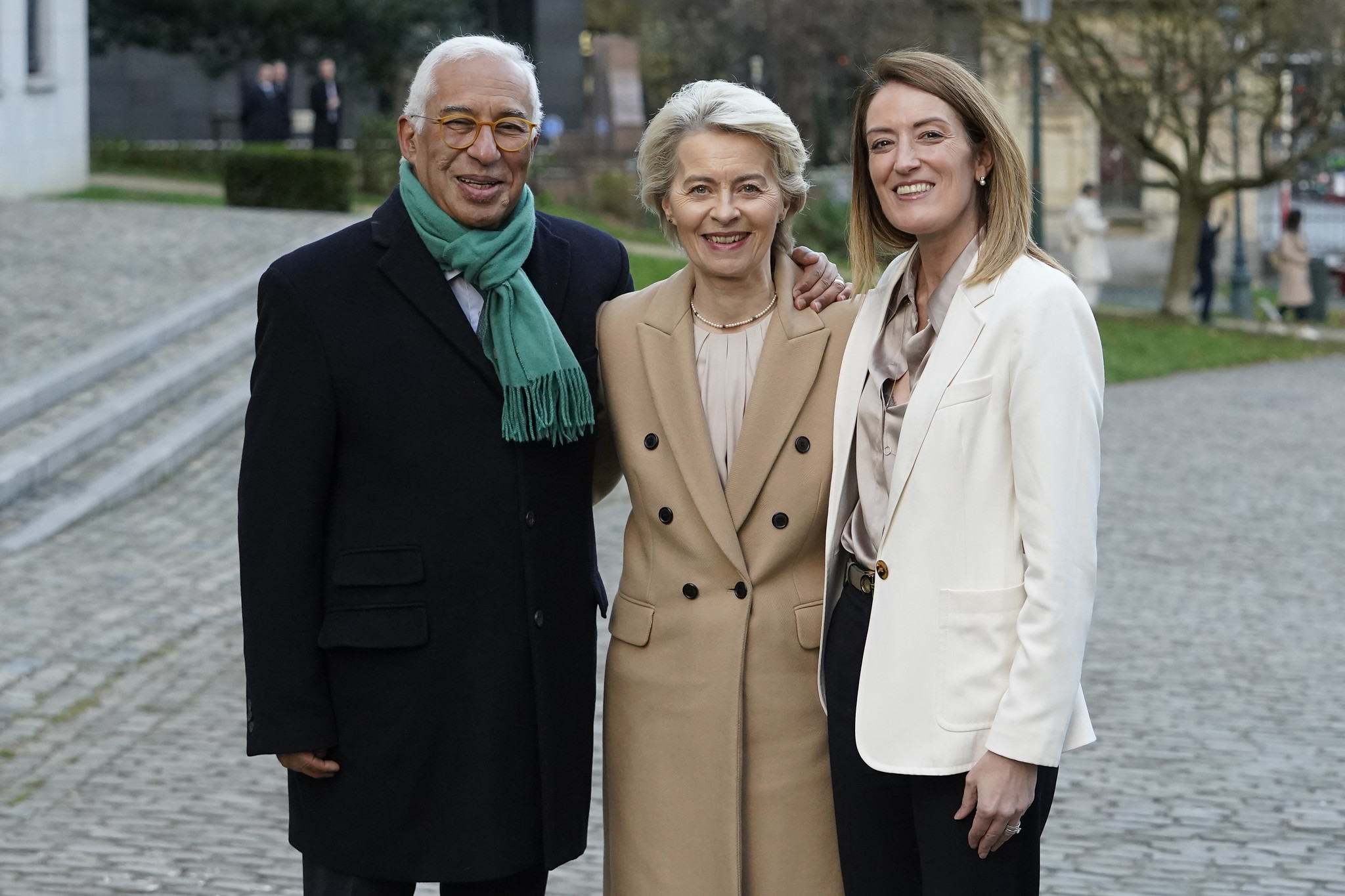 (From left to right) António Costa, President of the European Council; Ursula von der Leyen, President of the European Commission; and Roberta Metsola, President of the European Parliament
Source: European Parliament | Flickr
Arguably the most important individual job in the European Union is that of President of the European Commission. The Commission (see Blog 5) plays a central role in the EU. Its President must chair and lead a diverse and potentially unwieldy Commission college, inspire and manage a large bureaucracy, handle tricky relations with each of the 27 Member States and with the other EU institutions, represent the European Union in the wider world (working alongside the President of the European Council), and play a significant role of leadership in the European Union as a whole.
The abilities and effectiveness of the President of the Commission are thus of immense importance. As Europe has become larger and more complex, and its challenges greater, the case for a forceful, hands-on leader of the Commission has grown. Its current President, Ursula von der Leyen, now in her second 5-year term of office, is a former German government Minister. She probably exercises a firmer grip on the institution, and on the other individual Commissioners, than any of her predecessors. Her international profile as the principal international face of the EU has evolved commensurately.
The President of the European Council leads and presides over the meetings and work of the European Council comprising the Heads of State or Government of the 27 Member States (see Blog 3). The role is currently held by António Costa, a former Prime Minister of Portugal. The Council Secretariat, which services the work of the Council of Ministers and the European Council, works to him. Together with the Commission President, he represents the EU externally at the highest level. Although the European Council President has a less dominant role within his institution than the Commission President has within hers, he can nevertheless exercise significant influence.
Given the shared roles of the Commission and European Council in driving forward the work of the Union, as well as their joint role in representing it externally, it is of particular importance that the working relationship between the Presidents of the two institutions is a good one. While the two current Presidents work well together, this has certainly not always been the case in the past.
The European Parliament also elects its own President. The present incumbent is Roberta Metsola from Malta. Assisted by a Bureau of Vice Presidents, she chairs its plenary sessions, represents it in its dealings with the Presidents of other institutions, manages its Secretariat and ensures that its rules are respected (see Blog 7).
Another important role in chairing meetings falls to the “High Representative” (full title: High Representative of the Union for Foreign Affairs and Security Policy) who chairs the Foreign Affairs Council that brings together the Foreign Ministers of the 27 Member States. The High Representative is also a Vice President of the European Commission and the chief coordinator of the EU’s Common Foreign and Security Policy. The current High Representative is Kaja Kallas, a former Prime Minister of Estonia.
The appointments to the four positions described above are treated as a political ‘package’ to ensure, insofar as possible, an overall balance. Whereas the President of the Parliament is formally elected by Parliament, the other three positions are filled, according to complex procedures, by the European Council and Parliament working together. The overall balance aimed for in the four appointments has many dimensions: a balance between large and small Member States (3 of the 4 positions are currently held by smaller Member States); between left and right (the current incumbents represent a variety of political affiliations); male/female (3 of the current 4 are women); new Member States and old; northern and southern Member States. Perceived national interests also plays a big part in the appointments.
While the primary requirement for each appointment should obviously be competence in all its dimensions, this can sometimes be partially lost sight of in the horse-trading necessitated by the need to shape a balanced package of appointments with so many variables. The process is complex, subtle and democratic but the outcome may well be far from perfect. It is partly due to good fortune that the four current office holders are widely perceived as being competent and suited for their roles.
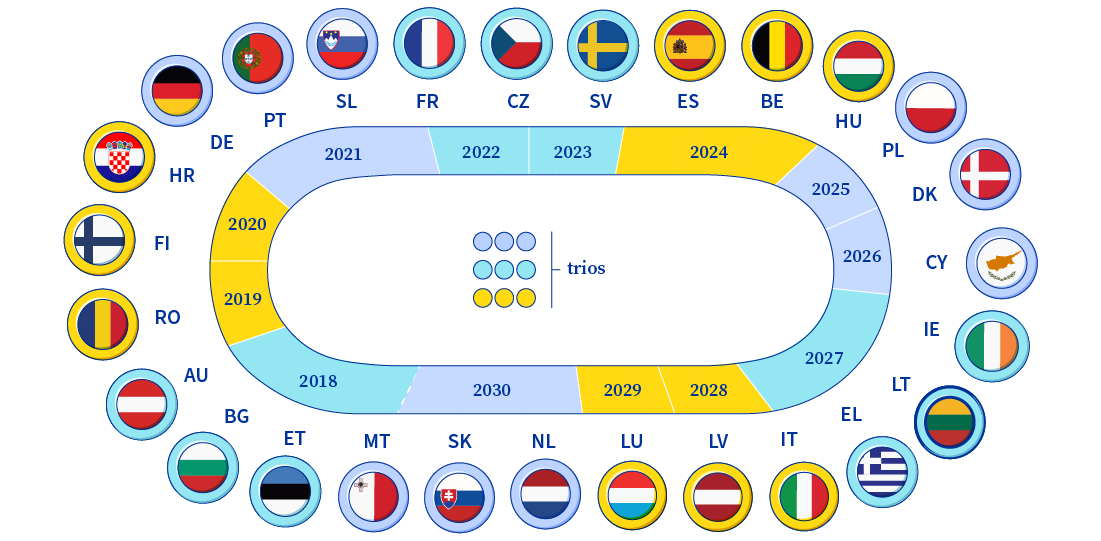
Another important aspect of chairmanship in the European Union is the rotating national Presidency. Each Member State in turn, according to a system of strict rotation, holds the six-month Presidency. It will be Ireland’s turn to hold the EU Presidency again from July to December 2026. As the need has grown for long-term coherence in an enlarging Union, the role of the rotating national Presidency has been somewhat diluted. For example, two of the roles outlined above that are now filled by longer-term incumbents, namely the chairing of the European Council and the Foreign Affairs Council, used to fall to the rotating Presidency.
However, the Presidency is still significant in helping to drive forward the Union’s agenda. It chairs nine of the ten formations of the Council of Ministers (the exception, as explained above, being the Foreign Affairs Council), as well as the Council’s many preparatory bodies, including the influential Committee of Permanent Representatives (which meets in two formations, Coreper II and Coreper I). The Presidency also represents the Council in many of its dealings with the other EU institutions, notably in seeking to negotiate agreement with the European Parliament and Commission on legislative proposals.
Each Presidency draws up in advance a programme of work. That programme is not plucked out of thin air. Rather a Presidency assesses the European Union’s ongoing priorities and challenges, and tries to shape those into a coherent and agreed set of collective ambitions for its six-month period. Each Presidency brings its own energy but is at the same time a link in a coherent chain. Continuity is strengthened by the fact that each Presidency forms part of a “trio” of succeeding Presidencies covering an 18-month period and that each is closely supported by the permanent Council Secretariat.
Each Presidency is essentially an honest broker that seeks to take forward the interests of all Member States. This year’s Irish EU Presidency, while it can bring its own flavour and ordering of its priorities, would fail if it simply tried to advance a national agenda, rather than the wider European interest. Holding the Presidency brings a country right to the heart of the Union’s workings. If it is successful, as all previous Irish Presidencies have been, that country’s standing and influence will be enhanced.