

The European Union in 12 Objects 3. The Table
Bobby McDonagh, Former Ambassador to the EU and UK, has developed a series of blogs, to explain what the European Union is and how it works. The publication of this blog series by the IIEA will be phased over 12 weeks, each dealing with one of the 12 Objects. Find out more here.
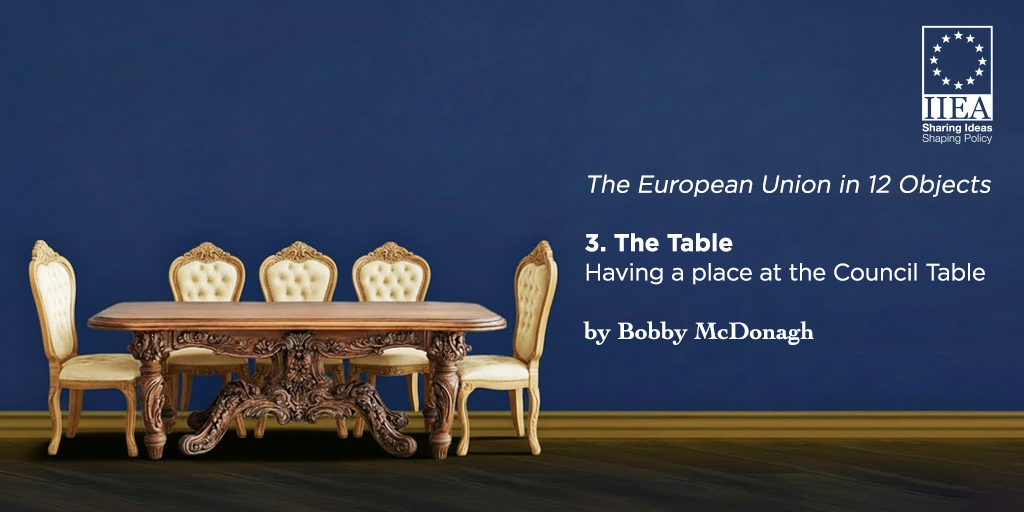
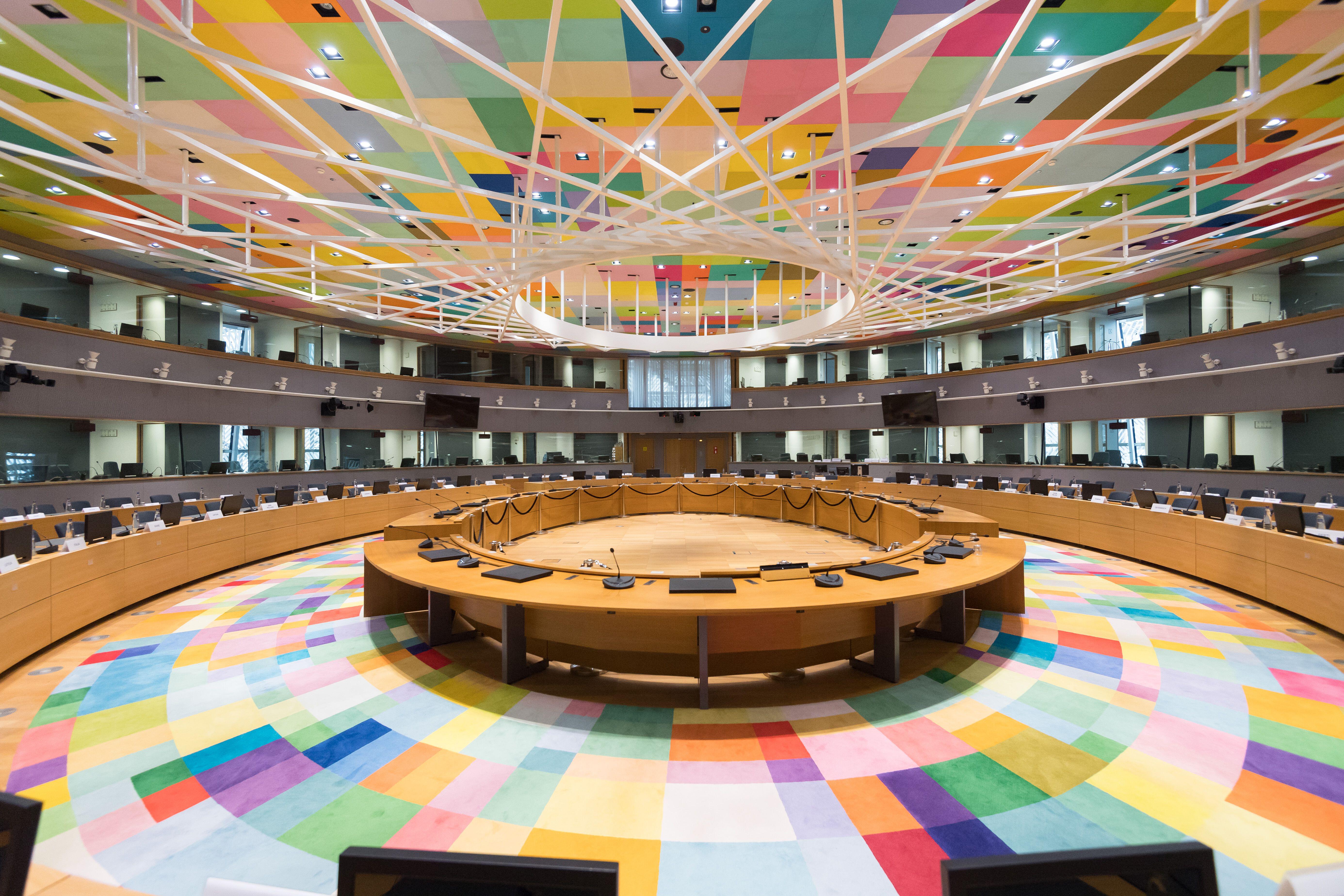
Perhaps the most obvious object to symbolise the European Union is a table. I have chosen a table to symbolise the negotiating reality and format of the EU’s Council of Ministers (often referred to as simply “the Council”) . The Council is the institution that brings together the representatives of the Member States.
A table is, of course, often similarly required, in practical terms, as a piece of furniture in each of the EU institutions and beyond. However, the very definition of the Council is the “table”, the negotiating table, around which the Member States sit. The Council has no alternative to taking its decisions and formulating its policies around such a table. When reference is made to “having a place at the table” in Europe, it is normally the Council that is being referred to. That is why I have chosen a table to symbolise the Council.
Background
Currently, there are 27 Member States in the Council. Each has its own equal place at the table and equal right to be there. Originally there were only six Member States. After Ireland joined along with the UK and Denmark in 1973 there were nine. The number continued to grow, including with the significant accession of ten new Member States in 2004 following the restoration of democracy in central and eastern Europe, until the number reached 28. Following the Brexit referendum in 2016, the UK became the first country to leave the European Union and thus lost its “place at the table” where, of course, many of the decisions that still affect it continue to be taken. There are now 27 Member States, with many others negotiating to join.
The European Commission (which will be discussed under Object 5) also sits around the Council of Ministers’ table. While it plays a significant role in that context, including in its role as the initiator of the draft legislation being considered by the Council, it is not a member of the Council and has no voting rights there.
The Council of Ministers meets in ten different configurations. The 27 Agriculture Ministers, for example, meet to negotiate on agricultural matters, the 27 Environment Ministers to discuss environmental issues, and so on. There is no hierarchy as between the different formations of the Council. The General Affairs Council, however, is responsible for cross-cutting issues, institutional issues and the preparation of meetings at the highest level, namely the “European Council”.
The European Council
The European Council is not the same thing as the Council of Ministers (or “Council”). It brings together, at that highest level, the 27 “Heads of State or Government” (so-described because, while most Member States are represented by their Prime Minister in the European Council, a few - including France - are represented by their Head of State).
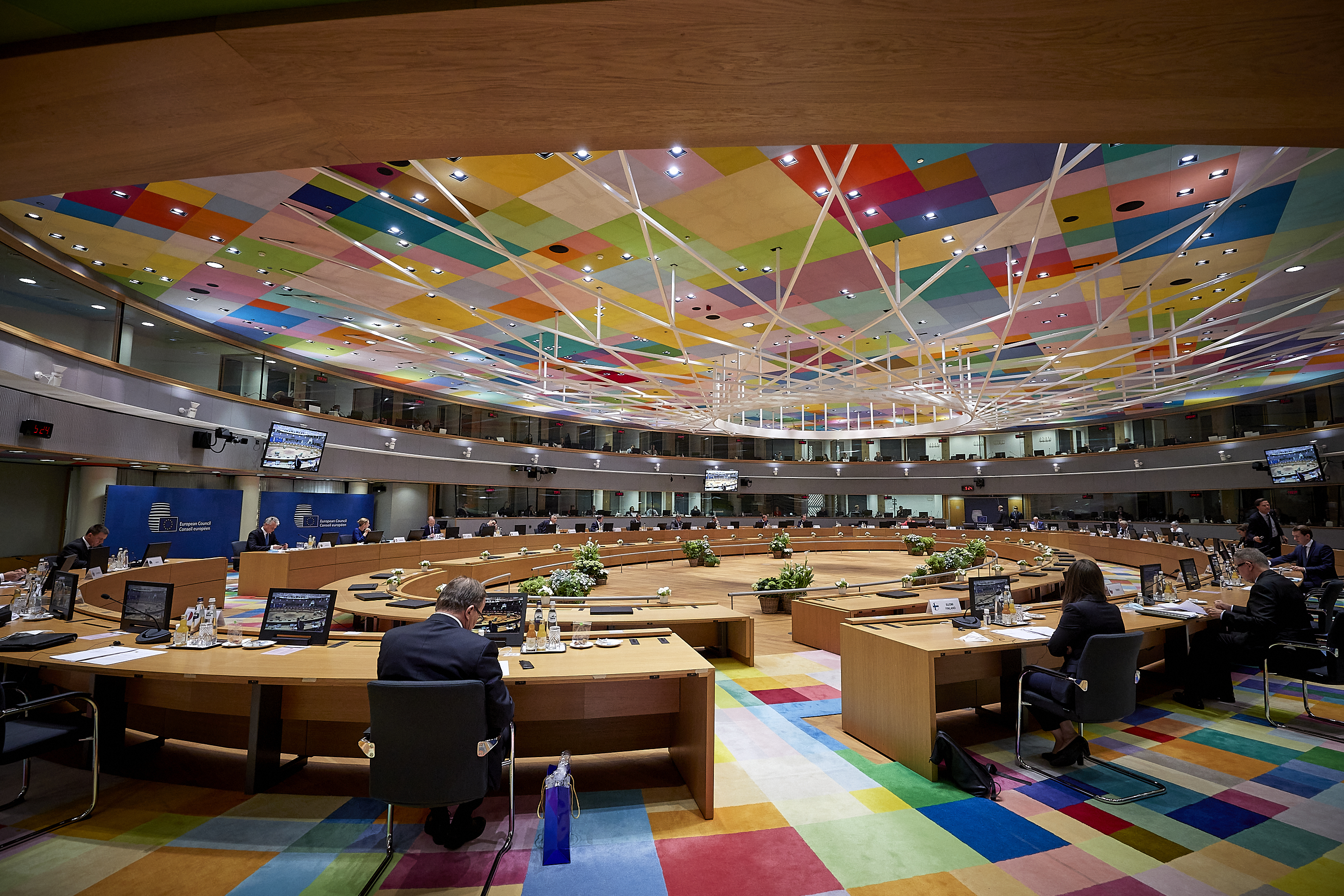 Image source: Council of the EU
Technically, the European Council is a separate institution from the Council. Unlike the Council, it cannot adopt legislation. However, other than as regards legislation, it is in practical terms the highest level of the same negotiating structure as the Council of Ministers, with all 27 Member States around the table. Given that the European Council comprises the most senior politicians in each of the Member States, it gives overall direction to the work of Ministers in the Council, shapes the EU’s overall direction and is its most influential body.
It is important to note that, unlike at the Council of Ministers, in which national ministers are accompanied by one of more of their officials or even occasionally represented by one, the Prime Ministers or Presidents who represent their 27 Member States at the highest level in the European Council are strictly unaccompanied at its meetings. Thus they sit around a smaller table and must negotiate on their own, reacting to evolving discussions and proposals. This in turn means that the personal ability, knowledge and experience of the political leaders in question is of particular importance both in promoting their national interests and in shaping European compromises.
The symbolism of the table and its significance apply as much to the European Council as to the Council of Ministers.
Preparatory Work at Official Level
The work of the 27 Ministers in the Council is prepared by officials from the 27 Member States who sit around similar tables at earlier stages of the negotiating process. Thus the work of the Council takes place initially at official level and subsequently at political level.
On every working day, numerous working groups, comprising officials from each of the 27 Member States, take place to begin and take forward the process of shaping legislation and policy across the wide range of EU business. Ultimately, it is for the Ministerial level to reach decisions. However, a great deal of the highly complex work of taking into account the different points of views and refining the proposals to be considered by Ministers necessarily takes place between their officials, in the same Council building and around similar tables.
The highest level at which officials meet to prepare Ministerial discussion in Council, and to resolve the outstanding disagreements to the extent that they can, is Ambassadorial level. The 27 Ambassadors from the Member States to the European Union are called Permanent Representatives. They each head up a large diplomatic mission in Brussels called a “Permanent Representation” (in effect their country’s Embassy to the EU), typically comprising officials assigned there for several years from every Ministry in their home capital.
The 27 Permanent Representatives, as well as their 27 Deputy Permanent Representatives, constitute two separate high-level committees (Coreper II and Coreper I respectively) through which all of the work from the numerous working groups is funnelled towards the Council of Ministers meeting in its different formations. (At a similarly senior level, the Political and Security Committee and Special Agriculture Committee help to prepare Ministerial discussions on foreign policy and agriculture respectively).
Coreper II and Coreper I meet at least for one day every week, and very often more frequently, sometimes at short notice. Their role is to reduce the areas of disagreement on which Ministers will have to focus their discussions and to make those Ministerial discussions as coherent and effective as possible. Sometimes the Ambassadors at Coreper II and Coreper I can reach substantive agreement that only needs to be formally approved by the political level.
Each member of the European Council appoints a “sherpa”. These 27 sherpas, in tandem with the Permanent Representatives in Coreper II and Ministers at the General Affairs Council, help to prepare the work of the European Council.
EU Presidency
There is a six-monthly EU “Presidency” that rotates on a strictly equal basis between the 27 Member States. During its six months, each national Presidency aims to advance the work of the European Union as effectively as possible, including by chairing most of the formations of the Council of Ministers and much of the work at official level.
However, as the EU has become more complex, and continuity has become more necessary and challenging, the role of the six-monthly rotating Presidency has been diluted somewhat. For example, the European Council (namely the highest level negotiating forum) and the Foreign Ministers’ formation of the Council of Ministers are now chaired by more permanent appointees.
Ireland will hold its next EU Presidency in the second half of 2026.
Council Secretariat
A permanent Council Secretariat provides important support for both the Member State holding the rotating Presidency and for the ongoing work of the Council as a whole.
General Reflections
The main point to retain from this summary of the Council of Ministers (and the European Counci) is that each Member State has a place, as of right, around the EU’s most influential table. Contrary to the frequent complaint that “Brussels” decides everything, with the implication that Member States must meekly accept policies foisted on them by European bureaucrats (the infamous “Eurocrats”), the representatives of the 27 democratically-elected European governments sit around the Council table every day, at every meeting and at every level, to take the important decisions. That represents both an important responsibility for each Member State, and a significant opportunity.
As set out in Chapter 2, in which the central importance of compromise to the EU’s way of doing business is underlined, the Council operates on the bases of agreed and binding procedures and its work is generally shaped by an ethos of accommodation and respect.
Both the binding procedures and the spirit in which they are implemented mean that it is very rare for a Member State like Ireland to be “outvoted” on any proposal in the Council. While, in common with every Member State, we can rarely obtain everything we want in a negotiation, we almost always achieve enough of our priority objectives to support whatever proposal emerges.
At every level of the Council, as well as at the European Council, the gradual enlargement of the EU over the years, from 6 countries to 27, has led to a necessarily evolution in the way business is conducted. So-called “tours de tables”, that is “table rounds” in which every Member State speaks on a particular topic, have necessarily become increasingly rare. Any discussion in which every Member State, and the European Commission, were to set out their position for, say, ten minutes each, would take about five hours. While such “tours de tables” do still take place occasionally on exceptionally important topics, negotiators have become more agile and flexible in how and when they intervene. While each Member State retains the right to speak when it asks for the floor, effectiveness and influence have increasingly required strategy, selectivity and brevity in the interventions made.
While the negotiating process has necessarily become more complex and challenging as the European Union has enlarged, it is remarkable how the process has retained its efficiency and inclusivity. The fear that the EU could not enlarge successfully, because it would become unwieldy, has become a “dog that didn’t bark.” Further enlargement in the future will, of course, pose additional challenges.
Alliances
The development of alliances within the Council is essential to the protection and promotion of a Member State’s interests.
Some groupings between Member States are of long standing, such as BENELUX that has brought together Belgium, the Netherlands and Luxembourg since even long before the establishment of the EU itself.
Other alliances have developed over time based on, or limited to, shared interests in a broad policy area such as agriculture or taxation. Yet other temporary alliances relate to a particular proposal or even to a specific aspect of it.
Ireland works closely with other Member States or groups of Member States as appropriate, especially when shared priorities have been identified. We have taken the view that, while working particularly with likeminded countries makes sense, we should use every opportunity to influence every other Member State on every issue of importance to us. We are one of the few countries to have an Embassy in every other Member State and we strengthened our embassies in European capitals following Brexit, especially our most important ones.
Intergovernmental Conferences
Member States also negotiate from time to time in another context, namely at an Intergovernmental Conference, or “IGC”. The EU Treaties provide for an IGC to be convened if the Member States wish to change the Union’s fundamental Treaties.
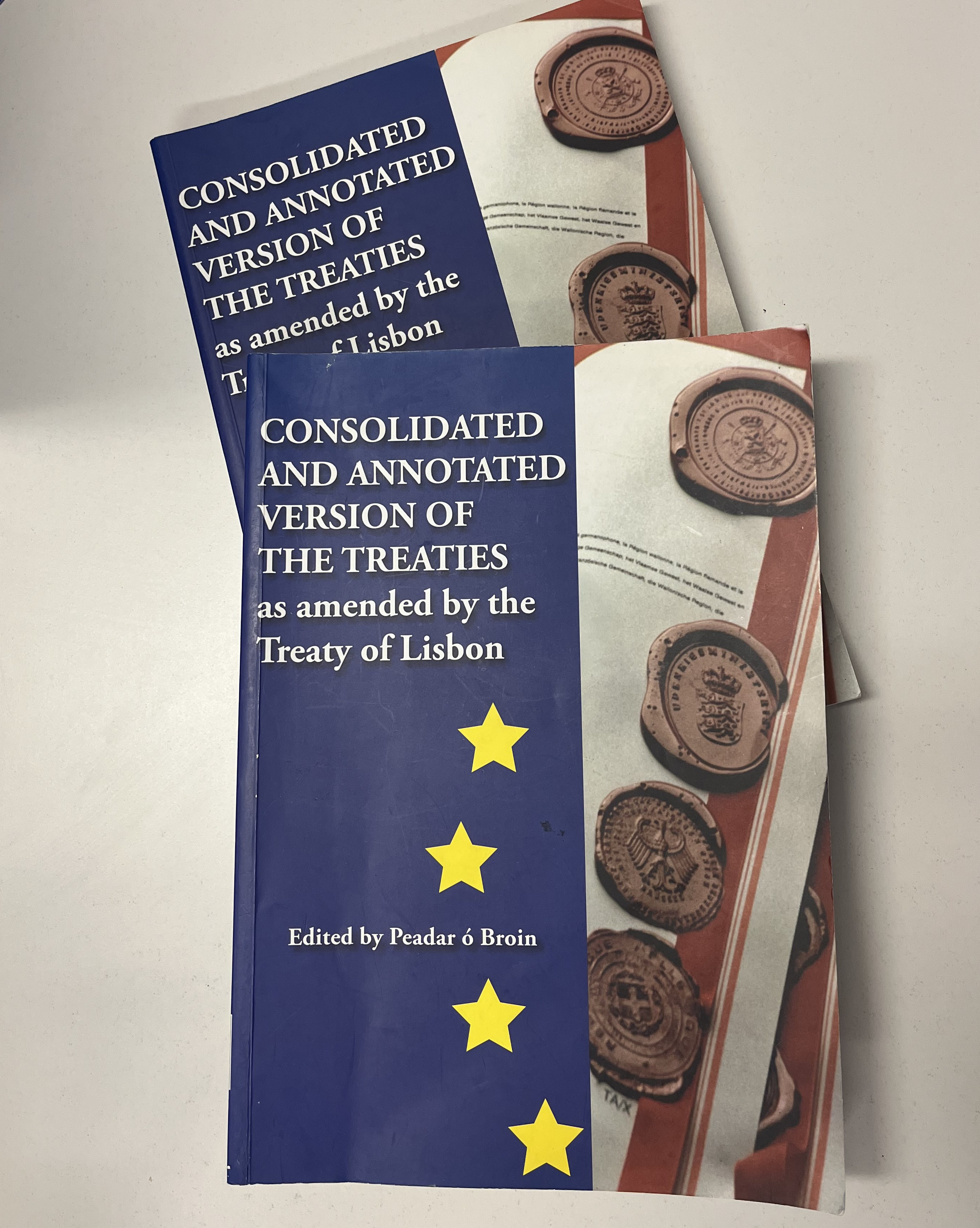
While the role of an IGC is defined in the EU Treaties, it is not in itself an EU institution, as reflected in the use of the word “intergovernmental”. Rather it is the format in which the Member States can go about changing the EU’s scope, procedures or institutions.
Every decision at an IGC requires unanimity. In a larger and more diverse Union, this is increasingly hard to achieve. However, it means that no Treaty change can be imposed on a Member State. Each national government must not only approve whatever agreement emerges at the end of the negotiation in which it has participated, but must also then seek approval of the Treaty changes at national level. Depending on the constitutional requirements of each Member State, this will require either a referendum, as has applied in Ireland for every significant EU Treaty change, or - in the case of most Member States - approval by the national parliament. It is important to emphasise that the European Union can acquire no new competences without the agreement of every single Member State. All of its existing competences have been conferred on it unanimously by the Member States.
For significant Treaty change, an IGC will now typically be prepared by a European Convention, a large deliberative body in which not only national Governments but also representatives of national parliaments are involved, as well as representatives of the European Commission and the European Parliament.
Irish EU Presidencies have played a central role in shaping and brokering agreement at several previous IGCs.