

‘Turning Back the Clock’: A Personal Reflection on the first European Council in Dublin
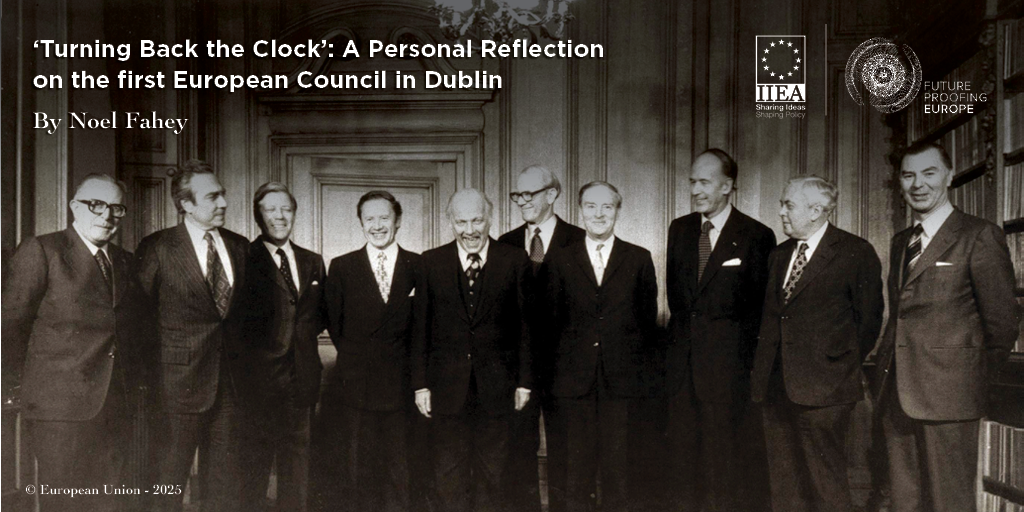
Photo: The European Council in Summit of Dublin, 10 and 11 March 1975 - From Left to right: Mariano Rumor (IT), François-Xavier Ortoli (EC President), Helmut Schmidt (RFA), Gaston Thorn (LU), Johannes Den Vyl (NL), Knud Borge Andersen (DK), William Thomas Cosgrave (IE), Valéry Giscard D'estang(FR), Harold Wilson (UK), Léo TindemansI (BE) - Photo © European Union - 2025
Meetings of the Heads of State and Government (HOSG) were not very usual in the first decade or so of the European Community (EC), to use the term of the time. There was a reluctance among the smaller Member States to give a role to a format that operated outside the protections in the founding Treaties. Under President de Gaulle, France was determined to limit meetings at the summit level that could add to the ECs’ prestige.
However, in December 1969 (after de Gaulle’s departure), the Heads of State and Government met in The Hague and lifted the block on negotiations for the accession of new Member States, including Ireland. In December 1972 another Summit in Paris welcomed the new Member States, Ireland, the UK and Denmark, and set an ambitious agenda for the future of the enlarged Community. This summit was a precursor to the European Council which was created and defined in 1974.
It also established a practice of holding a Summit during each Presidency. Pressure mounted to make the gathering more structured by involving the Council Secretariat in the organisation and producing formal conclusions. This suited the proponents of HOSG level meetings as the apex decision-making organ. It suited those Member States who suspected this development by keeping some level of formality to the gatherings.
Effectively the development acknowledged that the leaders of the Member States would have to be involved in decision-making if progress was to be made on the major issues. The experience of the last 50 years has confirmed this view. The key decisions were going to have to be taken at the Summit - the work of the EC and later the EU went well beyond traditional foreign policy.
The new format was agreed in Paris in December 1974, on the eve of the first Irish Presidency. It was part of an ambitious future agenda that included the development of a regional policy, more structured political cooperation and a continued commitment to eventual EMU.
An immediate issue to be solved during the Irish Presidency was, in my view, like an early form of Brexit. The new Labour government led by Mr Harold Wilson had demanded an improvement in the entry terms negotiated by his predecessor Mr Heath. In particular Wilson sought a reduction in the UK contribution to the Community budget, changes in the CAP and better market access for New Zealand dairy products.
The first half of 1975 was always going to be a very challenging period in Europe for the Irish government. There was the immediate issue (familiar recently from Brexit) of what would we do if our major trading partner (and the main economic reason why we joined the EC) were to leave? It was in our interest to try to make sure the negotiations that were coming to a climax on our watch went smoothly and with an outcome that could be sold to the British voter. This had to be done without appearing to show undue favour to the UK on Ireland’s part and it had to maintain the positive commitment to further European integration that we had shown from the time we joined.
In the background, of course, and increasingly fundamental to the Dublin/London relationship, was the continuing unrest in Northern Ireland and how it should be handled. There Wilson’s government had been reluctant to take the initiative after the collapse in 1974 of the Sunningdale Agreement.
On top of these national preoccupations Ireland would have the practical challenge of running its first Presidency of the Council.
In the decades since then the practical role of the Presidency has become less onerous. For example, European Councils are now largely Brussels-based events supported by the facilities laid on by the Council Secretariat and when the European Council was formally recognized as one of the EU institutions in 2009 in the Lisbon Treaty, the position of a full-time President of the European Council was created to improve the continuity and coherence of the work of the European Council.
This would not have been quite the case in 1975. The main services provided by the Council Secretariat at the European Council were translation and interpretation and a modest assistance and note-taking presence at the actual meeting. So, the Presidency was a whole of government test for the Irish administration at both political and official level. Ministers and officials still relatively new to operation of the EC, would have to progress the Council agenda. Sometimes this had to be done in areas where there was little direct Irish experience (a substantial Mediterranean products package in the Agriculture Council, for example). The number of senior Irish officials across many Government Departments was relatively small, and the day to day work at home did not go away.
A big investment was made in being prepared. But how would it go on the day? A success would mean a real boost of confidence in the Irish administration. We would demonstrate our capacity to pull our weight in the EC in a very clear way. We would show the others - and ourselves - what we could do. A failure would have long term adverse consequences.
There was background noise from the usual quarters about Ireland’s alleged incapacity to run the operation. And there were rumours that there were plans for a “rescue” should Ireland look like failing. Denmark was the first “small” member State up in the second half of 1973 and had a wretched time because of wider events. The Danish Presidency coincided with the first oil shock. Europe was very divided and in serious disarray. Finding a united response was very difficult. President Pompidou’s fatal illness which the French were anxious to conceal did not help especially with the management of the Copenhagen Summit, the signature Presidency event, in December 1973.
In fact the Irish Presidency went smoothly from the first day. The Government Departments with direct experience from the accession negotiations - Foreign Affairs, Finance, Agriculture and Industry and Commerce took on their responsibilities with (apparent) ease. Other Departments that had less advance experience (Revenue, Transport, Labour, and Social Welfare, for example) rose to the challenge. The ‘green jersey’ effect had a very positive impact - as it was to have in future Presidencies.
Political Cooperation - cooperation in foreign policy - was still infancy in 1975. The theology demanded that meetings be held in the Presidency country. The Department of Foreign Affairs had to organise these meetings with all the necessary services for delegations. The official level meetings were mostly held at the headquarters of the Department in Iveagh House. The Ministerial meetings were hosted in Dublin Castle and an informal meeting was in held in Farmleigh House (then still a Guinness family residence, and borrowed for the occasion).
The European Council session on 10 and 11 March 1975 was historic. It was the largest diplomatic event to take place in Dublin since Independence. It seems relatively unexceptional now, but in 1975 it was still hard to imagine the presence in Dublin of the leaders of eight other European countries including the British Prime Minister. I believe it was the first visit by a serving Prime Minister since Mr Attlee dropped in to Government buildings during holiday visit to Mayo in 1948, and the first such visit since Mr Asquith came in 1916 in the aftermath of the Rising.
As it turned out, the European Council went very well and the two key issues with the British, the Budget contribution and New Zealand exports were largely solved - at least for the moment.
The Taoiseach, Mr Cosgrave, and the Foreign Minister, Dr FitzGerald, managed the meeting effectively. Mr Cosgrave, a former Minister for External Affairs, chaired the meeting with his usual calm. Dr FitzGerald’s confidence in dealing with the press and his long experience of the broader Europe was a key advantage.
In the run up to the meeting the Irish Ministers and senior officials worked smoothly with their counterparts from the Commission and the other Member States to lay the ground for agreement.
The meeting demanded a very large personnel investment from the Department of Foreign Affairs in support of the Taoiseach’s Department. This was necessary because the burden of organisation and management of the European Council fell mainly on the Presidency as host.
The meeting itself took place in Dublin Castle. Facilities had to be provided for the delegations. Protocol had to supply a range of facilities from airport reception to catering in the Castle and Iveagh House. The organisation in the Castle required the involvement of the Office of Public Works (OPW), who managed the venue. Communication facilities had to be laid on to meet the needs of the visiting delegations and of course of the large press contingent - no mobile phones or internet then! Furthermore, provision of security required a major effort from the Gardai at a time when they and the Defence Forces were stretched by the ‘Troubles’ in Northern Ireland.
As an official who was dealing with British renegotiation, I particularly recall working through the weekend before the Council. We had to pull together briefing and reporting up to the final briefing meeting with the Taoiseach on the morning of the European Council itself. Information from Brussels and other overseas diplomatic missions came in by telex. We did have a fax which was quite an innovation for the Department (even if the actual technology was decades old). Would instant communication and mobile phones have made practical matters easier? Possibly. Or would they have created new problems?
On the evening before the Council - a Sunday - I was in the back row at a briefing of Dr FitzGerald in Iveagh House. This was followed by a walk through the Conference centre in Dublin Castle. The venue was small by later standards (even for Dublin Castle). St Patrick’s Hall was used for the plenary and George’s Hall for side meetings. Single delegation rooms were along the corridor to the right of the first floor landing. The press centre was in the lower floor, directly beneath where the Council would meet. After many European Councils since then the facilities now seem modest. But for the time for Dublin they were impressive.
On the morning of the meeting I had to rush the final briefing papers from St Stephens Green over to the Taoiseach’s Office in Merrion St in person (did I hail a taxi?). From midday delegations arrived in the Castle, processed through the airport by a stretched Protocol team. We watched them troop through the Upper Yard of Dublin Castle to be greeted by the Taoiseach.
I was assigned a ‘gofer’ role at the plenary meeting. I was one of a large group of junior officials who provided support services for the event. Nowadays these services are largely provided by the Council Secretariat in or from Brussels. Then their presence was relatively modest – the Secretary General himself, a note-taker and the assertive Head of interpretation, Madame Van Hoff, with her team, Conference services were provided by Irish officials. For the first day I was present at the plenary carrying messages from the room for the Presidency team.
So I was able to observe some of the dynamics of the actual meeting. Helmut Schmidt and Valery Giscard d’Estaing acted as a team and dominated the room. They were seated beside each other. They had obviously settled a common line in advance. I remember Schmidt warning that if too much pressure was applied to him on the budget, the German electorate would replace him with Franz Josef Strauss, the nationalist Bavarian conservative.
I also remember the attitude of Harold Wilson and James Callaghan. As was common enough in those years the Labour ministers did not conceal their impatience with the Community system and with having to debate policy especially with smaller countries. It seemed to me at the time that there was an obvious condescending tone to their interventions.
The Council broke for dinner in Iveagh House in the early evening. That event seems to have been convivial. There was a birthday cake for Mr Wilson which may have improved his mood. It was agreed to get officials to hammer out a text on New Zealand the following morning while the HOSGs discussed other issues. The formal meeting was supposed to resume in the Castle after dinner but was cancelled. This caused some discomfort to a few of the Italians who had decided to avoid the Iveagh House event and to dine in their Embassy Residence in Lucan House. When they returned to the Castle for the resumption, they found it was off. Those were the days before mobile phones - how ever did we manage?
I was told to sit in on the New Zealand side meeting on the second day and to take notes. It was a lesson to watch the late Jimmy O’Mahoney, the senior Agriculture ECs expert in action. He piloted the group to a compromise in an area where in normal circumstances Ireland would have resisted any concessions (in those days I remember an Agriculture official’s simple advice to his Minister on the line to take on New Zealand on another occasion - “I would give them nothing, Minster”).
I remember a rush at the end of the meeting to produce texts of the various conclusions. In pre word-processing days this was a chore and the pressure on the typing and photocopying services was severe. Delegations rushing to catch flights were impatient. There was pressure from the press centre with deadlines to meet. The clatter of telexes and typewriters in the press centre is another feature of international events that has gone since then.
The meeting ended successfully in the late afternoon with an agreement that proved very favourable to New Zealand over the years afterwards. The British budget agreement only lasted until the arrival of Mrs Thatcher who eventually negotiated a generous replacement in 1984. But the Dublin result was sufficient to win a Referendum in the UK later in the year. Ireland was saved having to make a choice at a far less favourable juncture in our development than in 2016.
The Presidency press conference was very positive with Dr Fitzgerald particularly in his element. His openness to the press and his facility with French made him a favourite of the Brussels press corps. This was a considerable advantage to the Presidency as was his obvious commitment to closer European integration. I sat in on Mr Wilson’s press conference with a couple of the Brussels people whom I knew. Wilson seemed bumptious and rude to the non-British journalists and this drew a strong rebuke from the New York Times correspondent.
After the delegations departed the junior officials were able to avail of the press bar in the basement of the Castle. It was a mixed crew mainly from Foreign Affairs, Taoiseachs and the Office of Public Works. There was genuine relief that the event had gone so well - a real feeling that “we did it”. This was reflected a broader boost in confidence throughout the Irish administration that carried us comfortably through the rest of the Presidency. I think it has echoes to this day. How to manage membership was no longer a mystery.
My recollections are partial and draw on my memory of 50 years ago. Others will have different recollections - equally valid. I attended many European Council meetings over the subsequent 25 years and saw the forum become much more structured in that time. The organisation of the meeting held in Dublin in March 1975 was very different from the two meetings held in Dublin in 1996 (my last Irish Presidency in Dublin). But what was a terra incognita back in 1975 was a well tried path twenty years later and the challenges were different. The Conference Centre in Dublin Castle was much larger and the facilities much more elaborate. But the experience was well used and many of the senior officials in 1996 and later had their first experience as juniors in 1975.
For more than half of its lifetime as an independent state, Ireland has been a Member State of the European Communities, later the European Union. It is now preparing for its eighth Presidency in the second half of 2026. In 1975 hosting the leaders of Nine Member States was seen as an enormous challenge. In 2026, Ireland will host a meeting of up to 47 leaders of the European Political Community (EPC), an informal European Council and 22 informal Council meetings at Ministerial level. The task next year is as challenging as it was in 1975. I am sure that Ministers, officials and all involved from across government will be as determined to ensure a success, as those involved were in 1975. They will take the opportunity to assert Ireland's commitment to the European Union. They will demonstrate Ireland's capacity to meet the obligations and challenges that a Presidency, and membership itself, presents.
Noel Fahey was a First Secretary in the EEC Division of the Department of Foreign Affairs in 1975. He has served as Assistant Secretary in the Economic/EEC Division of the Department and as Ambassador of Ireland to Germany and the United States and the Holy See. He retired in 2011. He is a member of the IIEA