

The European Union in 12 Objects 6. A Persian Rug
Bobby McDonagh, Former Ambassador to the EU and UK, has developed a series of blogs, to explain what the European Union is and how it works. The publication of this blog series by the IIEA will be phased over 12 weeks, each dealing with one of the 12 Objects. Find out more here.
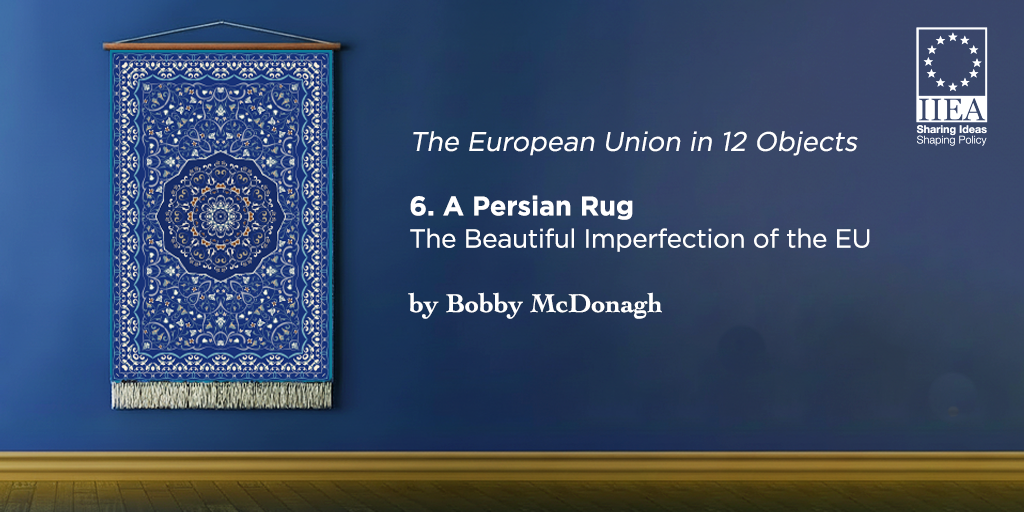
Handmade Persian rugs often deliberately contain an imperfect design element, referred to as a “Persian Flaw”. Such imperfections are frequently seen as a mark of authenticity and quality. It is said that Persian rugmakers, like Islamic artists, include a deliberate imperfection in their designs to reflect their belief that only Allah can make something that is perfect .
I have chosen a Persian rug as one of the 12 objects to represent the European Union because the EU is also necessarily imperfect. Like a Persian rug, the EU is an example of beautiful imperfection.
The European Union is self-evidently flawed. It is essential to recognize that because it is the necessary starting point for any realistic appraisal of the EU and for remedying its weaknesses.
Moreover, not to accept the EU for what it is, “warts and all”, would be to set it up to be judged by impossible standards. Every institution in the world is imperfect - every government, every parliament, every business, every organization, every family. The European Union and its institutions, despite their remarkable strengths and successes, are no different.
The EU and its Member States make big mistakes and small ones.
They blundered through the early phase of the Eurozone debt crisis, for example, and were initially slow in responding to the Covid crisis when it struck. The EU’s collective response to the situation in Gaza was entirely inadequate.
Moreover, in the decisions that they take every day and the positions they adopt, the EU institutions are no more immune to human error than anyone else. Misjudgements, arrogance, naivety and self-interest can all play their part as they do in all politics. It is part of human nature.
However, it is worth considering, in mitigation, four particular challenges that the European Union must face. That is not to deny its mistakes but to place them in context.
The first challenge, most obviously, is that the EU consists of 27 independent democratic countries, each of which has its own perspective, priorities and legal entitlements under the Treaties. The European Union, unlike an individual country, must therefore not only identify the best course of action to pursue but also get 27 Member States, or in some cases at least a qualified majority of them, to agree to that course of action. This is an enormous challenge that usually involves significant delays, and often leads to imperfect outcomes and sometimes to failure.
The unanimity required for foreign policy decisions, for example, often makes it impossible for the EU to speak as one and act effectively, the Middle East situation being an obvious recent example (see Chapter/Object 10). It has also complicated its response to Russia’s brutal invasion of Ukraine.
Nevertheless, overall, given the ambitious EU experiment in the pooling of sovereignty between many independent democracies, an experiment unique both in today’s world and in history, what is remarkable is not Europe’s significant failures but rather its remarkable achievements.
The second challenge specific to Europe’s decision-making is the complex interaction that is necessary between the three EU institutions that provide the delicate equilibrium required by the European project; the Council of Ministers (see Chapter/Object 3), the European Commission (see Chapter/Object 5), and the European Parliament (see Chapter/Object 7) .
Third, the EU can only act strictly within the competences that the Member States have given to it under the Treaties. In the health area, for example, the bulk of competences remain at national level. Thus, in responding to the Covid crisis, which the EU did effectively after some initial stumbles, it had significantly limited levers at its disposal.
The fourth and obvious challenge that the EU faces, not one unique to Europe, is the extraordinary complexity of some of the issues it must confront, issues to which the answers will always be imperfect compromises. An obvious case in point is how to handle migration, an enormous challenge that is set to grow. People will propose, as is their right, simple answers, ranging from putting a stop to all migration to removing effective barriers to it. In this as in other cases, the EU has to deal, not with ideological perfection or political posturing, but with a complex reality, and against a background in which Member States are sharply divided and many of the competences to act remain at national level.
Like a Persian rug, the European Union is, in many respects, imperfect. It has weaknesses that should be remedied. It makes mistakes that should be avoided or rectified. It should not, however, be held to impossible standards.
Perhaps we should take some reassurance from Leonard Cohen’s observation: “There is a crack in everything, that’s how the light gets in.”