

The European Union in 12 Objects 4. The Dictionary
Bobby McDonagh, Former Ambassador to the EU and UK, has developed a series of blogs, to explain what the European Union is and how it works. The publication of this blog series by the IIEA will be phased over 12 weeks, each dealing with one of the 12 Objects. Find out more here.
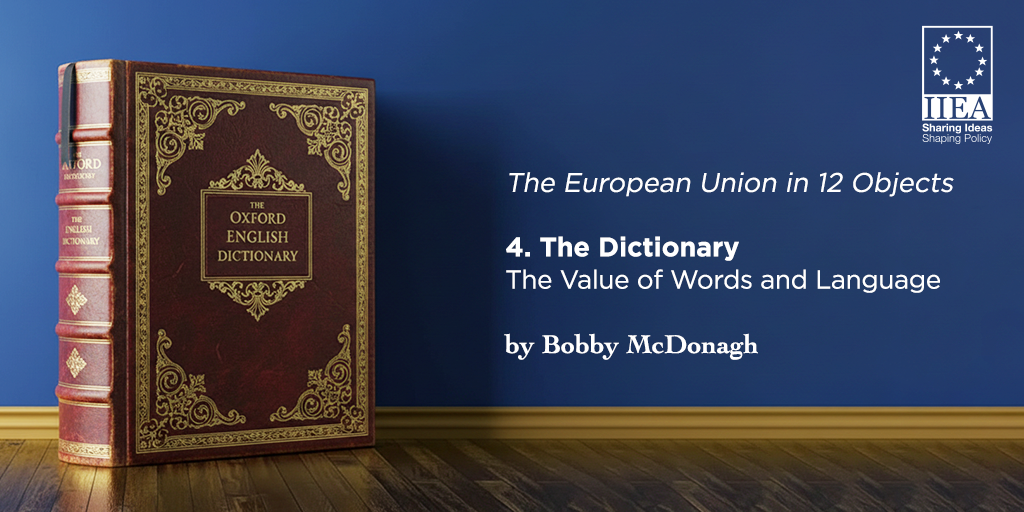
As my fourth object I have chosen a dictionary. The European Union is founded on the simple belief that words have meaning.
We live in a world in which words increasingly seem to have lost any meaning. For populists and autocrats, words have become mere playthings to advance their agendas and their interests. Lies are casually described as “alternative facts”. Straightforward truths are frequently dismissed as “fake news”.
In the European Union, with all its faults and weaknesses, words retain precise meanings and language still matters. Some might argue that the EU is overcomplicated and that it uses too many words. But Europe’s numerous written treaties and laws and declarations remain the subtle and necessary building blocks of peace and prosperity on our continent and the assertion of our values in the wider world.
 Photo Credit: ID 354116193 | Eu Documents © Tatsiana Kuryanovich | Dreamstime.com
The European Union Treaties are somewhat akin to the national constitution of a country. They are the foundation on which and within which the EU institutions must operate. They represent both the necessary springboard for every activity that the EU wishes to undertake and the strict confines within which those activities must fall.
The Treaties, like any document, represent the coming together of words in a formulation that gives them meaning. When EU treaties are being negotiated, every word, as I know from personal experience, is haggled over. When treaties are agreed, every Member State signs up to every single word contained in them. Any “opt out” for a Member State on a particular policy must likewise be explicitly set out in the Treaty. When treaties are being implemented, their words are binding.
EU legislation, likewise, is necessarily composed of words, fiercely contested while being negotiated, but collectively adhered to when they have become the law.
The European Union is sometimes accused of adopting too much detailed legislation; naturally it does not always get the balance right. However, a great swathe of European laws, far from creating overcomplicated rules, are designed to remove the complicated national rules that would otherwise hamper trade within the EU’s Single Market, which brings so much benefit to European businesses and citizens. It is often the Member States which, for domestic political consumption, criticise the complexity of European laws that they themselves had, in the first place, called on the Commission to bring forward.
The two principal types of EU legislation are Directives and Regulations. A Directive sets out a binding goal that individual countries must achieve but leaves some scope to each country to devise their own detailed laws to achieve that goal. An EU Regulation is a directly binding legislative act.
When the European Court of Justice rules on the legality of EU legislation, or on a Member State’s implementation of it, it is again words that are at issue; what they mean and how they are to be interpreted.
However, for the European Union, the importance of words goes well beyond formal legislation. It is the EU’s belief in the value of words, for example, that guides its declarations and statements, including on foreign policy and on its relations with international partners.
Words are not only embodied in eventual compromises but it is the respectful use of the spoken and written word that makes those compromises possible. That is how the EU generally does its business internally and externally. The “conclusions” adopted by each meeting of the high-level European Council, although not legally binding, are considered politically binding for the Union’s ongoing work.
This is utterly unlike the whimsical impulsiveness of, say, Trump’s America where words are often detached from any meaning and are rarely worth the paper they’re written on.
Another important illustration of the value that the EU attaches to words is that it stands by the international Treaties that it has signed up to. That may seem like a self-evident thing to do, but around the world these days we see examples of treaties being disrespected as if the words written down in them, agreed and then ratified, no longer have meaning. The behaviour of President Trump’s administration offers the most obvious example in that regard but, some years ago, Brexit saw the Conservative Government in the UK explicitly indicating its intention to break a Treaty it had ratified.
The EU’s measured and essentially trustworthy use of language stands in contrast to the misuse of language by many, but of course no means all, international partners.
A further illustration of the respect that the European Union shows for language is that the national language of every Member State, including Ireland, is now an official language of the European Union. A very significant proportion of EU employees are therefore translators or interpreters. English, at the same time, has increasingly become the predominant language of EU negotiations.
The rule of law always requires respect for the sacredness of language.
The creative and precise use of language makes trust possible between nations. As we know from the subtle drafting of the Good Friday Agreement, it can replace misunderstanding and confrontation with reconciliation and peace. The European Union is a perfect illustration of the power of language.
Seamus Heaney wrote “if you have the words, there’s always a chance that you’ll find the way”. The devaluation and misuse of words, on the other hand, carries enormous dangers.