

The European Union in 12 Objects 12. A Drawer
Bobby McDonagh, Former Ambassador to the EU and UK, has developed a series of blogs, to explain what the European Union is and how it works. The publication of this blog series by the IIEA will be phased over 12 weeks, each dealing with one of the 12 Objects. Find out more here.
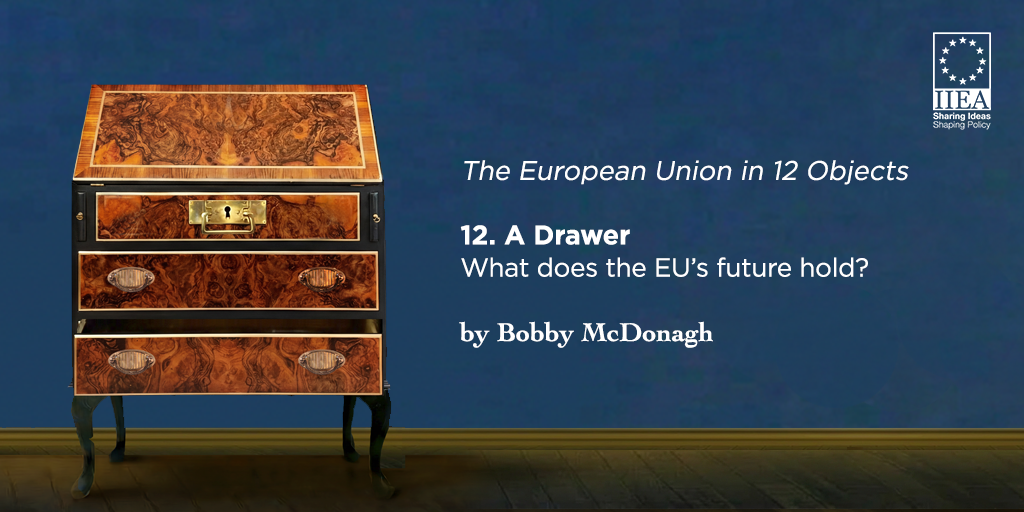
The final item I have chosen to represent the European Union is a drawer.
The European “drawer” is the one in which all the answers about the European Union’s future are apparently stored away. Many people confidently predict Europe’s future. They seem to believe that some hidden “drawer” exists where the secrets about Europe’s future are locked away. It is, of course, a fictional drawer. But it is nevertheless an important fiction that can shape our thinking.
These days, predictions frequently envisage the decline of the EU’s influence. They prophesy its inability to address successfully the challenges it will face on issues like security, migration, further enlargement, euros-scepticism or other forms of populism. Sometimes the prophets of doom even call into question the future of the European Union itself.
But the question is, if there were such a drawer in which all the answers about Europe’s future could be squirrelled away, where would it be found? Commission President, Ursula von der Leyen, certainly doesn’t have one. Nor does French President, Emmanuel Macron, nor German Chancellor, Fredrick Merz. No Member State or European Institution has all the answers or can know the future. We all face political uncertainties and difficult choices every day and will continue to face them in the years and decades ahead.
Europe’s future, in truth, depends on the complex and unpredictable interaction of its Member States and institutions, and ultimately on the priorities and ambitions of its people.
The European Union faces threats to its security from Putin’s Russia, to its economic wellbeing from Trump’s America, to its competitiveness from emerging economies, and to its values from those who don’t share its belief in democracy and peaceful coexistence. It faces broad global challenges such as trade competition, climate change, migration, future pandemics, assaults on the rule of law, as well as the risks posed by uncontrolled social media and artificial intelligence. Domestically, it risks being undermined by populism and by the emergence of rogue regimes that don’t share its fundamental values.
However, it is not those threats or challenges that will define Europe’s future. Our future depends rather on how we, the people of Europe, in Ireland and elsewhere, respond.
The simple truth is that there is no drawer in which the answers about what lies ahead for Europe are to be found. The imaginary “drawer” has been chosen as one of my items to represent the European Union, in order to highlight the crucial reality that nobody knows what Europe’s future holds. It’s destiny lies in our own hands.
Europe, with all its faults, has delivered unprecedented prosperity and security for its people. Despite its mistakes on the global stage and its weaknesses at home, it remains the world’s most important advocate for multilateralism and the rule of law. There is nowhere that most of us would rather live.
We Europeans owe it to ourselves, to our children and to their children, and to the world more generally, to reassert our support for our complex, infuriating and magnificent European Union. We should be determined to remedy its weaknesses and mistakes. We should be ambitious for its continued success and development.
There is no predetermined future for Europe.
If we fail, the fault, to borrow Shakespeare’s words, will lie “not in our stars/ But in ourselves.”