

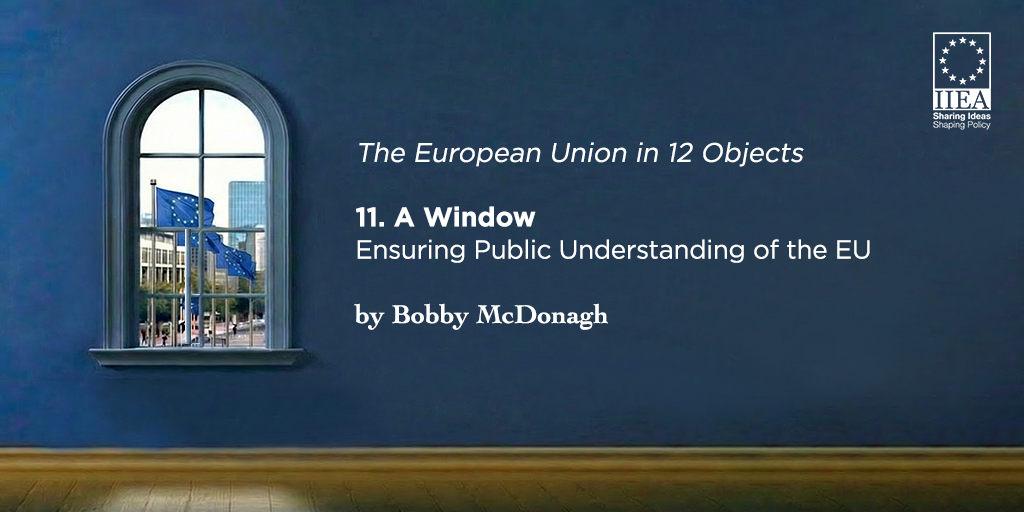
The European Union in 12 Objects 11. A Window
 Bobby McDonagh, Former Ambassador to the EU and UK, has developed a series of blogs, to explain what the European Union is and how it works. The publication of this blog series by the IIEA will be phased over 12 weeks, each dealing with one of the 12 Objects. Find out more here.
Retaining public support is an ongoing, potentially existential, challenge for the European Union. The Member States and EU institutions must therefore take particular care as to how it is perceived by European citizens.
I have therefore chosen a window to represent the importance of perception and understanding, the window through which the public can see and judge the European Union.
The European Union does some things very well but also makes serious mistakes (see Blog 6). However, there are many obstacles that stand in the way of the public’s capacity to make a balanced and accurate assessment of the EU’s work.
In many ways, the EU seeks to be as transparent as possible. The deliberations of the European Parliament are largely held in public. The legislative process in the Council of Ministers is also formally held in public, although almost all of the real negotiations take place behind closed doors. While meetings of the European Commission are held in private, it is generally more open as an institution - to Member States, civic organisations and other interest groups - than most government departments are at national level, including in Ireland.
In addition to the difficulty that any organisation would face if it had to negotiate everything in public, the EU legislative process faces a further particular challenge. Unlike at national level, where the negotiation of national legislation generally takes place publicly in the national parliament, the Union’s legislative process is a hybrid one. The negotiation of new European laws in the Council of Ministers is, in an obvious sense, a legislative process. However, it is also, at the same time, an international negotiation between Member States. Such international negotiations are not held in public because the possibility of fully frank exchanges and the necessary willingness to compromise would be undermined. The necessarily hybrid nature of this process goes a long way towards explaining the limited transparency in the workings of the Council of Ministers.
Moreover, the ability of EU citizens to understand the European Union is seriously challenged by three specific factors.
First, people naturally tend to be most interested in what they feel closest to. Everywhere, the primary interest of most people is in what is happening locally, in their own city, village, locality, neighbourhood or community. Beyond that, it is normal that they take significant interest in what is happening at national level in their own country to which they owe their primary civic allegiance. The European Union, understandably, seems to many to be just that bit more remote. Even though Ireland is every bit as much part of the EU as Brussels and Strasbourg, the work of the Union’s institutions seems to be at a further remove from people’s daily lives. This is inevitable and represents a significant challenge.
Second, the way in which the European Union, of its nature, is compelled to do its business, seeking to reconcile the perspectives, priorities and aspirations of 27 vibrant independent democracies, is immensely complex. Its agenda is vast and continues to grow. Understanding the procedures and detail of its work is more challenging than understanding the politics and economics of a single country. Yet the amount of media coverage of the EU across the Member States, however professional in some cases (and its better in Ireland than in most countries), is a mere fraction of the coverage given to domestic issues. Neither national media nor ordinary citizens have sufficient time or head space to devote, respectively, to explaining and understanding the European Union anything like as well as they do in respect of their own country.
Third, the European Union, like every democracy, is challenged by deliberate misrepresentation. The propagation of “alternative facts”, the circulation of “fake news”, the labelling of truth as “fake news”, and the interference of malign foreign actors in our democracies are all becoming more widespread. The EU is particularly vulnerable to such distortion, falsehood and malevolence because of its complexity. The challenge of understanding the intricacies of the European Union provides fertile ground for those who wish to find fault with everything it does, without themselves needing either to understand it or to justify their own views. As we have seen in our Irish EU referenda, simple falsehoods are always easier to get across than the complicated truth.
How this deficit of explanation and understanding can be addressed, in Ireland and elsewhere, would require its own detailed analysis. As far as Ireland is concerned, it is clear that it must involve our education system at every level. It also requires greater genuine prioritisation within our political system and public service. Our Government, and national politicians more generally, should not only proclaim, as most of them rightly do, their broad support for the European Union, they should understand the detail of what it is and what it does far better than most of them currently do. This would enable them to lead and enrich the deeper public debate that is needed.
It is important to emphasise that the European Union is not something that happens “out there” in Brussels or Strasbourg. Its achievements and failures affect the lives of every citizen in Ireland and in every other Member State. Moreover, a crucial point, inadequately appreciated, is that Member States remain the principal driving force in the European Unio. Ordinary citizens therefore largely determine the direction and policies of the European Union through their elected national Governments, which sit in the European Council and Council of Ministers, and through the Members they elect to the European Parliament.
The Irish Permanent Representation to the European Union, Ireland’s largest Embassy, is staffed by officials from every Irish Government department. They, as well as the Ministers and officials who travel from Dublin every day to represent Ireland, have a seat at the European table and a real opportunity to advance Ireland’s agenda in Europe. In common with every other Member State, they rarely obtain everything they want but almost always ensure a relatively positive outcome for Ireland. Moreover, the work of those who work in or travel to Brussels to represent Irish interests, is backed up by many staff in every Government department at home, and by arrangements for close coordination at political and official level.
The window through which the public perceives the European Union should ideally be more effective. This means devoting time and resources not only to explaining what happens in Brussels but also to deepening the awareness that we ourselves, at national level, can and do substantially shape those outcomes.
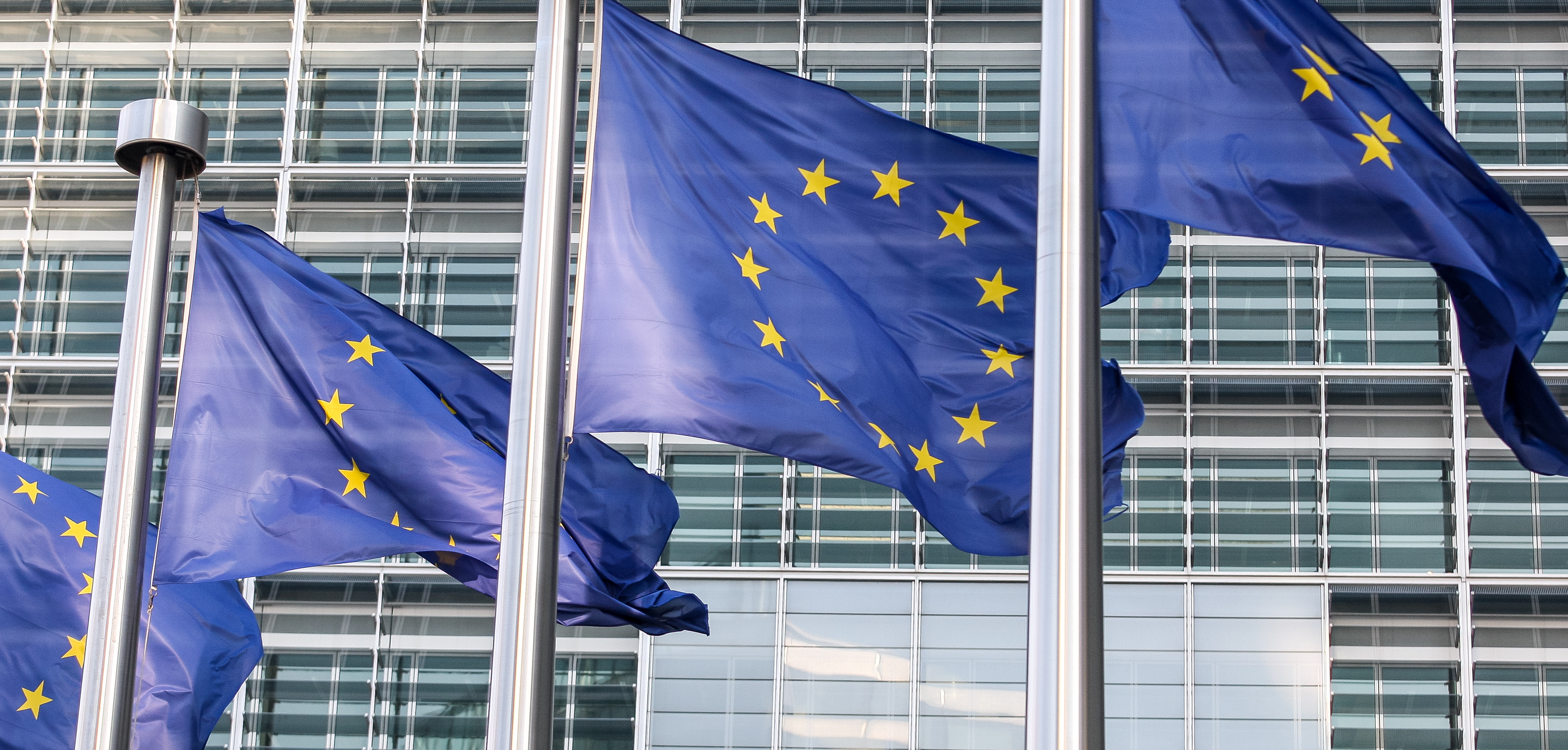 Source: Adobe Stock Editorial