

Labour’s first 200+ days
The 2024 UK General Election
On 04 July 2024, voters went to the polls in UK General Election. It was the third election since the country voted to withdraw from the European Union (EU) in 2016, and the first since the country officially left the bloc in 2020. The UK Labour Party under Keir Starmer scored a resounding victory as had been widely predicted, taking 411 of the 650 seats in the Westminster Parliament, almost doubling their haul from the previous election in 2019. Labour entered government for the first time since 2010 with a majority of 172 seats, only five behind Tony Blair’s record landslide victory in 1997[1]. The Conservatives lost more than half their seats and returned to the opposition benches.
A few takeaways from UK General Election 2024
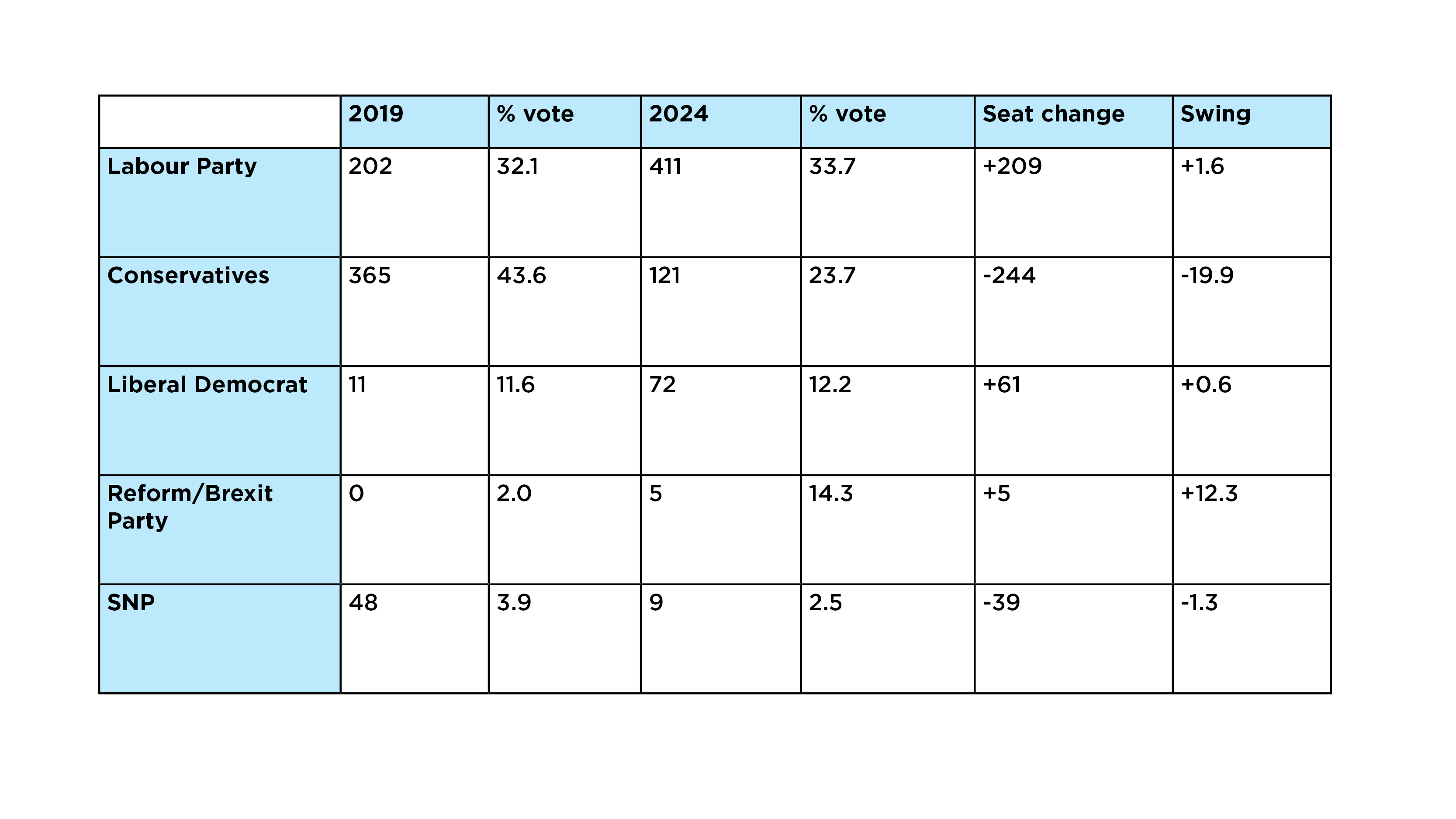
In the UK, the first-past-the-post electoral system for parliamentary elections, with single-seat constituencies, can see even small changes in aggregate public sentiment have a dramatic effect on electoral outcomes (see table 1). This system can also make it hard for small parties and independents to find a foothold in Parliament. This differs from almost all European countries, including Ireland, where proportional representation ensures that the number of elected representatives tracks the proportion of votes cast for parties and candidates to varying degrees. The radical disproportionality between votes and seats in the UK system hides the fact that Labour received fewer votes than in 2019 in absolute terms, albeit on a lower turnout, while the Conservative Party vote collapsed by almost 20 per cent. How long such a system can retain its legitimacy while insulating against voter volatility presents a major challenge for the future of the UK’s democracy.
Put simply, a relatively small uptick in support for Labour between the 2019 and 2024 elections of 1.6%, translated into an increase in seats of 103 per cent. This saw Labour ‘rebuilding its red wall’ in the north of England, alongside a modest recovery for the party in Scotland at the expense of the centre-left Scottish National Party (SNP), and a consolidation of support across traditional Labour heartlands in London and Wales. Part of Labour’s success has been put down to good candidate strategy and constituency management under veteran MP, Pat McFadden, the Labour Party’s National Campaign Coordinator for the election. Needless to say, Labour also benefited from the ongoing turmoil within the Conservative Party, which has seen five changes of leadership since the 2016 Brexit referendum. In November 2024, former Business Secretary and conservative hardliner Kemi Badenoch became the latest candidate to ascend to the Tory Party’s top job, following a protracted internal election process. Badenoch made history by becoming the first black leader of any of the UK’s major political parties.
Table 1: 2024 UK General Election results
 Source: House of Commons Library, General Election 2024 results, see https://commonslibrary.parliament.uk/research-briefings/cbp-10009/
Aside from the successes and failures of the UK’s main parties at the General Election, other outcomes might prove consequential for the UK and its neighbours in the longer term. Firstly, the SNP vote collapsed, with the party losing all but 9 of the 48 seats they won in the 2019 general election. Labour surged from a single seat in Scotland in 2019 to 37 of the available 57 in 2024. The forthcoming Scottish Parliamentary elections, expected to be held in 2026, will prove significant for the independence question, if Labour, a unionist party, continues to makes gains. Polls in Scotland continue to report around 45% (or there abouts) support for independence, but Scottish independence as a political force has been greatly diminished by the SNP’s electoral decline. The weakened position of the SNP in Westminster will also likely see the debate on Scottish independence increasingly pushed to the margins, at least in other parts of the United Kingdom.
Secondly, the Reform Party under Nigel Farage, the inheritor of the Referendum Party, UK Independence Party (UKIP), and the Brexit Party, returned five seats at the July elections. It is likely that Reform, a populist-nationalist party, will continue to mount a challenge to both Labour and the Conservatives in some of those parties’ traditional heartlands. Starkly for Labour, Reform won more than 4 million votes and came second in 98 constituencies, including in 89 where Labour won. Meanwhile, in late 2024, Badenoch and Farage clashed over who represents ‘the real opposition’ in Westminster, with Farage claiming that Reform had overtaken the Conservatives in terms of oredinary party members, something which has been robustly challenged by Badenoch. Needless to say, the Conservatives are existentially threatened by the rise of Reform, with the prospect of a reverse takeover of that party, or of the emergence of a hybrid Reform/ex-Tory party movement, led by Nigel Farage a real possibility.
Reform are targeting successes in the 2026 Welsh Senedd elections, where candidates are elected via proportional representation, unlike the system used for UK general elections. Reform have been here before, given the success that its forerunner UKIP had in European elections. This includes in 2014, the final European Parliament election before the 2016 Brexit referendum, which saw UKIP come first with 26.6% of the vote, the first time in modern British history when a national election was not won by either of the two main parties. Success at the level of the European Parliament, historically viewed as a second-order election in the UK and across the EU, gave UKIP and other challenger parties access to resources and an opportunity to gain legitimacy and to raise their profile in the eyes of the electorate.
Thirdly, despite the political volatility at home, it is clear that the new Labour Government has made efforts to initiate a fresh start in relations with its neighbours, including with Ireland and the rest of the European Union, following the often acrimonious and difficult relations of the past decade. This has been especially the case since the re-election of Donald Trump in November 2024.
Labour in Government
Unlike in Ireland, where government formation typically takes months, Keir Starmer was appointed Prime Minister by King Charles III on 05 July, the day following the General Election, as the Labour Party’s massive majority became clear. The new Government’s moved to enact its priorities as set out in its manifesto, focusing attention on economic recovery, climate action, and restoring public trust in government, which had reached a historical low following years of instability and contestation within the Conservative Party.
Predictably for a social democratic party, Keir Starmer’s new administration has committed to working towards creating jobs, reducing inequality, and boosting public services. Public investment would include large-scale investment in infrastructure, particularly in green energy and renewable technologies as part of the Government’s planned ‘Green Industrial Revolution’, and the establishment of a National Wealth Fund. Labour also moved quickly to raise the minimum wage to £12.21 per hour from April 2025.
Labour has committed to tackling the social determinants of health, aiming to reduce hospital waiting times, improve patient care, and address staff shortages. Predictably, major part of Labour’s platform has pertained to increasing the availability of affordable housing, launching a programme to build 1.5 million new affordable homes over the coming decade. The party also moved to reform parts of the welfare system, simplifying application processes and rolling out new measures to combat child poverty, including by expanding access to free school meals for all primary school children.
However, Prime Minister Starmer is clearly pessimistic about the possibility for quick gains. Only two months into his term, Prime Minister Starmer stated that that things will likely ‘get worse before they get better’, a month after Rachel Reeve’s, the new UK Chancellor of the Exchequer, the first woman to hold the position, identified a ‘£22 billion black hole in the public finances’, as she ushered in cuts to winter fuel payments for pensioners. All this raises questions of the new Government’s capacity to realise or deliver on the improvements they promise, at least in the short term.
An area where Prime Minister Starmer could make meaningful, durable progress is in relation to climate and the environment. Labour have committed to accelerating the UK’s transition to net-zero emissions by 2040, a decade earlier than the target set by the Conservative Party in government. The Government have pledged substantial investments for green energy projects and for reskilling the workforce. In November 2024, in advance of the UN Climate conference in Baku, COP 29, Keir Starmer announced a new target of 81% emissions reductions by 2035 compared with 1990, as part of the UK’s 2035 Nationally Determined Contribution emissions reduction target under the Paris Agreement. This represents some of the most ambitious climate change targets in the world. Indeed, following COP 29 in Baku, the UK are increasingly seen to be reclaiming a position of climate leadership, just as the EU’s much vaunted green leadership is at risk of faltering.
Chancellor Rachel Reeves delivered the UK’s 2024 Budget on 30 October, which included tax rises worth £40 billion in what the Chancellor said is ‘not a budget we want to repeat’. The budget placed a major emphasis on green investment, committing £20 billion in green technologies and infrastructure, including electric vehicle (EV) infrastructure, and renewable energy and carbon capture initiatives in a bid to make the UK a clean energy superpower. In a break with their predecessors, Labour’s first budget introduced tax rises of £40 billion, targeted on the wealthiest individuals and corporations, while, middle and low-income earners saw no significant income tax increases. The Government also introduced targeted measures to ease the cost-of-living crisis, including a one-off £500 payment for households with children and continued subsidies for energy bills during the winter months, albeit with controversial new eligibility criteria, mentioned above.
In February 2025, amid Russia’s ongoing war in Ukraine and the re-election of Donald Trump in the US, Prime Minister Starmer announced his intention to increase defence spending from 2.3% to 2.5% of Gross National Income (GNI) by 2027. The Prime Minister said that the increase would be fully funded by a cut of to the UK’s foreign aid budget by 40%, from 0.5% of GNI to 0.3%, a move which was welcomed by the White House but which has received major opposition from some in the development sector, accusing the Government of displaying ‘cruel indifference to the poorest billion people in the world’ (Caritas, 2025).
All this happens against the backdrop of increasing turbulence globally and as the UK continues to try to forge alliances and (re)establish relations following their withdrawal form the EU, and amid the return of Donald Trump, the UK must, to an extent, determine where to position itself between the two. One of Labour’s primary foreign policy priorities has indeed been to improve relations with the European Union, aiming to restore closer economic and political ties with the bloc, including with a potential veterinary agreement, notwithstanding the practical challenges this might pose. Clearly the UK remains a major security player in Europe and the world, and shared interests around support for Ukraine, as well as the ongoing risk of a trade war with the US, presents clear shared challenges for the UK and the EU, and a potential basis for greater cooperation. In addition to the Government’s position on climate change policy, the country is clearly positioning itself as a potential leader in AI and automation technologies, which could create both challenges and opportunities for relations between the UK and the EU.
Much of what the party hopes to achieve in government will take years, and time will tell if the electorate will be willing to afford Labour the time needed for appreciable change to come about. Labour’s first budget can be seen as a social democratic effort focused on long-term, sustainable economic recovery, although higher taxes on businesses and the inflationary pressures this might cause could also create problems for the Labour Government, especially in the absence of economic growth. Prime Minister Starmer has asked regulators in the UK for proposals to help boost growth in light of these challenges. Already in October, only three months on from the General Election, Prime Minister Starmer appointed Cork-born Morgan McSweeney as his chief of staff, replacing the embattled Sue Gray. In December, Starmer announced six new ‘policy milestones’ in a bid to reset his fledgling premiership, focusing on shorter NHS waiting lists, new affordable homes, and better living standards. Clearly there is already a question of organisational capacity in central government, and efforts to improve the party’s ability to engage in effective political communication with a public jaded by years of political turmoil will remain a priority for the Starmer Government.
Some analysis
The new UK Government is trying to deliver major investments that are in keeping with their manifesto promises. A major challenge will be, somewhat predictably, whether the country will experience the economic growth that would be required to sustain such investment. At a political level, the Starmer Government is fearful of being a one-term government, and will be conscious both of the time (and patience) that is required for meaningful change to be realised, and of the sustained growth of the Reform Party, with an electorate exhausted by years of cost-of-living crises and economic stagnation.
Looking closer to home, and despite the somewhat gloomy outlook for the Labour Government at home, the election of Keir Starmer has reset Irish-UK relations following what has been a challenging decade diplomatically and politically. Indeed, the UK’s departure had deprived Ireland and UK with many of the crucial informal channels and habits of cooperation which allowed relations between the countries to flourish. The appointment of the political heavyweight Hilary Benn to the role of Secretary of State for Northern Ireland (SOSNI) has helped to introduce a fresh start to Irish-UK relations. However, the Democratic consent vote on the continuing application of the Windsor Framework, shows the deep divisions that persist in Northern Ireland with respect to the post-Brexit trading relations on these islands, and relations between the EU and the UK. The ongoing controversy surrounding the Northern Ireland Legacy bill is also likely to continue to strain relations. Notwithstanding this, having a substantial SOSNI who is seen as close to the UK Prime Minister and as being on good terms with the Irish Government, and the improved tone and substance of Irish-UK relations in teneral, should be welcomed.
Looking ahead, there are many areas where the new Irish and UK Governments could constructively engage, now that the white heat of Brexit has dissipated. In the short term, this could relate to cooperation with regard to cross-border health, energy security, and defence matters. The revivification of the Good Friday Agreement institutions and a return to high-level ministerial engagement between Ireland and the UK would be a bonus, against the backdrop of an increasingly uncertain geopolitical context.
[1] Notably, the increase in non-voting Sinn Féin MPs from two to seven across this time sees the Government obtain the same working majority as Blair did in his first term.