

Ireland’s EU Presidency: Perspectives from Minister Thomas Byrne
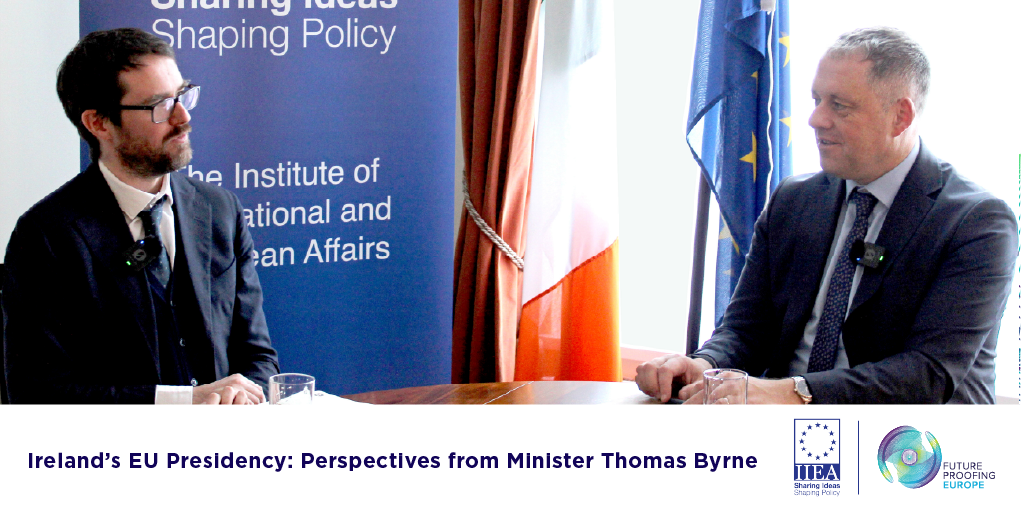
The fourth podcast in the 2025 F.E. podcast series was an interview with Thomas Byrne, Minister of State for European Affairs and Minister of State for Defence by Barry Colfer, Director of Research at the Institute of International and European Affairs in Dublin.
The theme of the podcast was Ireland’s Presidency of the Council of the EU in the second half of 2026. Minister Byrne commenced the interview by describing his long-standing experience and interest in European Affairs from his student days to his work in the legal profession and his current role as a politician and Minister of State for European Affairs. He explained the role of the rotating Presidency which involves chairing a wide range of meetings at every level in Dublin, Brussels and Luxembourg and representing the EU position at various international summits which might take place during Ireland’s presidency such as the COP, International Maritime Organisation, and possibly WHO on a Pandemic Treaty.
At domestic level, he said that several government departments are already working on the administrative arrangements and preparations needed to run a successful presidency and to best represent the voices of the other Member States.
As to what the general public will see of the Presidency, he said it would mainly be the arrival of EU leaders for an informal European Council and that the largest event of the Presidency would be the meeting of the European Political Community, (EPC) that will take place in Ireland during our term of the Irish presidency which would involve up to 47 leaders from European countries and would be the largest ever political event in Ireland and could raise security concerns in terms of drone attacks by rogue actors, activities of the Russian shadow fleet regarding possible damage to subsea cables, and other forms of digital disruption by countries who do not value democracy.
In terms of the visibility of the Presidency , there would 22 informal ministerial meetings, a quarter of which would be held outside Dublin and about 250 other meetings taking place all around Ireland where intensive work would be carried out by civil servants and ministers which will complement the work of the Committee of Ambassadors to the EU, (COREPER) in meetings in Brussels and Luxembourg.
The Minister described steps the government is taking to engage the Irish public in the Presidency, such as the consultation portal for citizens’ views on what Ireland’s priorities should be and to find a word/theme which could define the theme for Ireland’s Presidency.
In terms of Presidency priorities, he said that some priorities are a given as they are part of the ongoing legislative agenda in the EU and will need to be advanced. He adverted to the fact that the six month Presidency is part of a trio of Presidencies which in Ireland’s case involves two other Member States, Lithuania and Greece. The purpose of an 18-month trio is to maintain continuity and consistency across the three Presidencies. As to likely priorities, the Minister mentioned:
- Principles-based priorities such as values, the rule of law and social Europe;
- competitiveness, the simplification and easing the burden of red tape for businesses – developing the single market and capital markets union and savings and investment union;
- security and defence, and resilience would be a third basket where Ireland, as a non-member of NATO will have to act as an honest broker and allow Member States to achieve their ambitions and satisfy the specificities of their own security and defence needs;
- The MFF, the multiannual financial framework would be a central item on the agenda.
- Enlargement of the EU, which has gained momentum as a guarantor of security for the EU, could see the negotiations on accession of Montenegro being concluded during the Irish Presidency, with others like Albania following behind, on a merit-based assessment of their progress.
To conclude, the Minister said that the discussion about priorities is ongoing and that the priorities will be announced in June 2026 when the trio Presidency agenda is agreed with Lithuania and Greece and taking account of any geopolitical developments in the EU at that time, and specific issues prioritized by Ireland. To date, discussions around the main priorities have centred on values, competitiveness, security, resilience, defence, the MFF and enlargement. The Minister would like to capture the anticipation and attention of the public for the Presidency, in order to place citizens at home and in other Member States at the centre of the Presidency process. The main objective then would be move forward as an honest broker in advancing the legislative agenda for the six months of the Presidency, to see where Ireland can have an impact on shaping the agenda and how it might achieve consensus, all of which would enhance the reputation of the country, both from an administrative and diplomatic point of view.