

How the EU-ETS could reshape European farming; Implications for an Irish Farmer
The European Union is examining how agricultural emissions could be priced more directly. While the need to reduce emissions from agriculture is not a matter of debate, for Irish farmers, any move towards an agricultural emissions trading scheme, or an equivalent levy-rebate model, would raise practical questions about farm income, competitiveness, food production, and climate obligations. This blog explains: how the existing EU Emissions Trading System (EU-ETS) works; why agriculture may be the next industry to have its emissions priced in this manner; what we can learn from similar models adopted elsewhere; and, finally, what this debate could mean for Ireland.
However, it should be noted that the EU has not proposed or adopted a farm-level agricultural emissions trading scheme. This article considers how a future agricultural carbon-pricing instrument, whether an ETS, levy-rebate model, or hybrid approach, could affect Irish farming.
1. What is the EU ETS is and why does it matter for agriculture?
The EU-ETS is the European Union’s main carbon-pricing mechanism. Under the system, covered entities surrender allowances according to their emissions, with one allowance representing one tonne of carbon dioxide equivalent. The system is designed to make emissions a cost of production and to create incentives for firms to reduce them.
The EU-ETS has become a central part of the EU’s climate policy framework. The revised EU ETS is designed to reduce emissions from its covered sectors by 62% by 2030 relative to 2005. The next phase, ETS2, will extend carbon pricing to fuel suppliers in road transport, buildings, and additional sectors. It is distinct from a potential agricultural carbon-pricing instrument and does not currently price farm-level livestock or fertiliser-related non-CO₂ emissions directly. Together, these reforms show that carbon pricing is likely to remain an important tool in the EU’s efforts to meet its long-term climate targets.
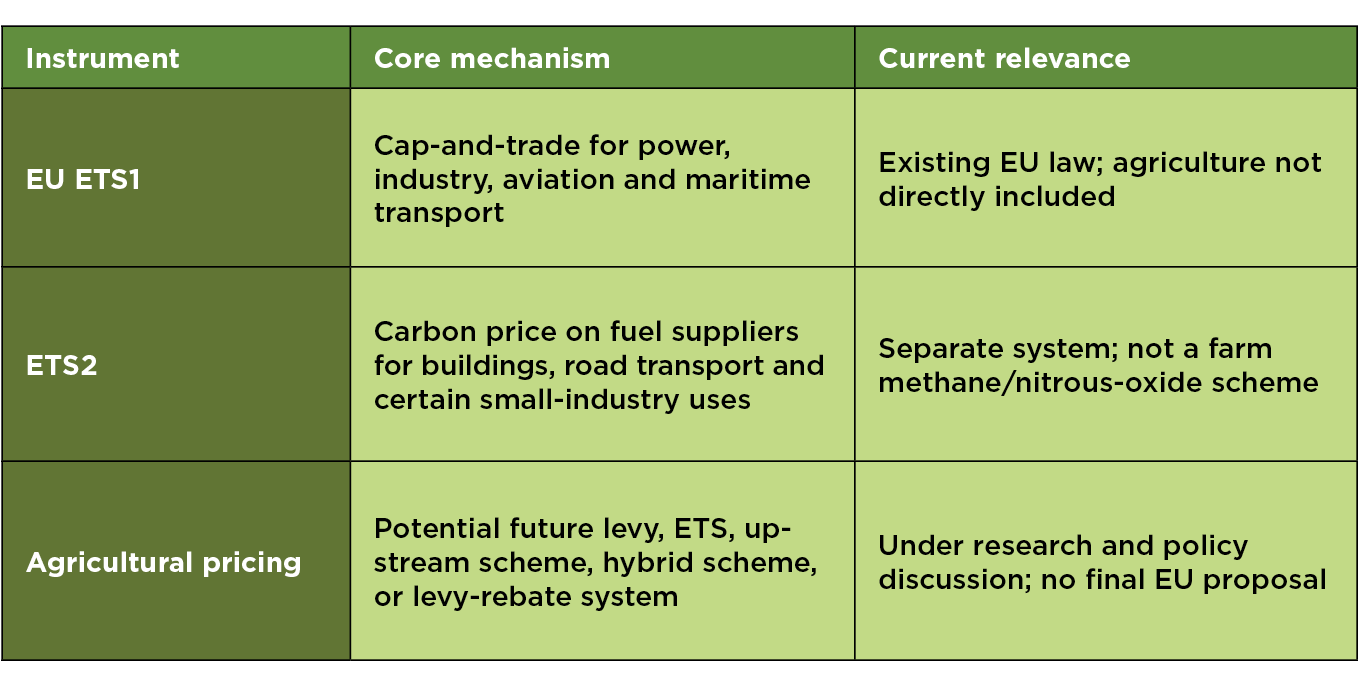 Agriculture has not been covered by the EU-ETS in the same way as heavy industry or energy-intensive sectors. However, there is not currently an adopted EU proposal to introduce a farm-level agricultural ETS. The central question remains whether a workable policy can reduce emissions while maintaining farm viability, production capacity and public legitimacy.
2. How an agricultural ETS could work?
No EU-level agricultural ETS has been proposed or adopted. However, policymakers and researchers are examining whether agricultural emissions might eventually be addressed through carbon-pricing instruments, including a farm-level levy, an upstream charge on inputs, a cap-and-trade system, or a levy-rebate model.
The Ag-ETS could work as a a market-based system that ensures polluters pay for excessive pollution, using a carbon-pricing mechanism for agricultural emissions. Whilst the economic cost to farmers poses valid concern, the overall goal is to protect the entire value chain and to protect production capacity and “food sovereignty”. Protection does come at a cost for farmers, however, and particularly for dairy and livestock, which are the largest net exporters in the EU agriculture industry.
The Ag-ETS could operate as a standalone system, separating itself from the ETS1 and ETS2 programmes. Equally, this protects the agricultural industry in many ways; politically and economically, but also simply permitting the specific allowances to the agricultural industry without the risk of other industries collectively benefiting from these allowances. The isolation of the Ag-ETS similarly guards market competition for EU Member States that are highly agriculture based.
3. What Denmark’s model suggests
Denmark provides a useful policy-design case study rather than a proven implementation model. Its political agreement on agricultural greenhouse-gas pricing illustrates how a phased levy, deductions or rebates, and recycling of revenues could be used to balance emissions incentives with farm competitiveness.
As noted in the IIEA’s Designing Agricultural Climate Policy in Ireland from 2030 to Net Zero, evidence from other sectors shows that pricing works: emissions covered by the EU-ETS fell by almost half between 2005 and 2023, demonstrating that a well-designed cap-and-trade scheme can deliver sustained emissions reductions at scale. An agricultural emissions trading scheme, or an equivalent levy/rebate system, would apply the same principle to farming by capping total emissions and allowing flexibility in how and where reductions are achieved. The IIEA’s paper highlights that adopting the scheme has the potential to directly affect farm profitability by transforming mitigation in a core component of farm operational efficiency. Farmers would integrate emissions reduction as an input cost similar to feed or fertiliser.
Denmark can be used as an example of a successful implementation of a carbon strategy that prioritises food security. Denmark applied a tripartite agreement encompassing government, industry, and farming organisations that would introduce a tax on GHG emissions. The Danish case study explains that farmers will receive a 60% tax rebate on average livestock emissions, recognising the challenges faced by the agricultural industry faces in reducing unavoidable emissions. Denmark will implement a phased introduction of the programme, giving farmers adequate time to implement necessary changes.
The Danish government originally established an expert group which focused on Green Tax Reform; specifically designing a carbon pricing instrument for all emissions. The group initially rejected the concept of a carbon trading system, saying that the administrative demands and volatility risks were too much. The group recommended a carbon levy system, which uses a rebate system to protect market competitiveness and incentivises market participation. While Denmark’s attempt is part of a wider international effort, it exemplifies the bottom-up approach from farm to policymaker in reducing the ecological and environmental impact of the agricultural industry.
4. Implications for Irish farmers
Carbon pricing could provide a strong market indicator for investment in low-carbon technologies. This idea is equally relevant to both the agricultural and industrial industries and highlights the importance of maintaining a short-term vision for relying on an allowance-based system.
The issue has particular salience in Ireland because agriculture is the country’s largest emitting sector, accounting for 37.9% of national greenhouse-gas emissions in 2024. Livestock methane and nitrous oxide from fertiliser use and manure management are the principal sources, making measurement, mitigation and the distributional consequences of any carbon-pricing instrument especially important for Ireland’s grass-based livestock systems.
The Ag-ETS could also help create new by-products for farmers who diversify into new streams of revenue. The Commission is encouraging the reduction of dependency on imported fertilisers and encouraging domestic entrepreneurship to fill gaps in the organic, bio-based and traditional mineral fertiliser industry. This focus on enlarging the decarbonisation industry serves both economic and environmental objectives.
While this rollout could prove challenging for industry wide adaptation, the ETS is an essential measure to ensure 2040 climate targets are achieved. The programme could direct funding towards industrial decarbonisation such as the proposed decarbonisation bank. The EU rewards the reduction of emissions with significant incentives for decarbonisation. The Ag-ETS is therefore seen by some as an essential instrument to mitigate the risk of the agricultural industry becoming the leading contributor to carbon emissions in the European Union.
The discussion of the Ag-ETS tool requires further examination of the concept of “food sovereignty”. While originally viewed as a domestic issue, the topic of food sovereignty has become increasingly important as the dependence on importation of certain agricultural products becomes more susceptible to global shocks. The European Commission has formally recognised the importance of “food sovereignty” in its February 2025 agri-food policy, explaining that it provides a guiding principle for the entire union’s future strategic orientation.
It must be noted that the Ag-ETS also has the potential to add administrative burden on European farmers, many of whom are experiencing growing pressure due to rising operational costs. Dublin experienced the effects of this frustration in early April 2026 during a period of historically inflated fuel prices. While there is extreme political sensitivity to this matter, it appears that agriculture is at an inflection point in its transition. The Dublin agricultural protests highlighted just how vulnerable the food system is to market shocks. It may also have uncovered a severe disconnect between the consumer and the overall supply chain. Sectoral reform is imperative for the survival of both producer and consumer in an increasingly expensive global market.
5. Conclusion
Introducing emissions pricing is not merely a compliance tool but a catalyst for change. Without credible long-term price signals to redirect investment and innovation, agriculture risks locking itself in production systems that are incompatible with evolving climate targets and with the sector’s social licence to operate in a climate-constrained future. For Irish farmers, the challenge is how to maintain food production, stable farm income, and rural regeneration while adopting essential carbon mitigation measures. Denmark provides a case study to reiterate the effectiveness of carbon emission reductions while still maintaining market competitiveness. Trust in programmes like this could continue to determine the pace at which emissions will be mitigated. The objectives of the programme equally have to nurture food production, farm incomes, and rural sustainability. While the ETS is not a panacea to the climate impact of agriculture, it does present a transitional tool that can help set the blueprint for the next generation of farming.
References
Colonna, C. and Alessandrini, M. (2026) What food sovereignty? assessing the new French food sovereignty law against the Common Agricultural Policy’s objectives, European Papers. Available at: https://www.europeanpapers.eu/e-journal/what-food-sovereignty-assessing-new-french-food-sovereignty-law-common-agricultural-policy-objectives (Accessed: 21 May 2026).
Commission presents plan to secure Europe\’s fertiliser supply and food security (2026) European Commission - European Commission. Available at: https://ec.europa.eu/commission/presscorner/detail/en/ip_26_1099 (Accessed: 20 May 2026).
Europe’s Emissions Trading System: Unpacking Industry Opposition - An InfluenceMap Policy Brief (2026) InfluenceMap. Available at: https://influencemap.org/insight/Europe-s-Emissions-Trading-System-Unpacking-Industry-Opposition-39104.
Marcu, A., Nouallet, P. and Caruana, N. (2025) Future of emissions trading in the EU:Agriculture ets, ERCST. Available at:https://ercst.org/futureofemissionstradinintheeuagricultureets/ (Accessed: 18 May 2026).
Mal, M. (2025) REDUCING EMISSIONS FROM AGRICULTURE - Reflection on the potential design and scope of an EU Emissions Trading System for agriculture, ERCST. Available at: https://eeb.org/wp-content/uploads/2024/10/Agri-ETS-Position-Paper.pdf (Accessed: 18 May 2026).
Matthews, A., and M. O’Neill. 2025. Designing Agricultural Climate Policy in Ireland from 2030 to Net Zero. Available at: https://www.iiea.com/publications/designing-agricultural-climate-policy-in-ireland-from-2030-to-net-zero LÓPEZ, J.F. (2026) Revision of the EU emissions trading system | think Tank | European Parliament, Think Tank - European Parliament. Available at: https://www.europarl.europa.eu/thinktank/en/document/EPRS_BRI(2026)782615 (Accessed: 18 May 2026).